
All Stories by Emily Conover
- Math
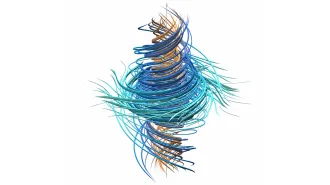
AI may have solved one of math’s biggest puzzles, raising controversy
For decades, researchers wondered if the Navier-Stokes equations, which describe fluid flow, break down. OpenAI put thousands of agents on the question.
- Particle Physics
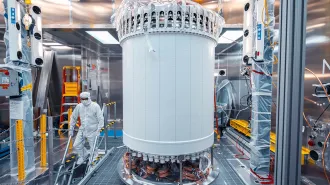
Dark matter hunters may have finally spotted a hint of the particles
Shadowy dark matter has eluded scientists for decades. The LZ experiment may have spotted one particle, called a WIMP, but more data is needed to check.
- Physics
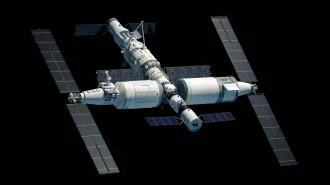
Free-falling atoms in space put a new twist on Galileo’s gravity test
Rubidium atoms on China’s Tiangong space station fell with the same acceleration, upholding a cornerstone of Einstein’s general theory of relativity.
- Life
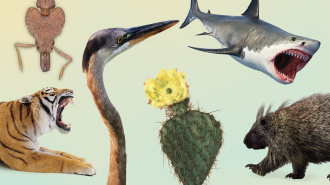
Spikes, claws and stingers have no single best shape
A study of 143 piercing tools, from tusks to love darts, finds they trade off piercing ability for durability. And no one shape wins out.
- Physics
Static electricity is a mystery, and scientists are all charged up
Scientists are largely clueless about the origins of static electricity. A quirky group of researchers aims to change that.
- Physics
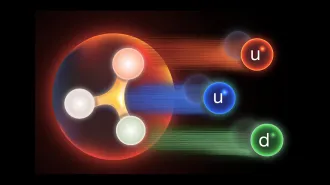
The glue that binds a proton may be key to its identity
Gluons do more than hold protons together. They may also help define the proton’s identity through a quantum property called baryon number.
- Space
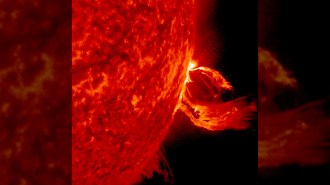
Stars’ plasma spurts may be blocked by magnetic fields
The sun frequently flings plasma into space, but sightings of such eruptions on other stars are rare. Magnetic fields could explain why.
- Space
A shoebox-sized satellite could expose hidden nuclear weapons in space
There’s never been a good method to check for violations of the Outer Space Treaty’s prohibition of nuclear weapons in space.
- Physics
Pickles glow when you plug them in. Science explains why
A scientist, a jar of pickles and a power strip walk into a room. The punchline involves physics, glowing condiments and a scientific party trick.
- Particle Physics
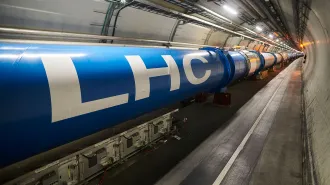
CERN shutters the Large Hadron Collider for a major transformation
The High-Luminosity LHC, planned to switch on in 2030, could help physicists unravel mysteries about the Higgs boson, dark matter and more.
- Physics
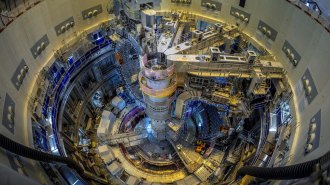
A potential hindrance to fusion power may help instead
Researchers were unsure whether alpha particles would aid or hinder fusion. Simulations suggest they help, by dampening turbulence.
- Physics
Clocks made from an atomic nucleus just ticked on for the first time
First dreamed up decades ago, the world's first nuclear clocks are set to improve quickly, becoming more precise and aiding the hunt for dark matter.