
All Stories by Lisa Grossman
- Astronomy
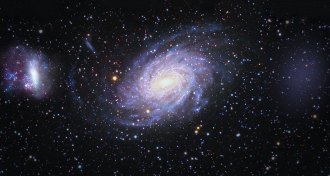
Astronomers may have spotted the ghost galaxy that hit the Milky Way long ago
Astronomers think they’ve identified a galaxy that hit the Milky Way and ruffled its edges millions of years ago.
- Astronomy
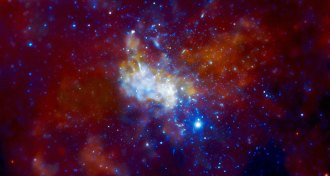
The accretion disk around our galaxy’s black hole has been spotted at last
The Milky Way's central black hole has a disk of gas and dust orbiting it, astronomers can finally say with confidence.
- Astronomy
Watch the oldest surviving film of a total solar eclipse
A short film of the 1900 total solar eclipse was restored by conservation experts and is now available to view online.
- Planetary Science
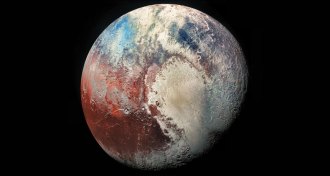
Icy volcanoes on Pluto may have spewed organic-rich water
Planetary scientists found ammonia-rich ice near cracks on Pluto, suggesting the dwarf planet had recent icy volcanoes.
- Physics
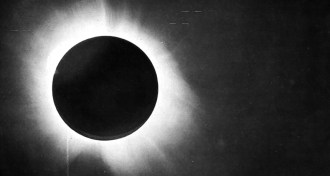
100 years ago, an eclipse proved Einstein right. Today, black holes do too — for now
In 1919, an eclipse affirmed Einstein’s famous general theory of relativity. Now scientists hope to use black holes to poke holes in that idea.
- Physics
Big black holes can settle in the outskirts of small galaxies
Astronomers have found dozens of surprisingly massive black holes far from the centers of their host dwarf galaxies.
- Physics
What a nearby kilonova would look like
Physicists imagined what we’d see in the sky if two neutron stars collided just 1,000 light-years from Earth.
- Physics
LIGO is on the lookout for these 8 sources of gravitational waves
Gravitational wave hunters are on a cosmic scavenger hunt. Here’s what they’re hoping to find.
- Planetary Science
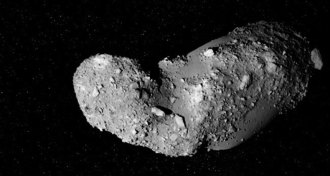
Water has been found in the dust of an asteroid thought to be bone-dry
Scientists detected water in bits of an asteroid thought to be devoid of the liquid. Such space rocks might have helped create Earth’s oceans.
- Astronomy
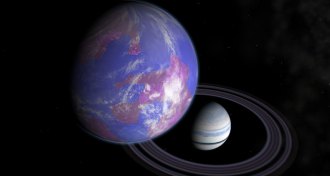
Skepticism grows over whether the first known exomoon exists
New analyses of the data used to find the first discovered exomoon are reaching conflicting results.
- Planetary Science
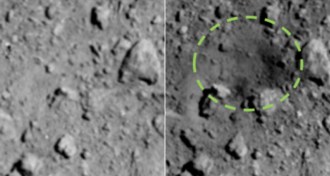
Pictures confirm Hayabusa2 made a crater in asteroid Ryugu
Hayabusa2’s crater-blasting success, confirmed by an image beamed back from the spacecraft, paves the way to grab subsurface asteroid dust.
- Physics
The M87 black hole image showed the best way to measure black hole masses
The first image of M87’s black hole suggests it is 6.5 billion times the mass of the sun — close to what was expected based on how stars move around it.