Meet the deep sea disrupters charting the bathysphere
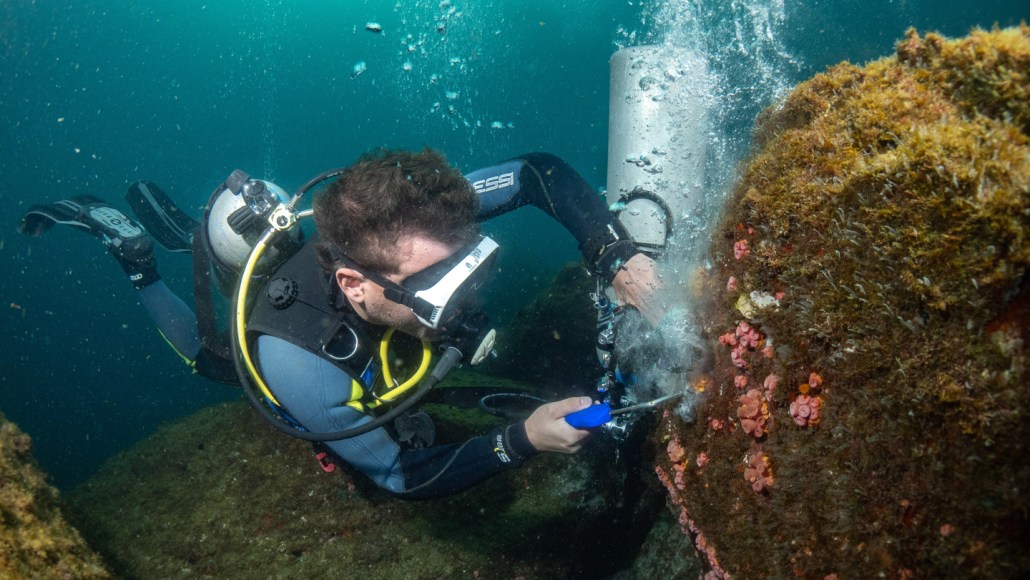
A researcher air blasts invasive sun corals in Brazil’s Alcatrazes Archipelago Wildlife Refuge.
Leo Francini
By Susanna Camp
The ocean has a squatter problem. Invasive sun corals are aggressively colonizing reefs and industrial infrastructure, snuffing out native biodiversity and adding millions to the maintenance costs of offshore assets. While the old-school fix involved divers with hammers and chisels — a process about as efficient as mowing a lawn with nail clippers — today’s underwater frontier might be all about the air gun. Danielle Beurteaux takes us on a deep dive for SN.
🪸 A seismic shift in pest control
At a popular dive site off the coast of Brazil, scientists are testing high-precision underwater air guns to blast coral invaders off the map. Unlike physical scraping or pneumatic hammers, which not only can miss spots but also cause the invasive coral to spread, the air blasts are better targeted and more effective. If researchers can develop heavy-duty versions for cleaning up structures like ship hulls, the new method may serve to merge environmental preservation goals with industrial efficiency.
🌊 Charting the bathysphere
As offshore wind and subsea infrastructure sectors grow, the demand for robotic sentinels and janitors in the form of Autonomous Undersea Vehicles (AUVs) is also increasing. The global AUV market is projected to reach over $4.6 billion by 2030, fueled by rising investment in commercial, scientific and defense sectors. Innovation in sensors, navigation systems and AI is also shaping trends in underwater robots.
🤿 Deep-sea disruptors
Here’s who’s currently leading the charge in automating the management of aquatic frontiers:
- Orpheus Ocean’s AUVs can reach a depth of up to 11,000 meters to perform high-resolution surveys and seafloor sampling. Spun out of the Woods Hole Oceanographic Institution, the company has raised approximately $3 million in total funding across its early stages, including a most recent investment in early 2026.
- Bedrock Ocean Exploration: With $58 million in total funding to date, Bedrock is helping build the Google Maps for the seafloor. Their platform and proprietary AUVs provide the high-resolution topographic data necessary. The company is a partner on the Seabed 2030 project, a collaboration between the Nippon Foundation of Japan and the General Bathymetry Chart of the Ocean (GEBCO), which aims to produce “the definitive map of the world ocean floor by 2030.”
The most profitable future for our oceans is one where the robots do the dirty work so the environment doesn’t have to.
Disclaimer: The Science News Investors Lab newsletter is for informational purposes only and does not constitute investment advice. Society for Science and Science News Media Group assumes no liability for any financial decisions or losses resulting from the use of the content in this newsletter. Society for Science and Science News Media Group do not receive payments from, and do not have any ownership or investment interest in, the companies mentioned in this newsletter. Please consult a qualified financial advisor before making any investment decisions.