What’s new in spacesuits? Meet the tailors.
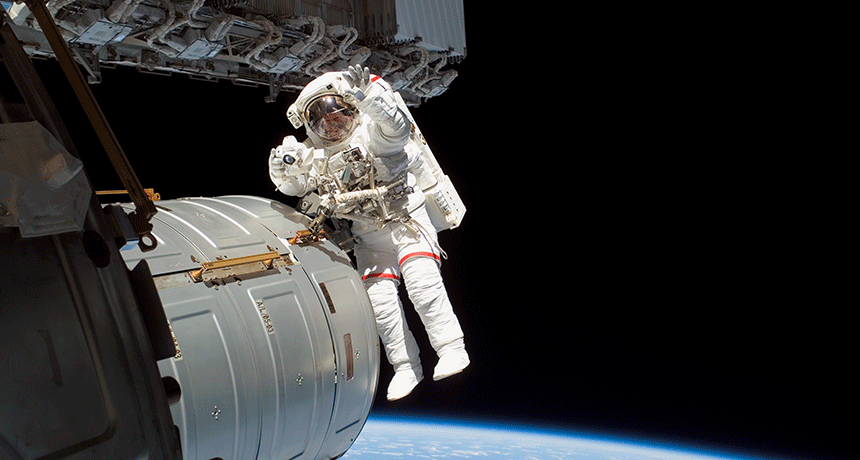
Astronauts don bulky suits to protect themselves as they “walk” outside the International Space Station. A new material might one day make those suits even more protective.
NASA
By Susanna Camp
The preflight safety checklist for a trip to outer space is long, basically from here to the moon. Everything must be just so, from the structural integrity of the spacecraft to the propellant efficiency to the in-flight environment, down to the clothes on the astronauts’ backs. If the suit fails, the mission fails. Such life-or-death safety concerns are why the multibillion dollar Artemis III roadmap recently hit a bump in the road. That mission will no longer land on the moon. Instead, NASA is delaying the next moon landing until 2028. Before then, they must address rocket fuel leaks and finish landers. And they also need to perfect the spacesuits that a new generation of astronauts would actually wear on the lunar surface. SN astronomy writer Lisa Grossman maps out the detour.
🧵 Meet the space tailor
Before any actual moon landing, NASA’s Artemis III mission will be a high-stakes stress test for expensive wearable tech. Spacesuits are basically self-contained, pressurized spacecrafts with sleeves. Each suit consists of as many as 16 layers, including a liquid-cooling garment that regulates body temperature and a layer designed to repel micrometeoroids (read: space dust) that can shred standard materials. The spacesuits must be flexible enough to allow for the astronauts to bend and lift tools and to move comfortably in antigravity conditions.
👩🚀 The bespoke astronaut
The current era of suit-making has shifted from one-size-fits-most to bespoke biological integration. Modern providers like Axiom Space use software to create a digital twin of each spacesuit, streamlining the testing process. Testing involves thousands of hours in buoyancy labs (think giant indoor pools) and vacuum chambers to simulate the temperatures and pressures of space. The goal is to maximize manual dexterity while allowing an astronaut to operate a drill or a touchscreen in the harsh conditions on permanently shadowed parts of the moon.
🪐 If the suit fits
While NASA sets the requirements, the private sector is stitching the future:
- Axiom Space is the current frontrunner for the Artemis lunar surface suits, with a high-profile collaboration with Prada (yes, the luxury retail fashion brand). They’ve successfully pivoted from commercial spaceflight and space station module developer to integrated space services. Axiom has raised over $850 million to date, with a massive $350 million February 2026 round led by Type One Ventures and Qatar Investment Authority.
- Collins Aerospace (a subsidiary of RTX, formerly Raytheon): The legacy incumbent whose forerunner company was involved in spacesuits dating back to the Apollo program, they were also until recently developing the next-generation spacesuits for the International Space Station. They’ve “descoped”, due to what space industry analysts speculate are delays and cost overruns and a failure to remain competitive under the terms of the fixed-rate contract.
- SpaceX: The company’s development of a suit designed for planetary exploration, tested during its Polaris Dawn mission that included the first commercial spacewalk, represents a major threat to the traditional contractors. SpaceX is currently planning to IPO with a valuation of $1.75 trillion.
With the cost of each single suit in the millions of dollars, the delay is a small price to pay to ensure the mission doesn’t come apart at the seams.
Disclaimer: The Science News Investors Lab newsletter is for informational purposes only and does not constitute investment advice. Society for Science and Science News Media Group assumes no liability for any financial decisions or losses resulting from the use of the content in this newsletter. Society for Science and Science News Media Group do not receive payments from, and do not have any ownership or investment interest in, the companies mentioned in this newsletter. Please consult a qualified financial advisor before making any investment decisions.