Righteous Nobel props, biosecurity, and what’s new in stem cells
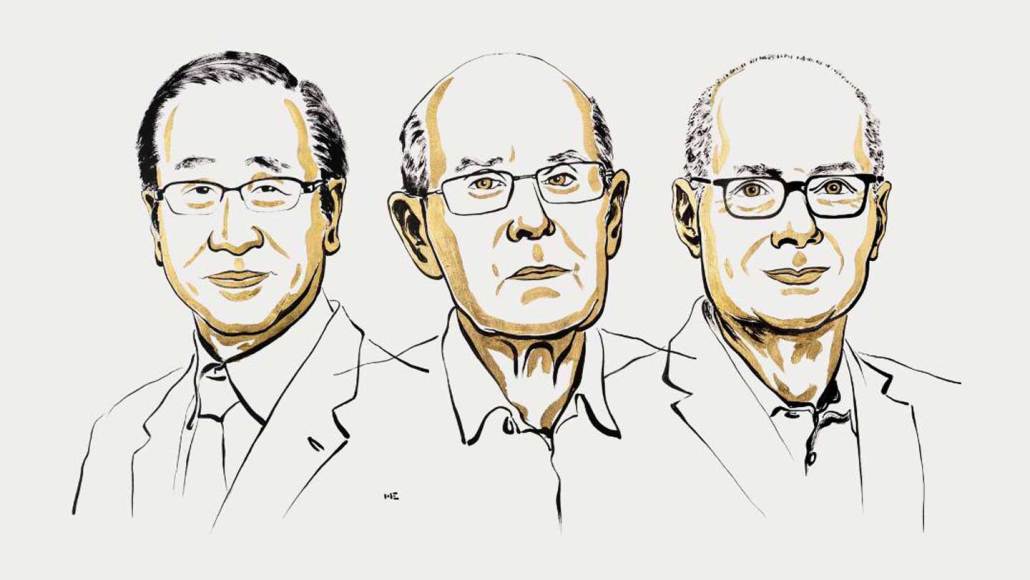
Susumu Kitagawa, Richard Robson and Omar Yaghi (illustrated left to right) have won the 2025 Nobel Prize in chemistry for their work on metal-organic frameworks. These capacious molecular structures can be used to trap gas, water and other chemicals.
Niklas Elmehed © Nobel Prize Outreach
By Susanna Camp and Elana Spivack
🏅 Metal-organic frameworks: The Nobel Prize with room to grow
Metaphors are a great way to explain complex terms in relatable language. When awarding this year’s Nobel Prize in Chemistry, the Royal Swedish Academy of Sciences members and commentators applied no less than five different creative analogies to describe the groundbreaking research on metal-organic frameworks (MOFs) that took home the prize. Indulge us while we dwell on these mental images for a spell:
- Like “Hermione’s handbag or Mary Poppins’ carpet bag”, MOFs look small on the outside but are vast on the inside. The large internal surface area of MOFs allows them to store immense quantities of gas in a tiny volume.
- Like “rooms in a hotel”, there are cavities within the molecular structure of MOFs. Gas molecules or other chemicals can check in and out of these tiny, well-ordered “rooms”.
- Molecular architects: The laureates were described as designers who build molecular-scale structures. In this analogy, metal ions serve as the “cornerstones” and long organic molecules act as the “links” to build crystals with large cavities.
- “A molecular sponge”: This analogy emphasizes the porous and absorbent nature of MOFs, which can soak up and contain gases and liquids.
- The TARDIS from Doctor Who: Like Hermione’s bag, the TARDIS from the science-fiction series is also famously “bigger on the inside” and was used to describe the surprising interior volume of MOFs.
Science News senior writer Meghan Rosen reports on the spatial molecular structures making headlines.
🕳️ Tiny holes, big returns
What exactly are MOFs? These molecular structures are built by stitching together metal ions and organic linkers, creating a vast, organized network of tunnels and cages. Their exceptional internal surface area allows MOFs to soak up and separate specific gases and chemicals with unprecedented efficiency. The applications aim to address several of humanity’s most pressing resource needs and environmental challenges, meaning MOFs could be an indispensable tool for the next industrial era. Their ability to selectively capture gases means they can contribute to industrial decarbonization, extracting air pollutants directly from smokestacks and even open spaces. Beyond climate, MOFs are positioned to address global water security through atmospheric water harvesting, literally pulling potable liquid from the air in arid zones. Furthermore, in lab studies, their highly tailored structures can trap and recover ultra-dilute, high-value materials, such as rare earth elements from waste streams or toxic “forever chemicals” (PFAS) from contaminated water sources.
💸 The money in the molecular grid
Materials science is a $3 trillion market, with room to grow. The investment landscape already has a few emerging contenders in the MOF and MOF-adjacent space.
- Heirloom Carbon, which specializes in sucking CO2 directly from the air, secured a $150 million Series B round in late 2024, contributing to its total funding of over $200 million. While Heirloom uses a modified limestone — not MOFs — for capturing CO2, its success validates the market appetite for cost-effective atmospheric adsorption (the adhesion of atoms, ions or molecules from a gas, liquid or dissolved solid to a surface).
- Closer to the core MOF technology is Swiss company novoMOF, which recently raised a $5.4 million Series A round in April 2025. The company targets its MOFs to high-emissions industries such as steel, and space-limited situations where “Hermione’s handbag” might be useful, such as maritime transport CO2 capture.
- A third compelling player is Decarbontek, which has developed a system to quickly move CO2 in and out of their MOFs’ proverbial hotel rooms, for applications including cement plants and treating gas emitted from landfills. The company is private with no publicly available investment data.
Keep your eye on this space as these molecular cages capture more funding.
☮️ Keeping the peace in the immune system
The body’s immune system is constantly self-regulating. When under attack from infections and wounds, the system recruits and assigns certain cells to fight them. Afterwards, another group of cells will tell those recruits it’s time to stand down. That second group acts as peacekeepers, getting an active immune system to stop fighting. As reported by SN’s Tina Hesman Saey, three scientists who did pivotal work to understand the key roleplayers in the immune system were awarded this year’s Nobel Prize in Physiology or Medicine.
🕊️ Turning off friendly fire
The central discovery is the T-reg, a specialized type of white blood cell acting as the immune system’s regulator. For decades, we knew the system could overreact, causing painful and debilitating autoimmune disorders like Type 1 diabetes and rheumatoid arthritis. Now we know why: the T-regs, whose job is to return systems to normal when an infection is cleared, were either missing or malfunctioning. The laureates showed that the FOXP3 gene is the essential master switch for T-reg development. By isolating and mobilizing these cells, medicine might now restore the natural balance, offering a mechanism to stop the body from attacking its own tissues rather than just masking the symptoms with broad immunosuppressants.
⚕️Countering chronic chaos
T-reg biology represents a paradigm shift from management to addressing root causes, for global chronic disease markets worth hundreds of billions of dollars. This innovation has at least three primary applications. First, in autoimmune disease and allergy treatment, we can engineer or multiply T-regs to restore the peace. Second, in transplant medicine, targeted T-regs can potentially prevent the immune system from rejecting a new organ. Thirdly, in oncology, researchers are exploring ways to temporarily disable T-regs, allowing the body’s killer T cells to fully engage and eradicate tumors without being regulated.
🍎 Many healthy returns
Venture capital has already rewarded this research, pouring significant capital into companies focused on immune modulation.
- Sonoma Biotherapeutics, notably cofounded by one of the Nobel laureates, Fred Ramsdell, has launched clinical trials of engineered T-reg cell therapies for rheumatoid arthritis and a chronic skin condition. They’ve raised over $365 million to date, including a $265 million Series B in 2021 and a subsequent $45 million payment from Regeneron in late 2024. (Regeneron Pharmaceuticals is a major financial supporter of the Society for Science & the Public, which publishes Science News.)
- On the M&A front, Human Immunology Biosciences (HIBio), which focused on targeted treatments for immune-mediated diseases, was acquired by Biogen in May 2024 for an estimated $1.8 billion, demonstrating a clear big-pharma appetite.
- Meanwhile, SetPoint Medical is commercializing a therapy for rheumatoid arthritis that involves electrically stimulating a specific nerve, which activates the body’s own anti-inflammatory immune pathways. SetPoint closed a $115 million Series D in August 2025 to fund its market launch, proving non-drug therapies that regulate the immune-nervous system axis are also rapidly scaling.
Science is finally giving peacemakers the spotlight, and we’re here for it.
🧬 Pernicious Proteins: AI, Biosecurity, and DNA Generation
One of artificial intelligence’s most promising applications is in protein discovery, fueling breakthroughs in biology and medicine. Erin Garcia de Jesús reports for SN on a critical safeguard for this powerful technology — new patches to biosecurity screening software that can make it more difficult for bad actors to harness this AI power to create potentially harmful proteins.
🔒 Biosecurity against generating harmful proteins
AI can help researchers unlock ways to adjust existing proteins for accomplishing specific tasks, design entirely new proteins or even generate new genomes altogether. Biosecurity screening software monitors processes for creating artificial proteins, so perpetrators can’t develop toxic or lethal proteins.
But even slight changes to toxins’ original genetic sequences with AI can bypass these safeguards, as researchers wrote in a paper published in the journal Science. The authors emphasize that reinforcing gaps in screening can boost the programs’ ability to flag sketchy AI-designed proteins, so DNA manufacturers don’t ship hazardous sequences to a lab.
The team simulated tests for biosecurity screening models, looking for weaknesses that might allow AI-generated proteins to escape filters undetected. They generated about 76,000 digital DNA blueprints for 72 harmful proteins, including ricin and botulinum neurotoxin. While the software halted DNA for almost all proteins in their original forms, many AI-tweaked versions slipped through.
💻 A need for beefed-up biosecurity
The market for AI-synthesized proteins is set to balloon. This past August, the National Science Foundation (NSF) invested nearly $32 million to accelerate this technology. And as AI models continue to grow ever more sophisticated, the possibilities for this field expand, too. This new paper reveals how with that expansion comes a secondary but equally critical market for biosecurity that will protect against synthesis of harmful proteins, including AI-tweaked blueprints that currently get past existing screenings.
🤖 Cutting-edge biosafety
Here are some companies and organizations at the forefront of biosecurity and defense:
- Aclid: Founded in 2021, this New York–based seed-stage company develops products for biosecurity, biosafety, and biodefense. Their sequence screening tool flags hallmarks of AI generation in custom-designed DNA along with other potentially problematic patterns. They offer a suite of other tools for research, compliance and more. So far, they’ve raised $3.3 million.
- Ginkgo Bioworks: While this company was founded in 2008, in 2020 it received a $1.1 billion loan to expand its commercial biosecurity, and in 2023 it entered a five-year strategic partnership with Google Cloud to continue developing biosecurity AI tools. In 2024, it announced two biosafety products, Ginkgo Canopy and Ginkgo Horizon, that detect the presence and migration of biothreats through avenues like testing airplane wastewater. With their Google Cloud partnership, they will work to develop new large language models to help clients in biosecurity as well as other fields. With investors like NSF and the Bill & Melinda Gates Foundation, Gingko has raised $1.6 billion in funding.
- Battelle: The Battelle Memorial Institute, headquartered in Columbus, Ohio, is a nonprofit research and development organization working in sectors including environment, health and national security. They developed the UltraSEQ Threat Identification Algorithm, which scans requested DNA sequences through their proprietary database. In 2023, the Institute received a $416 million grant from the NSF and a $6.1 million grant from the Biomedical Advanced Research and Development Authority.
AI-synthesized biomaterials will continue to grow more complex, but so will biosecurity.
🥚 Making Egg Cells from Skin Cells: The Power of Reprogrammed Cells
A new method of producing human egg cells combines a cloning technique with fertilization and a chemical assist. Tina Hesman Saey reports for SN on this proof of concept for creating human eggs from adult cells, which could one day help infertile people conceive.
🦠 Chemical coaxing
For years, researchers have been refining the technique of somatic cell nuclear transfer, which involves removing a human egg cell’s nucleus and replacing it with that of a certain type of skin cell. (Somatic cells are any cells other than reproductive cells.) This practice was key to cloning Dolly the Sheep as well as other species. Now, a team of scientists reports in Nature Communications that they’ve leveraged this method to transform skin cells into egg cells that can give rise to early human embryos.
Their spin on this technique comes from another step. They didn’t want to make a clone, but a typical egg cell with 23 chromosomes. However, the egg cell they produced already had 46 chromosomes—the number of chromosomes from when an egg cell and sperm cell combine. So the researchers added a chemical called roscovitine, which rid the egg cell of its extra chromosomes.
None of the embryos ended up with the correct sets of chromosomes, so none were viable. Still, some of the fertilized eggs led to early human embryos. The researchers chalked up their results to abnormal numbers of randomly paired chromosomes in their embryos. The team halted fertilized egg development after about six days.
🧫 Proof of concept for a potential market
While this technique is currently too inefficient and high risk to apply clinically, and raises questions regarding technology’s role in potentially creating new human lives, it could one day provide many people with the opportunity to have a child. It could treat infertility in those who no longer have egg cells due to early menopause, cancer treatments or age. It could also aid same-sex male couples to potentially conceive a child who is genetically related to both parents.
🚼 Pregnant with opportunity
Though this specific technique is far off from clinical application, a number of startups are transforming non-reproductive cells into egg cells with a different strategy known as in-vitro gametogenesis:
- Dioseve: Based in Tokyo, this Series A startup conducted experiments in mice and identified eight gene regulators that convert induced pluripotent stem cells, sourced from skin cells, into eggs. Since its founding in 2021, Dioseve has raised $9.2 million over two funding rounds.
- Ivy Natal: Founded in 2020, this San Francisco–based startup focuses on eliminating the stem cell middleman for in vitro gametogenesis by inducing meiosis, the process that halves the number of chromosomes in eggs and sperm, in somatic cells. Over two funding rounds, Ivy Natal has raised $1.8 million with Alameda Research among investors.
- Conception: This Berkeley, California–based startup starts their in-vitro gametogenesis with cells from blood samples rather than skin. So far, they have successfully used this technology to make viable mouse eggs that become healthy, live mice. Since its founding in 2018, Conception has raised $20 million, counting OpenAI CEO Sam Altman and Skype founding engineer Jaan Tallinn among lead investors.
Much like a healthy baby, this technology is poised to keep growing.
Disclaimer: The Science News Investors Lab newsletter is for informational purposes only and does not constitute investment advice. Society for Science and Science News Media Group assumes no liability for any financial decisions or losses resulting from the use of the content in this newsletter. Society for Science and Science News Media Group do not receive payments from, and do not have any ownership or investment interest in, the companies mentioned in this newsletter. Please consult a qualified financial advisor before making any investment decisions.