Snails, Sea Silk, & The War on Bugs. Plus: Our Sci-Fi Future
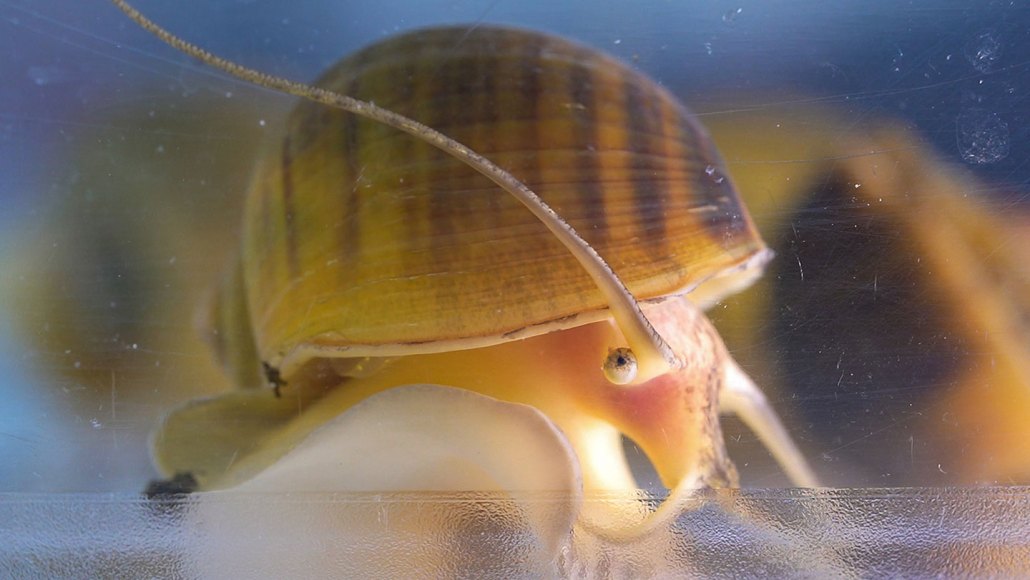
The golden apple snail can regrow its eyes, a trick that might one day help heal people’s eye injuries and diseases.
Stowers Institute for Medical Research
By Susanna Camp and Elana Spivack
🐌 Snail Vision: A Potential Path to Sight Regeneration
Consider the humble snail. These oddly adorable slowpokes may eat holes in your garden’s greens, but it turns out they may be useful for modeling human eye development. Science News’s Tina Hesman Saey reported how one invasive snail species may possess the key to ocular regeneration in people.
👁 The Golden Apple of Your Eye
You may have seen the freshwater golden apple snail (Pomacea canaliculata) chilling at the bottom of a fish tank. These little guys are actually one of the world’s most invasive species, and developmental biologist Alice Accorsi sought to understand the key to their survival.
She found that part of their secret is the ability to regenerate body parts, including their eyes. While this power isn’t unique to golden apple snails, their eyes have a lens, cornea and retina like humans’. Moreover, these critters require the same gene people do to grow eyes, which could help scientists locate the molecular switches involved in both human and snail eye growth.
In just a few years, Accorsi, who is an assistant professor of molecular and cellular biology at the University of California, Davis, has propelled these gastropods toward becoming laboratory stand-ins for human eyes — a feat that usually takes much longer. She published her findings in the journal Nature Communications in August.
👀 Putting the “Eye” in Investing
It will take years before the discovery of the basis of eye regeneration in snails leads to cures for people, but treatments are very much in demand. By one estimate, in 2024 the U.S. eye care market size was valued at $27.3 billion. It’s projected to grow to $41.2 billion in 2030 as the population continues to swell and age. Quite a few startups have already ventured into eyesight therapy, even without snails.
📈 Business Insights
- Beacon Therapeutics: Founded in 2023, this London-based Series B startup aims to treat diseases of the retina that lead to blindness. They leverage a popular virus-based mechanism to deliver enhanced genes that encode therapeutic proteins to treat retinal blindness. In their most recent funding round in June 2024, they raised $170 million, bringing their total funds to over $290 million.
- Tenpoint Therapeutics: Based in London, this company develops treatments for common age-related ophthalmic conditions, such as cataracts. Their most advanced drug candidate, the eyedrop Brimochol, aims to treat age-related difficulty viewing nearby objects clearly, or presbyopia. The formula shrinks pupils to only let centrally focused light rays enter the eye. Since their founding in 2020, Tenpoint has raised $70 million from investors.
- Ray Therapeutics: This San Diego–based startup, founded in 2021, is working on treatments for retinal diseases that transform patients’ remaining neurons to make them light-sensing. This therapy would improve vision regardless of mutations to the eye’s light-sensing cells or the underlying disease. An $8 million grant in April 2024 brought their total funding to $122 million.
- StemSight: Founded in 2021, this seed-stage Finnish startup utilizes induced pluripotent stem cells, which are cells that have been reprogrammed into adaptable stem cells. StemSight combines these cells with biomaterials to create possible treatments for cornea-related blindness. During their most recent seed round this past February they raised over $2.67 million, bringing their total to more than $3.36 million.
Keep an eye out for sight treatment as this visionary field continues to develop!
🦪 Sustainable Luxury: Biowaste Goes Bespoke
One of the world’s rarest textiles is sea silk. Rumored to have inspired the famous Golden Fleece of Greek mythology, this fabric comes from naturally strong fibers, called byssus, that the large Mediterranean clam Pinna nobilis uses to cling to surfaces. People harvest and then painstakingly process byssus into shimmering threads. Now, researchers have replicated the Golden Fleece from discarded parts of a related bivalve species commonly eaten in Asia, Celina Zhao reports for SN.
🌊 Upcycled Sea Silk
In 1992 the European Union banned harvesting P. nobilis, which was later classified as critically endangered in 2019 by the International Union for Conservation of Nature. But one of its relatives, the Atrina pectinata, or comb pen shell scallop, is farmed for food in South Korea. It also produces byssus that’s usually thrown out. But when subjected to the same process as its Mediterranean counterpart rather than being discarded, this byssus creates a similar sea silk.
“If we collect it instead, we may open a new branch of sustainable luxury,” says Dong Soo Hwang from the Pohang University of Science and Technology in Korea. Hwang is a corresponding author on a paper published in April in the journal Advanced Materials establishing how A. pectinata could become a renewable source of sea silk.
Hwang and his coauthors also describe the basis for sea silk’s unique shimmer, regardless of its source. They discovered the textile comprises spherical proteins called photonins, which twist together into helix-shaped bundles. Light reflects off these nanostructures, gleaming like soap bubbles or insect wings. And since the shine arises from structure rather than pigment, the signature glimmer won’t fade.
♻️ Funding Eco-Friendly Extravagance
In an era of fast fashion, many consumers search for sartorial options that endure in style and sustainability. The sustainable clothing market was valued at an estimated $3.6 billion in 2024. Entrepreneurs bank on the idea that upcycling organic materials can become a status symbol.
🍄 Nature’s Finest
- TômTex: Based in New York City and founded in 2020,this seed-stage startup creates biodegradable fabrics from a substance derived from the hard exteriors of many living things—chitosan. They source their chitosan from mushrooms as well as seafood waste. Over five funding rounds, they’ve raised $4.3 million.
- Ostrea Design: Founded in 2020, this French interior building materials company arose from the founders’ realization that France produces about 250,000 tons of wasted seafood shells, only 5 to 10% of which is recycled. Ostrea Design creates marine terrazzo for pieces like table tops by upcycling oyster, scallop and mussel shells, which comprised 65% of their product. During their most recent funding round this past March, they raised over $5.85 million.
- Ohoskin: While synthetic leather has been on the market for years, this Italian startup founded in 2019 innovates with its textiles made from Sicilian red orange and prickly pear cactus byproducts. In July 2024, they raised $300,000 in a pre-seed funding round.
Your next splurge just might come from a fruit, plant or mushroom.
🪳The War on Bugs Just Got a Biological Upgrade
A tiny invader is inspiring some big ideas. The spotted lanternfly, a voracious pest spreading across the United States, is a major threat to vineyards, orchards and forests. As an alternative to traditional pesticides, scientists are now looking to a more elegant, natural solution: marshalling other species such as wasps, fungi, birds and bats to fight back. SN’s Erin Garcia de Jesús explores this shift from chemical warfare to biological defense.
🍄 From Pests to Besties: Nature’s Enforcers
The problem with the spotted lanternfly is its insatiable appetite and lack of natural predators. Traditional pesticides present another problem because they can harm beneficial insects and pollinators, pose health risks to humans and kill organisms in the environment. That’s where biological pest control comes in. Scientists are working to identify and deploy specific organisms that naturally prey on the lanternfly but won’t harm native species. This could mean introducing a parasitic wasp that lays its eggs inside the lanternfly’s eggs, or developing a fungal pathogen that is lethal to the pest. (For more on tracking and controlling the infestation, the U.S. Fish and Wildlife service offers maps and tips.)
🌾 Funding the Future of Farming
The agtech community is an ally in the fight to reduce agriculture’s reliance on harmful chemicals. One of the major players in this space is AgFunder, a leading agtech venture capital firm. They, along with corporate incubators like Leaps by Bayer, have been active in backing startups that are developing biological alternatives to conventional pesticides — addressing a global problem estimated to cost billions of dollars in crop damage annually.
📣 Bio Boosters
A number of startups are at the forefront of these solutions:
- BioConsortia develops microbial biopesticides that improve crop yield and health, Based in Davis, Calif., they’ve raised over $80 million since their founding in 2014, most recently through a $15 million round in August 2025.
- Provivi, based in Santa Barbara, Calif., has developed a natural pheromone-based pesticide that uses a chemical signal to confuse pests and prevent them from mating. Provivi has raised over $191 million to date.
- SOLASTA Bio: This UK-based startup is developing biopesticides based on peptides, short chains of amino acids that don’t harm beneficial pollinators. They recently closed a $14 million oversubscribed Series A round, co-led by Forbion (via its Bioeconomy fund), FMC Ventures and Corteva.
We’re hopeful the future of farming can be a collaboration with nature, not a conflict against it.
🌬️A Breath of Fresh Air, and Opportunity
What if we could cool the earth through solar geoengineering, a category of techniques that aims to reflect sunlight back into space? Perhaps more importantly, should we? There’s a certain hubris to taking the initiative to alter the climate on the planet we all share, especially considering the unintended consequences (such as environmental impacts and geopolitical conflict from unevenly distributed benefits). Still, given global climate change, geoengineering may be a valid alternative. SN’s Nikk Ogasa explains NASA’s new visualization model that sheds light on the role of aerosols in our atmosphere.
🌡️ The Unseen Thermostat
Aerosols are a diverse cocktail of tiny particles, including dust, sea salt, smoke and pollution. While they are often associated with negative impacts on air quality, they also play a critical role in regulating the Earth’s temperature. Their bright surfaces reflect incoming solar radiation, creating a cooling effect. This is why major volcanic eruptions, which spew sulfur dioxide into the stratosphere, can temporarily lower global temperatures. NASA’s model provides a detailed visualization of how these particles travel the globe, illustrating a complex atmospheric ballet that influences everything from cloud formation to regional weather patterns. Understanding this science is the foundation for a new class of climate intervention strategies.
🧐 A Controversial Playbook for Climate
Solar geoengineering, also known as solar radiation management (SRM), aims to mimic the cooling effect of volcanoes by releasing reflective particles into the atmosphere. While the field is in its infancy and largely supported by philanthropic organizations and research institutions, a handful of private ventures are emerging. These startups are dipping a toe into a complex regulatory landscape to develop technologies to combat climate change.
- Make Sunsets: This startup, founded by two Silicon Valley entrepreneurs, is perhaps the most well-known—and most controversial—player in the space. Since their $750,000 pre-seed round in 2022, co-led by Draper Associates and Boost VC, the company has been selling “cooling credits” to fund the launch of weather balloons containing sulfur dioxide.
- SilverLining: While not a startup in the traditional sense, this nonprofit organization is a key catalyst in the SRM space, funding and advocating for research. They’ve received significant backing from foundations and wealthy individuals. They announced $20.5 million in funding to advance their governance and equity initiatives on near-term climate risk and climate intervention, from a number of climate foundations.
- Planetary: While not directly focused on SRM, this Canadian company specializes in marine geoengineering, specifically adding an alkaline substance to the ocean to remove CO2 from the atmosphere. They’ve received over $7 million in grants to date. Planetary’s mission and approach highlight recent venture capital interest in new, unproven climate technologies. They’re also a clear case study in community pushback against the organizations and funders who’ve initiated large-scale environmental interventions.
📚 Sci Fi Footnote
Want more? Two of our favorite works of speculative fiction tackle geoengineering as a solution to climate change — with dire (and at times humorous) technological, political and social consequences.
- Neal Stephenson’s Termination Shock: A wealthy Texas billionaire unilaterally launches a massive stratospheric aerosol sulfur injection project to combat global warming, igniting a geopolitical firestorm over who gets to control the planet’s thermostat.
- Kim Stanley Robinson’s The Ministry for the Future: This novel follows a new United Nations sub-organization tasked with navigating the political and technological challenges of responding to a climate catastrophe, with nations competing for geoengineering dominance through several means (sulfur aerosols, glacier core drilling and carbon credit cryptocurrencies).
Buy Termination Shock and The Ministry for the Future from Bookshop.org. Science News is a Bookshop.org affiliate and will earn a commission on purchases made from links in this newsletter.
Disclaimer: The Science News Investors Lab newsletter is for informational purposes only and does not constitute investment advice. Society for Science and Science News Media Group assumes no liability for any financial decisions or losses resulting from the use of the content in this newsletter. Society for Science and Science News Media Group do not receive payments from, and do not have any ownership or investment interest in, the companies mentioned in this newsletter. Please consult a qualified financial advisor before making any investment decisions.