Physics
We summarize the week's scientific breakthroughs every Thursday.
- Quantum Physics
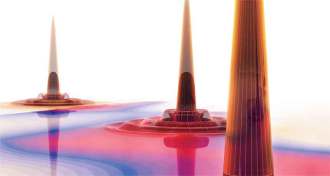
Quasiparticles help physicists make sense of the world
To improve semiconductors, superconductors and other materials, physicists view a particle and its surroundings as one entity.
- Physics
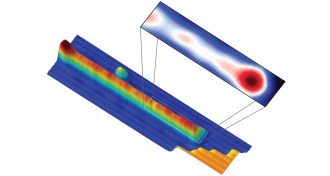
Signal of elusive Majorana particle emerges in a nanowire
New evidence supports existence of exotic Majorana particle — a particle that is its own antiparticle.
- Tech
Solar cell powers water-to-hydrogen conversion
High efficiency could make perovskite solar cells useful for generating environmentally friendly fuel.
- Science & Society
Banana peel slipperiness wins IgNobel prize in physics
Cartoons taught us that banana peels make for a slick trip to the floor, but scientists decided to find out just how slippery they could be.
- Math
Sharks’ hunting paths may not be driven by math
Penguins, tuna, sharks and other marine hunters have been shown to use math to find food. But simulations suggest the behavior is a result of rough water, not complex calculation.
- Materials Science
Making metamaterials ‘digital’ could simplify invisibility cloaks
The digital world of 1s and 0s has inspired a simpler way to make complex metamaterials.
- Quantum Physics
Three photons entangled, not just two
Physicists have found a way to entangle a trio of photons, but it works only once in every quadrillion attempts.
- Tech
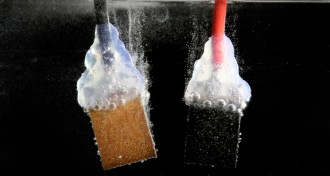
Hydrogen made using sunlight, cheap materials
Photosynthesis-inspired fuel cell uses water to make hydrogen gas and could feature in next-generation cars.
- Quantum Physics
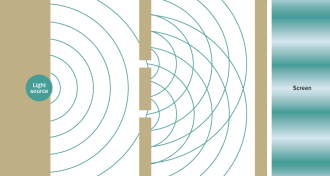
New analysis rescues quantum wave-particle duality
An experiment that supposedly contradicted the wave-particle duality principle of quantum physics has been reanalyzed, revealing a flaw.
- Particle Physics
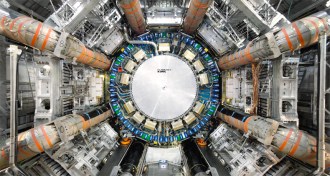
Evidence for new Higgs-related particle fades away
A close look at data from the Large Hadron Collider finds no evidence that the Higgs boson decays into a new, unknown particle.
- Quantum Physics
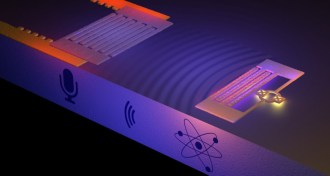
Artificial atom probes sound’s quantum side
Scientists have designed an artificial atom to emit sound that is divided into quantum particles.
- Materials Science
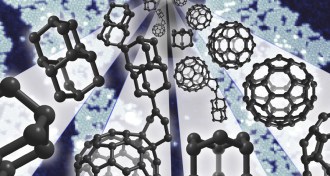
Buckyballs, diamonds inspire new synthetic molecule
Hitching a hollow ball of carbon to a diamond-shaped lattice yields a useful piece of electrical circuitry.