Astronomy
- Astronomy
Rendezvous with a comet
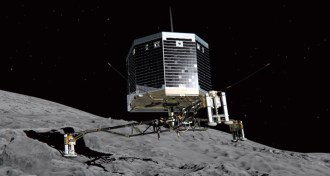
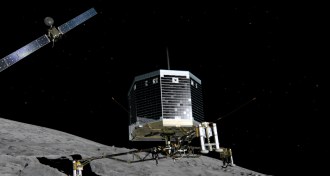
On November 12, Rosetta mission scientists successfully completed the first-ever attempt to put a lander on a comet. See all Science News coverage of Rosetta and Philae's voyage to comet 67P/Churyumov-Gerasimenko.
- Astronomy
Supersized sunspot is largest in decades
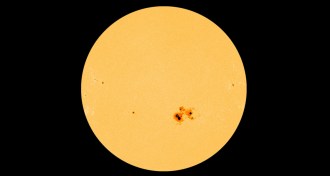
A colossal sunspot large enough to be seen with the naked eye now blemishes the nearside of the sun, covering an area wide enough to comfortably fit 10 Earths side by side.
- Astronomy
Comets caught zooming around nearby star
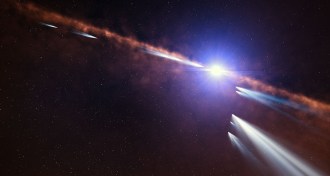
The young star Beta Pictoris hosts at least two families of comets, which might mirror our solar system’s past.
- Astronomy
A musician composes a solar soundtrack
Robert Alexander combines life long passions of both music and astronomy to uncover solar secrets.
- Planetary Science
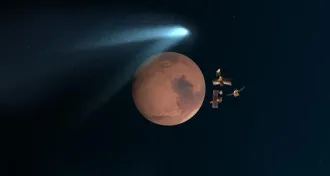
Comet Siding Spring makes close pass by Mars
Mars appears to have survived its close encounter with comet Siding Spring mostly unscathed.
- Astronomy
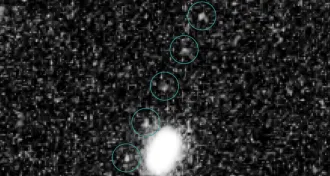
Second stop planned for mission to Pluto
Scientists identify three possible targets for the New Horizons probe after it visits the former planet.
- Astronomy
Comet-crazed, and for good reason
Coming to the edge of knowledge, especially about what’s out in space, fires the imagination.
- Astronomy
Rosetta readies for its close rendezvous with a comet
The Rosetta spacecraft and its lander Philae are ready to make history in a risky rendezvous with comet 67P/Churyumov-Gerasimenko.
- Astronomy
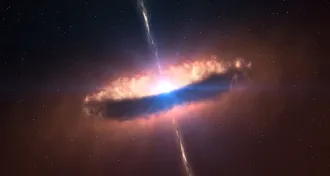
Cosmic jets re-created in a lab
Physicists have recreated in a lab the plasma jets that erupt from young stars and black holes.
- Astronomy
Nearby galaxy might explain what tore apart universe’s hydrogen
A local galaxy is leaking enough ultraviolet light to ionize surrounding hydrogen, which could explain how the earliest galaxies transformed the universe.
- Astronomy
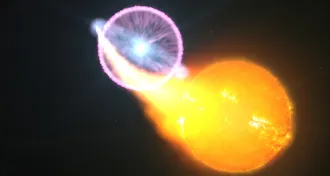
High-energy radiation from stellar explosions explained
The dance of a stellar duo might explain why some novas emit gamma rays.
- Planetary Science
Sun may make most of the water on moon’s surface
A constant stream of particles from the sun bombarding the moon's surface may be the source of most lunar water.