Physics
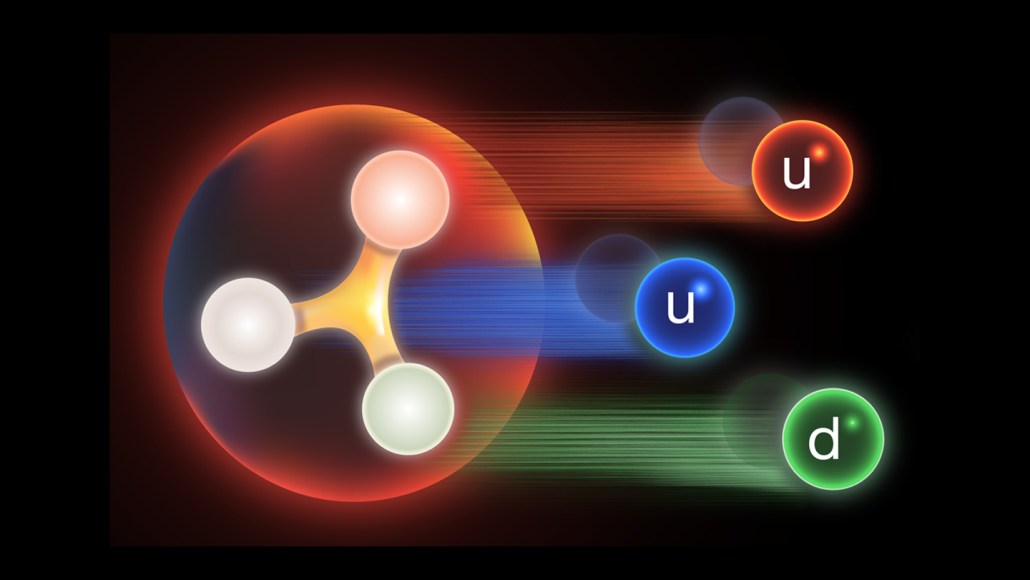
The glue that binds a proton may be key to its identity
Gluons do more than hold protons together. They may also help define the proton’s identity through a quantum property called baryon number.
We summarize the week's scientific breakthroughs every Thursday.
A scientist, a jar of pickles and a power strip walk into a room. The punchline involves physics, glowing condiments and a scientific party trick.
The High-Luminosity LHC, planned to switch on in 2030, could help physicists unravel mysteries about the Higgs boson, dark matter and more.
Researchers were unsure whether alpha particles would aid or hinder fusion. Simulations suggest they help, by dampening turbulence.
A mathematical model shows that attempting to sever a fundamental particle of light could conjure new ones out of thin air.
First dreamed up decades ago, the world's first nuclear clocks are set to improve quickly, becoming more precise and aiding the hunt for dark matter.
Swapping materials in its Majorana 2 chip boosted the effectiveness of quantum bits that rely on the math of topology to reduce errors, Microsoft says.
Metals like copper oxidize — reacting with oxygen in the air — but gold doesn’t, thanks to a quick switch in atom arrangement on its surface.
While the thunderstorms in The Legend of Zelda defy physics, plenty of places on Earth experience extreme weather.
Water droplets on soap films orbited and merged like colliding galaxies, a technique that could help scientists study the cosmos.