The rocks of North Pole Dome in Australia formed from lava that erupted on the seafloor 3.5 billion years ago. These rocks hold the earliest known evidence on Earth of something resembling plate tectonics.
Alec Brenner, Harvard University/Yale University
The arid hills of Western Australia’s Pilbara region contain the earliest evidence yet of tectonic plates sliding across Earth’s surface.
Tiny magnetic crystals locked in the bedrock recorded the terrain’s movement over time. Starting around 3.48 billion years ago, these rocks raced 2,500 kilometers poleward during a spurt lasting several million years, researchers report March 19 in Science. That pushes back the earliest physical evidence of plates moving by 140 million years.
“This is the only planet we know of that has [well-established] tectonics” and it’s important to understand when that began, says Alec Brenner, a paleomagnetic geologist at Yale University.
Researchers believe that tectonics stabilized Earth’s environment, allowing complex life to evolve. But scientists have fiercely debated when it started. Estimates range wildly from 1 billion to 4 billion years ago.
The researchers probably found “the only rocks in the world” that could convincingly show crustal movement so long ago, says Claire Nichols. The paleomagnetist at Oxford University wasn’t involved in the study but wrote an accompanying commentary.
In modern tectonics, continental plates slowly drift and grind against one another, while thinner, denser plates bend, sink and melt under the edges of continents — a process called subduction that fuels volcanoes and the growth of mountain ranges such as the Himalayas and Andes. This recycling of Earth’s surface produces new rocks, which absorb carbon dioxide as they break down, stabilizing Earth’s levels of greenhouse gases and climate over geologic time.
Scientists can reconstruct past continental movements by analyzing microscopic crystals of a mineral called magnetite. These crystals imprint the Earth’s magnetic field as they form; by measuring their compass-like orientation, scientists can estimate the latitude — that is, the distance from the equator — where the rocks were when they formed. Looking at rocks of different ages, they can track how tectonic plates moved over millions of years.
But the older the rocks, the fainter the signal. Magnetism is “a very, very tenuous property,” easily obliterated by heat and pressure, says Roger Fu, a paleomagnetic geologist at Harvard University.
Fu, Brenner and colleagues previously used paleomagnetic measurements in another part of Pilbara to show that this block of terrain drifted more than 5,000 kilometers over a 160 million-year period starting 3.34 billion years ago. But because they tracked only one piece of crust, they couldn’t entirely rule out the possibility that the Earth’s magnetic core had shifted — rather than crustal plates on the surface.
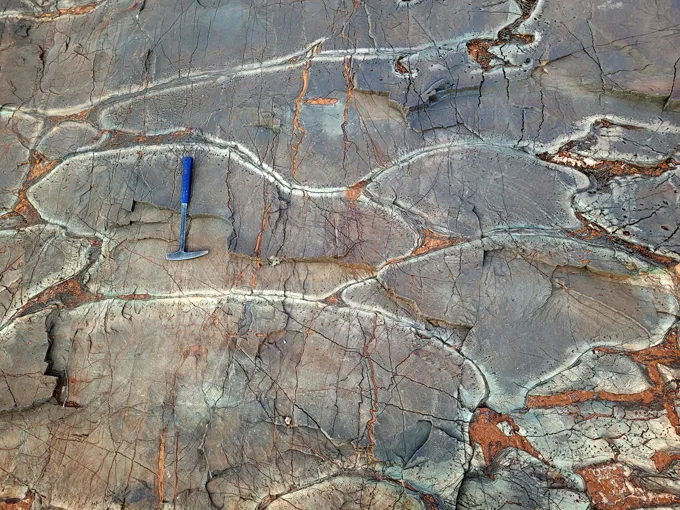
To overcome that uncertainty, the team searched another part of Pilbara, called North Pole Dome, with rocks up to 3.48 billion years old. Fu and Brenner — then at Harvard — spent three years seeking a magnetic signal there. It was “a big gamble,” admits Brenner. But it paid off.
Analysis of the magnetite’s orientation showed that over several million years, the rocks drifted from the latitude of present-day Berlin to that of central Greenland. And this time, their results were bolstered by other scientists’ measurements. Those showed that while North Pole Dome was moving, equally old rocks in South Africa remained stationary near the equator.
This means that “there [was] relative motion between two different parts of Earth’s surface,” says Brenner. “The only way to do that is with plates” moving independently. Prior to this, the earliest evidence for this kind of relative movement was from 2.5 billion years ago, for two pieces of the Earth’s crust that sit in modern-day Wyoming and Canada.
During the timeframe of the latest study, North Pole Dome moved 47 centimeters per year — six times faster than any plates are moving today.
That speed is likely plausible for the time period, says John Valley, a geochemist at the University of Wisconsin–Madison not involved with the work. “There was more heat that needed to be dissipated” from Earth’s interior, so the crust was warmer and bendier than today.
Valley believes that some parts of the Earth’s surface started moving even well before 3.48 billion years ago. Using a different technique — analyzing the composition of super-tough crystals called zircons to estimate how much the crust was mixing, melting and recycling — he and his colleagues conclude that some parts of early Earth’s surface seemed to be subducting while other parts remained in an immobile state.
Subduction and plate movement often go hand in hand — so Valley’s results could indicate that parts of Earth’s surface started moving 4.2 billion years ago — only 300 million years after the planet formed. “But subduction is not the same as plate tectonics,” Valley cautions. His zircon results might also arise from scenarios where the crust was stationary.
To prove that plates were actually moving, scientists would need to find direct magnetic evidence from in intact rock layers. But most of the rocks older than 3.48 billion years have lost their magnetic prints.
“There are rocks at 3.7 or 3.8 billion years where this might be possible,” says Valley. “That’s going to be the limit.”