AI is not ready to fly solo in space
In sci-fi, AI navigates the unknowns. It’s not actually intelligent enough to do that yet
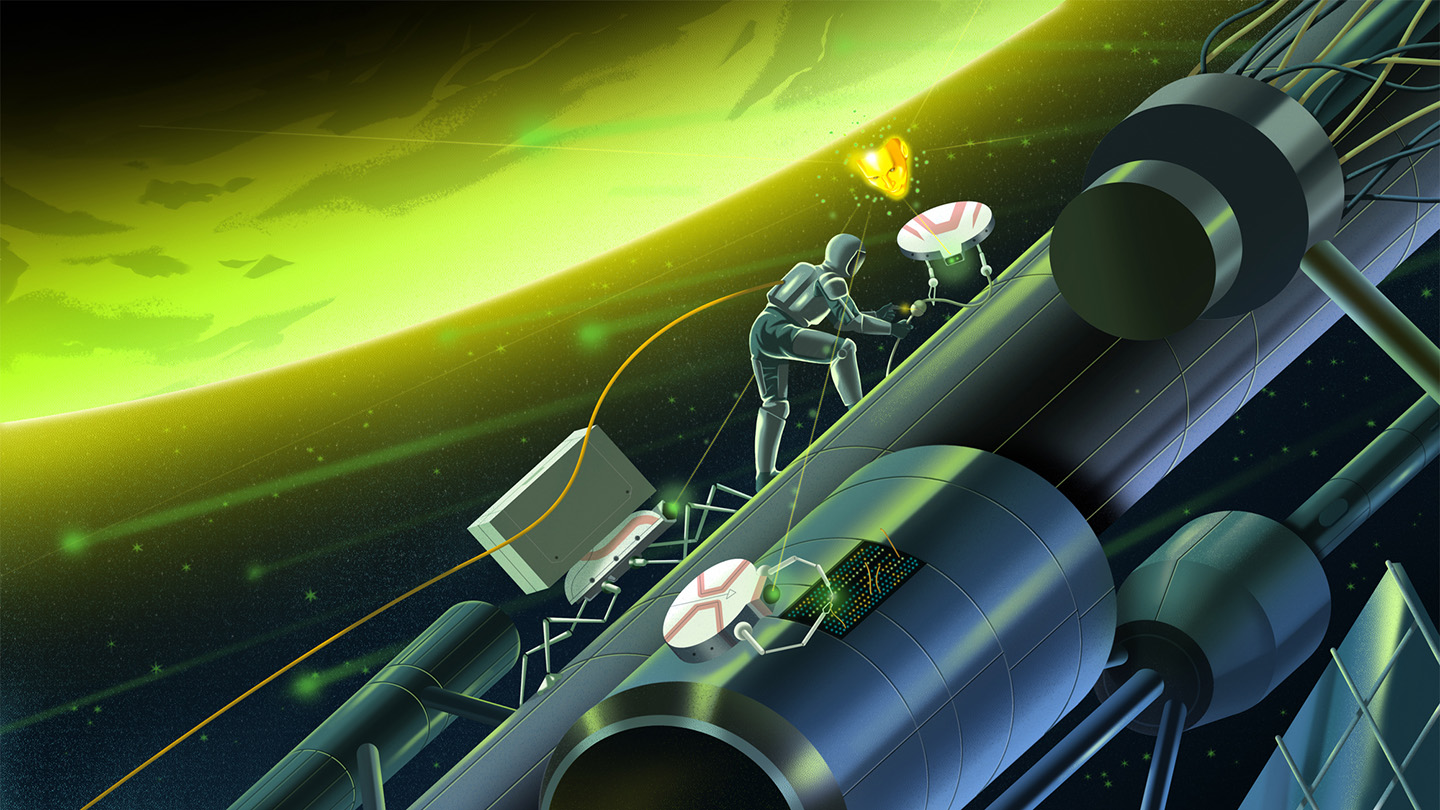
For space exploration, AI would need to be able to handle unpredictable scenarios.
Glenn Harvey
This is a human-written story voiced by AI. Got feedback? Take our survey . (See our AI policy here .)
In the movie WALL-E, some of the last Earthlings travel through the Kuiper Belt on the starship Axiom. For 700 years, a fully automated crew of robots has cared for them after our planet became uninhabitable. Running the ship is AUTO, an artificial intelligence system working to keep humans away — forever.
Here at home, space agencies such as NASA are using AIs to explore the solar system. They are piloting rovers on Mars, preventing satellite collisions and training astronauts for spaceflight. But for now, spacefaring humans would be ill-advised to rely so heavily on AI.
Today’s AIs are much more prone to mistakes and failure than what you see in fiction, says Daniele Gammelli, a roboticist at Stanford University who studies how to integrate AI systems into robots that interact with their environments.
AI systems in space robots would need to complete multistep tasks in all sorts of scenarios without making up inaccurate information. In space, Gammelli says, “you have virtually no room for error.”
The title robot in WALL-E is a trash-compacting machine that abandons his duties to follow another robot, EVE. His greatest strength is, arguably, his ability to handle change. The robot escapes a self-destructing pod using a fire extinguisher. When his wheel or eye malfunctions, WALL-E can replace the damaged part. All of this is learned from experience and done without additional programming.
Such versatility is an example of artificial general intelligence, AI that can think and learn across different situations and take on tasks that it hasn’t been programmed for. AGI doesn’t yet exist.
Adapting to unforeseen situations is a big goal for future spacefaring robots, Gammelli says. Between extreme temperatures, radiation and space debris, space is an ever-changing environment. “The kind of scenarios you are forcing on your robot are, by definition, things that nobody has ever seen,” he says.
Today’s AIs excel at single or closely related tasks, and with repetitive and predictable work. Their top skill “is processing a huge amount of data very efficiently,” says Sanjoy Paul, a computer scientist at Rice University in Houston who researches how AI can assist with space missions.
Martian rovers use this type of AI, all without human input. For instance, Perseverance employs AI algorithms to scan minerals and determine if rock samples are worth collecting. A human sorting through that kind of data could get overwhelmed, Paul says. “AI can cut through all the details … and highlight those things for humans to take a look at.”
To handle multistep tasks, nearly all space robots rely on “autonomy stacks,” Gammelli says. Separate modules responsible for different actions are linked. One AI model might detect rocks or obstacles using cameras or sensors. This info would be passed on to another module to interpret and determine appropriate actions. Other modules would then carry out physical maneuvers to get the job done.
Aboard Axiom, robots handle everything. Custodial robots scrub and polish. Utility bots do repairs and maintenance. Hover chairs cart the ship’s residents to their destinations. Axiom’s passengers live sedentary lives, watching videos and drinking food shakes.
In reality, “you still need humans in the loop,” Paul says. While AIs continue to improve, they remain unpredictable. “If your life depends on it, would you really bank on AI? Probably not,” he says.
Machines like rovers should eventually be able to make their own mini-goals that align with the overall mission, Gammelli says. That ability would allow bots to better handle unforeseen situations and free up humans to attend to more crucial tasks and decisions. “We want these robots to be as independent as possible,” he says. Though maybe not as independent as mission-quitting WALL-E.