How memories may survive hibernation
Changes in the brains of hibernating mice reveal surprising resilience
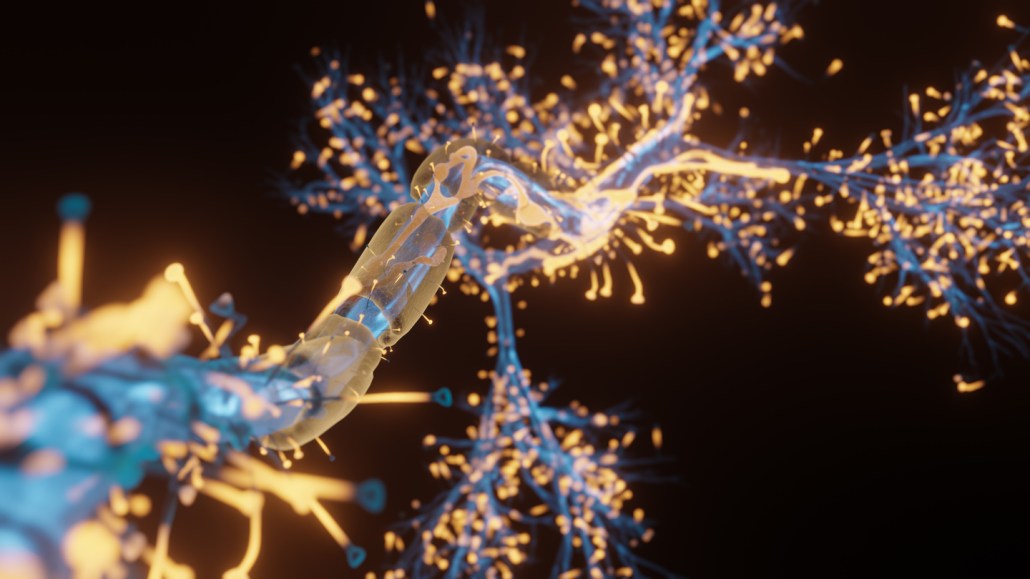
Synapses, connections between brain cells, are thought to be key to the biological basis of memory.
koto_feja/iStock/Getty Images Plus
This is a human-written story voiced by AI. Got feedback? Take our survey . (See our AI policy here .)
How do you fit a human life’s experiences into 1.3 kilograms of brain? Neuroscientists have searched for the cells that generate and store our memories for decades. Now, some surprising hints have turned up in the brains of hibernating mice.
Over two days, hibernating mice temporarily lost nearly half of the connections between their brain cells in a key brain region for memory. But after this ordeal, the mice retained their memories. Imaging shows that key connections between brain cells had regrown, often in exactly the same place that they had disappeared from. The researchers also identified hub-like clusters of brain cell connections that were preserved during the cull.
The findings, published August 13 in Science, bring scientists closer to understanding how memories are acquired, lost and preserved.
The human brain is constantly recording new memories, yet still manages to retain some of this information in the long term. Reconciling these two abilities is a challenge, says Kazumasa Tanaka, a neuroscientist at the Okinawa Institute of Science and Technology in Japan.
The hippocampus, the center of episodic memory, is “one of the most dynamic structures in the brain,” Tanaka says. There, synapses — connections between brain cells integral to brain function — grow and shrink almost constantly, but allow the brain to remember these episodic memories, like a a particularly significant meal or sunset, years later.
No animal demonstrates this mystery better than the ground squirrel. In a classic neuroscience experiment, Russian researchers showed that hibernating squirrels lost brain connections during their dormancy. But these structures were fully repaired within hours of their hibernation ending.
Rather than waiting out the winter with squirrels, Tanaka’s team induced a form of artificial hibernation in mice. The researchers imaged the mice’s brains before, during and after using electron microscopy, which reveals synapses and related structures called dendritic spines in vivid detail. During hibernation, activity in the mice’s hippocampi dropped by 70 percent.
Countless experiments have shown that the strength of a newly formed memory depends on the strength of linked synaptic connections. Tanaka says his team expected large dendritic spines, and the stronger synaptic connections they make, to be preserved during hibernation. That’s not what they saw.
As their brains shut up shop, the mice’s neurons withdrew more than half of their synaptic connections compared with mice that didn’t undergo hibernation. But just two days after hibernation ended, these connections had been restored. Many spines that persisted through hibernation were found in busy brain junctions called multisynaptic boutons. Synapses have two components — an axon that sends chemical messages and a dendrite spine that receives them. At multisynaptic boutons, one single axon joins onto several spines, like a multisocket adaptor that directs electricity into multiple devices.
In different experiments, anesthetized mice were given a drug known to impair memory formation. These mice lost their multisynaptic boutons — and their memories.
“It seems that the multisynaptic boutons, they are the key to preserving this structural connectivity,” says Michele Pignatelli, a neuroscientist at MIT who wasn’t involved in the study.
Another surprising finding was that over 80 percent of the lost dendritic spines reappeared in the same locations as before hibernation. “That says to me that although the spine is lost, the synaptic machinery … is still there,” says Cliff Abraham, a retired neuroscientist at the University of Otago in Dunedin, New Zealand, who was not involved with the research. It’s unclear how these connections get restored with such accuracy.
After the mice emerged from their hibernation, Tanaka’s team assessed their ability to remember locations linked to food rewards or mild electric shocks that they had learned about before their rest. Despite the huge changes in their brains, these mice could still remember the fear of a shock or the location of a treat.
The new findings, experts say, challenge the idea that individual connections formed during a memory must be maintained throughout their lifetime. Instead, the architecture of the wider brain network appears to preserve the memory.
Tanaka’s focus now is to see if there is a secret recipe that gives the spared spines their strength. “We are now working … to see if there’s any unique molecular profiles that makes these surviving spines under hibernation special,” he says.