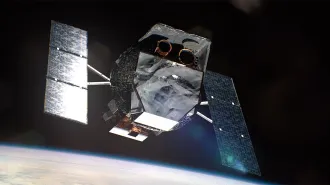
Thousands of satellites in orbit (some illustrated) could be destroyed by a nuclear weapon detonated in space. A new paper reports a method of detecting nuclear weapons in space.
Yuichiro Chino/Moment/Getty Images
Space is supposed to be free of nuclear weapons, but there’s no way to check. A newly proposed technique could search for illicit nuclear weapons in orbit.
Since 1967, nuclear weapons in space have been prohibited by the Outer Space Treaty, which has been ratified by 118 countries, including Russia and the United States.
Now, nuclear physicist Areg Danagoulian of MIT has fleshed out a plan to identify nuclear rulebreakers in space. A shoebox-sized satellite could cozy up to a suspicious satellite. If a nuclear weapon were aboard the scrutinized spacecraft, the inspector would detect neutrons produced when high-energy protons in the vicinity crashed into the weapon, Danagoulian reports July 8 in Nature.
A nuclear weapon, if detonated in orbit, would take out a huge number of satellites — a possibility that has become more concerning in recent years as satellite numbers have grown enormously and people have become reliant on the data they transmit.
In recent years, the United States has claimed that Russia is developing a space-based nuclear weapon. In particular, Russia’s Cosmos 2553, launched in February 2022, has been alleged to be a test run for a potential future nuclear weapon in orbit. Russia has denied this. The satellite passes through a band of radiation called the inner Van Allen belt, the lower of two such belts that ring Earth.
“That’s a terrible place to put a satellite at. You’re going to damage your satellite with all that radiation,” Danagoulian says. But it would be a good place to detonate a nuclear weapon. Radiation from the blast would accumulate in the belt, corralled by Earth’s magnetic field, and take out thousands of satellites that orbit below.
But the Van Allen belt can also help reveal the presence of nuclear weapons. High-energy protons in the belt would interact with uranium in a bomb, producing oodles of neutrons. A small satellite could be outfitted with detectors that would spot neutrons coming from the direction of the target satellite, Danagoulian proposes. Additional detectors would weed out signals from protons and electrons. The inspecting satellite could identify a thermonuclear weapon 4 kilometers away after shadowing its target for about a week, Danagoulian’s simulations suggest. With an even closer approach or with multiple inspector satellites, the measurement could be made in just hours, in a single pass.
“There’s a lot in this work that’s really interesting and exciting,” says astrodynamicist Thomas González Roberts of Georgia Tech in Atlanta. But, he notes, “the satellite that has this detection device … would need to maneuver to be near, very, very near” to the target satellite. In the past, satellites that approached within tens of kilometers have irked operators, Roberts says.
Without coordination between the two satellites’ operators, such proximity could even raise the possibility of a collision, Roberts says. He thinks the idea would work best if it were part of a formal verification scheme incorporated into a treaty, rather than unannounced snooping. That way, satellite operators could coordinate their maneuvers.
Still, satellites that could check for nuclear weapons could be a game changer. “It is really important to have verification mechanisms,” says political scientist Victoria Samson of the Secure World Foundation in Washington, D.C., who was not involved with the work. “It’s not just a matter of, ‘We’re asking you not to do this,’ it’s like, ‘We can tell if you have something up there.’”