Intricate silk helps net-casting spiders ensnare prey in webs

Looped structures make webs that are both stretchy and strong
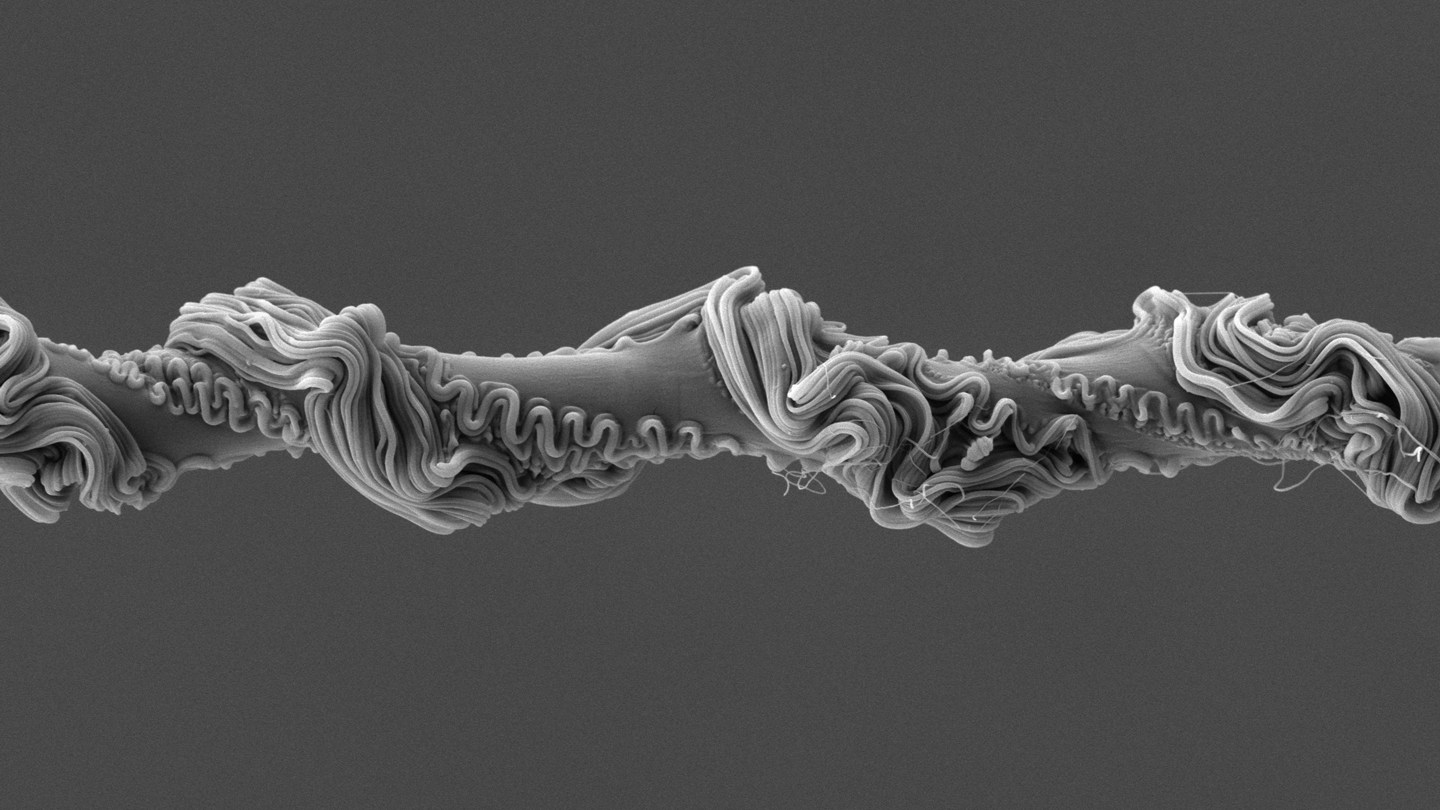
A strand of spider silk is covered in smaller, twisting and looping threads of silk.

The silk of the rufous net-casting spider, shown in a scanning electron microscope image, is simultaneously strong and stretchy, thanks to the loops of silk on its surface.

Martin Ramirez and Jonas Wolff

For spiders that fling their webs at prey, a sturdy net is essential.

A net-casting spider in search of a meal dangles upside down, holding a web in its legs before launching it at an unsuspecting insect. In the process, parts of the web can stretch to up to 24 times their original size in about a tenth of a second without breaking.

The web of the rufous net-casting spider (Asianopis subrufa) pulls off that feat thanks to looping strands that surround a stretchy silk core, researchers report in the Feb. 3 Proceedings of the National Academy of Sciences. Scanning electron microscope images revealed the spider silk’s intricate structure.

A net-casting spider launches its web at a grasshopper, dramatically stretching the silk fibers in the process.J.O. Wolff et al/PNAS 2026

For most materials, there’s a tradeoff: Substances that stretch tend to break more easily. But the webs of these spiders manage to be both strong and stretchy.

As a strand stretches, the loops straighten, and those threads reinforce the core and prevent it from breaking. The spiders customize the amount of coiling in different sections of the web to account for how much each portion needs to stretch. The spider extrudes the loops of silk from a different set of glands than the core fiber, producing a sturdy material.

The resulting fibers are beautiful — but deadly.

Senior physics writer Emily Conover has a Ph.D. in physics from the University of Chicago. She is a two-time winner of the D.C. Science Writers’ Association Newsbrief award and a winner of the Acoustical Society of America’s Science Communication Award.