Skip to content
Subscribe today

Every print subscription comes with full digital access

Subscribe Now
  • All Topics
    • Health
    • Humans
      • Anthropology
      • Health & Medicine
      • Archaeology
      • Psychology
      • View All
    • Life
      • Animals
      • Plants
      • Ecosystems
      • Paleontology
      • Neuroscience
      • Genetics
      • Microbes
      • View All
    • Earth
      • Agriculture
      • Climate
      • Oceans
      • Environment
      • View All
    • Physics
      • Materials Science
      • Quantum Physics
      • Particle Physics
      • View All
    • Space
      • Astronomy
      • Planetary Science
      • Cosmology
      • View All
  • Magazine
  • Menu
    • All Stories
    • Multimedia
    • Reviews
    • Puzzles
    • Collections
    • Educator Portal
    • Century of Science
    • Unsung characters
    • Coronavirus Outbreak
    • Newsletters
    • Investors Lab
  • About
  • SN Explores
  • Our Store
Donate
Home INDEPENDENT JOURNALISM SINCE 1921 SIGN IN
Home INDEPENDENT JOURNALISM SINCE 1921
  • All Topics
    • Earth
      • Agriculture
      • Climate
      • Oceans
      • Environment
    • Humans
      • Anthropology
      • Health & Medicine
      • Archaeology
      • Psychology
    • Life
      • Animals
      • Plants
      • Ecosystems
      • Paleontology
      • Neuroscience
      • Genetics
      • Microbes
    • Physics
      • Materials Science
      • Quantum Physics
      • Particle Physics
    • Space
      • Astronomy
      • Planetary Science
      • Cosmology
    • Tech
      • Computing
      • Artificial Intelligence
    • Chemistry
    • Math
    • Science & Society
    • All Topics
  • Health
  • Humans
    • Humans
      • Anthropology
      • Health & Medicine
      • Archaeology
      • Psychology
    • Recent posts in Humans

      • Animals

        When were dogs domesticated? The oldest known dog DNA offers clues

        By Tom Metcalfe17 hours ago
      • Archaeology

        Neandertals made antibacterial ointment, but may not have known it

        By Martin J. KernanMarch 24, 2026
      • Health & Medicine

        Amid vaccine policy whiplash, here’s how a pediatrician talks to families

        By Aimee CunninghamMarch 20, 2026
  • Life
    • Life
      • Animals
      • Plants
      • Ecosystems
      • Paleontology
      • Neuroscience
      • Genetics
      • Microbes
    • Recent posts in Life

      • Animals

        When were dogs domesticated? The oldest known dog DNA offers clues

        By Tom Metcalfe17 hours ago
      • Neuroscience

        Clumps of mouse brain cells can learn to play a virtual game

        By Andrea Lius20 hours ago
      • Physics

        These insects fly with their legs. Physics explains how

        By Emily ConoverMarch 24, 2026
  • Earth
    • Earth
      • Agriculture
      • Climate
      • Oceans
      • Environment
    • Recent posts in Earth

      • Space

        How realistic is Project Hail Mary?

        By Tina Hesman Saey and Carolyn GramlingMarch 20, 2026
      • Earth

        Earth’s continental plates were moving 3.48 billion years ago

        By Douglas FoxMarch 19, 2026
      • Microbes

        How warming is shifting microbial worlds

        By Erin Garcia de JesúsMarch 19, 2026
  • Physics
    • Physics
      • Materials Science
      • Quantum Physics
      • Particle Physics
    • Recent posts in Physics

      • Particle Physics

        Antimatter traveled by truck for the first time

        By Emily ConoverMarch 24, 2026
      • Physics

        These insects fly with their legs. Physics explains how

        By Emily ConoverMarch 24, 2026
      • Animals

        Female giant rainforest mantises grow up to strike harder than males

        By Susan MiliusMarch 23, 2026
  • Space
    • Space
      • Astronomy
      • Planetary Science
      • Cosmology
    • Recent posts in Space

      • Space

        NASA races to have the first moon base and nuclear-propulsion spacecraft

        By Nikk Ogasa and Lisa Grossman15 hours ago
      • Planetary Science

        A private moon lander challenges ideas about lunar volcanism

        By Lisa Grossman19 hours ago
      • Space

        In a rare event, the moon got a massive new crater

        By Lisa GrossmanMarch 23, 2026
Sponsored Content

The Society’s Top 10 moments of 2018
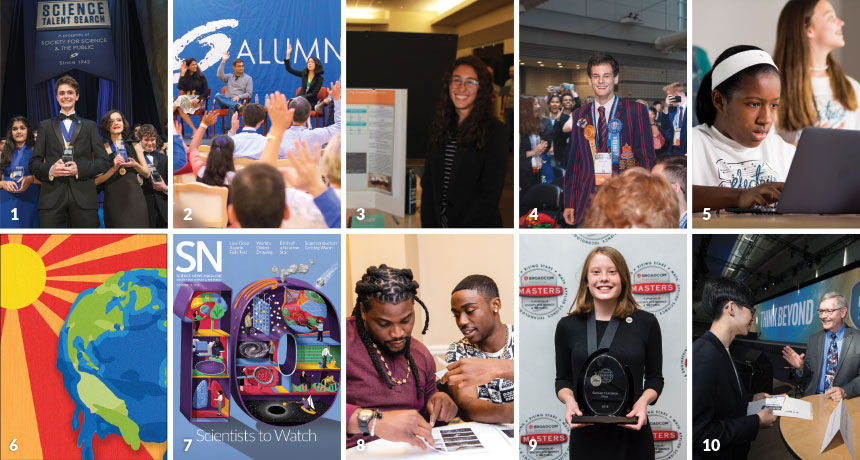
Society images

SOCIETY SUCCESSES  Some of the Society for Science & the Public's top accomplishments from 2018 include the forming of a National Leadership Council, new board members and prizes awarded in their STEM competitions.

Share this:

  • Share
  • Share via email (Opens in new window) Email
  • Share on Facebook (Opens in new window) Facebook
  • Share on Reddit (Opens in new window) Reddit
  • Share on X (Opens in new window) X
  • Print (Opens in new window) Print

1. Regeneron Science Talent Search

Benjamin “Benjy” Firester of New York City won the top award of $250,000 in March in Washington, D.C., at the Regeneron Science Talent Search 2018, a competition for high school seniors. He developed a mathematical model that uses disease data to predict how weather patterns could spread spores of the late blight fungus, which caused the Irish Potato Famine.

2. National Leadership Council

In April, Society for Science & the Public unveiled a new National Leadership Council made up of 20 alumni from the Society’s three science competitions. The council will advise the Society on key opportunities to help foster lifelong connections among the alumni community.

3. Advocates

In May, the Society named 50 Advocates — educators and scientists — who will work to find opportunities for underrepresented students to participate in science research competitions, inspiring the students to engage in science, technology, engineering and mathematics, or STEM, fields.

4. Intel International Science and Engineering Fair

Nearly 1,800 young scientists selected from 420 affiliated fairs in 81 countries, regions and territories competed in Pittsburgh in May at the Intel International Science and Engineering Fair 2018 — an international pre-college competition. Oliver Nicholls of Sydney won the first-place prize of $75,000 for designing and building a prototype of an autonomous robotic window cleaner.

5. STEM Action & Research Grants

The Society was proud to award $100,000 to 24 middle school science teachers to purchase much-needed equipment and $30,000 to seven innovative organizations supporting community-based STEM projects through our STEM Action & Research Grants Program.

6. Climate Change Chronicles

In September, Science News for Students launched a 10-month series called Climate Change Chronicles. The daily online magazine for middle school students, parents and educators is looking at how climate change is already impacting Earth, the new science behind those changes and what a warmer future may mean for the planet’s species.

7. SN 10: Scientists to Watch

For the fourth year, Science News highlighted 10 early- and mid-career scientists who are poised to solve some of the most important questions facing science and society. This year’s SN 10, announced in September, were Shahzeen Attari, Emily Balskus, Ibrahim Cissé, Christopher Hamilton, Paula Jofré, Lisa Manning, Joaquín Rodríguez-López, Anshumali Shrivastava, Douglas Stanford and Jenny Tung.

8. Science News in High Schools

Science News in High Schools, a program that provides educators with access to Science News, is available in more than 4,300 schools during the 2018–2019 school year. The program supports more than 15,000 educators, with a potential reach of 4.1 million students. 

9. Broadcom MASTERS

Georgia Hutchinson of Woodside, Calif., won the $25,000 Samueli Foundation Prize during the Broadcom MASTERS, a STEM competition for middle school students. She won the award in October in Washington, D.C., for her project on developing more efficient and cost-effective solar panels.

10. New Board Members

Nobel Prize–winning scientist W.E. Moerner (shown above, right), MacArthur Fellow Dianne K. Newman and San Francisco 49ers co-owner Gideon Yu joined the Society’s Board of Trustees in 2018. 

Science News

Science News was founded in 1921 as an independent, nonprofit source of accurate information on the latest news of science, medicine and technology. Today, our mission remains the same: to empower people to evaluate the news and the world around them. It is published by the Society for Science, a nonprofit 501(c)(3) membership organization dedicated to public engagement in scientific research and education (EIN 53-0196483).

  • Science News Explores
  • Science News Learning

Subscriber Services

  • Subscribe
  • Renew
  • Give a Gift Subscription
  • Customer Service
  • Follow Science News on Facebook
  • Follow Science News on X
  • Follow Science News via RSS
  • Follow Science News on Instagram
  • Follow Science News on YouTube
  • Follow Science News on TikTok
  • Follow Science News on Reddit
  • Follow Science News on Threads

More Information

  • FAQ
  • Newsletters
  • Rights & Permissions
  • Advertise
  • Contact

Society for Science

  • About the Society
  • Society Store
  • Donate
  • Careers

© Society for Science & the Public 2000–2026. All rights reserved.

1776 Massachusetts Ave NW, Washington, DC 20036 202.785.2255
Terms of Service Privacy Policy

Log in

Subscribers, enter your e-mail address for full access to the Science News archives and digital editions.

Not a subscriber?
Become one now.