Astronomy
- Astronomy
Key sugar needed for life could have formed in space
Sugar that forms backbone of cell machinery can form on icy grains blasted by ultraviolet light from young stars.
- Astronomy
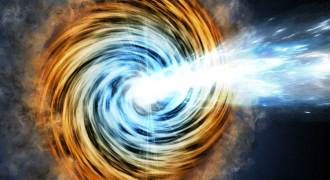
Possible source of high-energy neutrino reported
Scientists may have found the cosmic birthplace of an ultra-high energy neutrino: a blazar 9 billion light years away.
- Astronomy
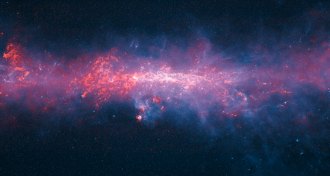
There’s far more to the galaxy than meets the eye
A new map of the galaxy as seen in submillimeter light reveals intricate details from nearby nebulas to the far-flung galactic center.
- Physics
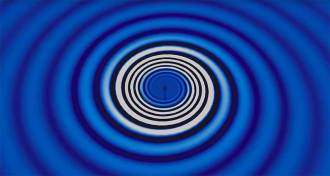
Faint gravitational waves could soon be on LIGO’s radar
In a few years, LIGO could detect hints of faint gravitational waves from black holes too far away to be seen directly.
- Astronomy
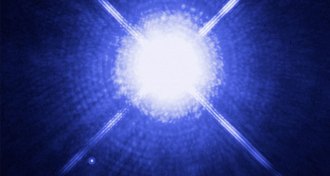
Odd white dwarf found with mostly oxygen atmosphere
A white dwarf that has been stripped of its hydrogen and helium provides a rare peek inside the core of a dead massive star.
- Astronomy
This eclipse goes on and on
The longest known stellar eclipse hides a nearby star for nearly 3.5 years behind a thick clump of orbiting dust once every 69 years.
- Astronomy
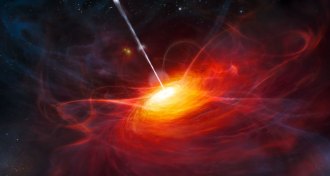
Earth’s hurricanes have nothing on this quasar
In a remote galaxy, a cosmic hurricane around a supermassive black hole is driving winds at nearly 20 percent of the speed of light.
- Astronomy
Japan’s new X-ray space telescope has gone silent
Japan’s newest orbiting X-ray telescope, ASTRO-H, has gone silent and might have broken into several pieces, the Japanese space agency reports.
- Astronomy
Companion star could have triggered supernova
An exploding star in another galaxy might have been pushed over the edge by a stellar companion.
- Astronomy
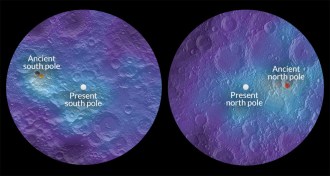
The moon’s poles have no fixed address
Ancient deposits of lunar water ice mark where the moon’s poles used to be.
- Astronomy
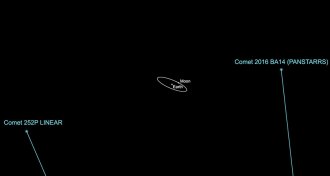
Two chunks of the same comet buzzing Earth this week
Two comets, one a possible fragment of the other, will slip past Earth on March 21 and 22.
- Astronomy
Quasars’ distance no longer in question
Astronomers now know quasars live around black holes in remote galaxies, but 50 years ago, one researcher argued they were much closer.