Damaged DNA can spread between human cells. What could that mean for cancer?
The fragments travel along wispy threads connecting cells
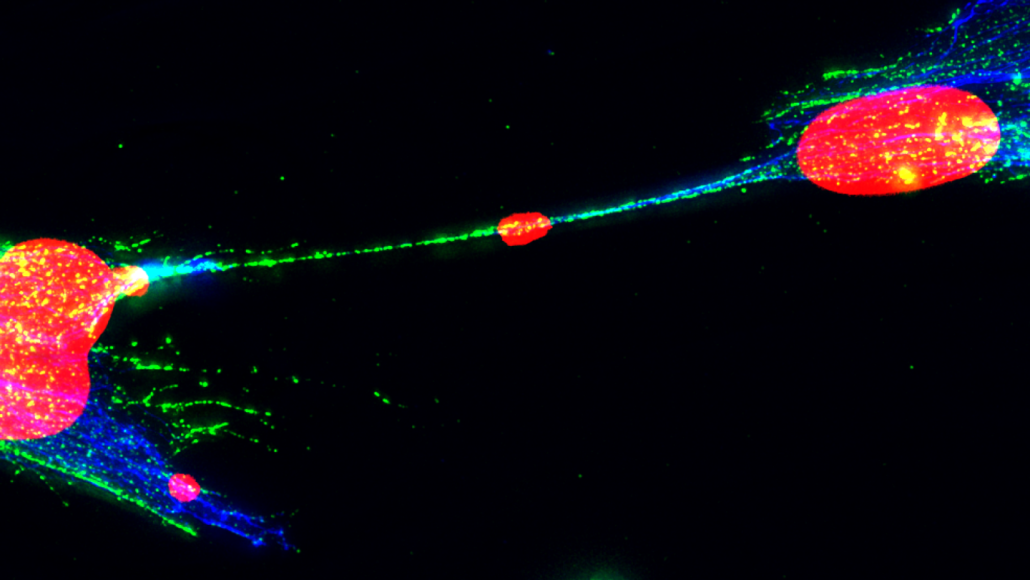
Fragments of DNA (red oval, center) can transfer from one cell to another via intercellular highways (green thread).
Peter Ly/E.G. Maurais et al./Cell 2026
Damaged DNA can escape from one human cell and infiltrate another.
Like prisoners tunneling out of jail, this DNA travels via tubelike structures between neighboring cells, scientists report May 19 in Cell. Once it has arrived at its new location, the dodgy DNA can start acting up, potentially transferring trouble between cells.
“This is an important and exciting discovery,” says cancer biologist Paul Mischel of Stanford University. The new study, which shows that one human cell can influence another by passing DNA directly, raises all sorts of questions about what role the phenomenon may play in cancer.
If tumors use this DNA transfer trick, harmful mutations could potentially spread from cancer cells to healthy cells, says cancer cell biologist Peter Ly of the Children’s Medical Center Research Institute at UT Southwestern in Dallas. How — or if — these roaming chunks of DNA might contribute to disease is “an area that we’re actively exploring,” Ly says.
His team first observed the traveling DNA after mixing two cell types together in the lab. When the researchers triggered damage to the genome, a cell’s full set of genetic instructions, they noticed that DNA fragments appeared to move between cells.
Human DNA typically stays protected within the nucleus — not out wandering from cell to cell. Looking under a microscope, Ly’s team saw living cells connected by wispy threads, like strands of spun sugar. Scientists have known about these threads, called tunneling nanotubes, for decades. They’re like highways for cargo transport between cells. Cancer cells can use nanotubes to steal mitochondria, the cell’s energy powerhouses, from their neighbors, and even send their own mitochondria out to “brainwash” healthy cells.
But until now, no one had seen DNA voyaging along these intercellular highways. And the traveling DNA, Ly’s team discovered, wasn’t just useless genomic jetsam. It could deliver functional traits. In one experiment, the researchers showed that an antibiotic-resistance gene engineered into the Y chromosome of male cells could transfer to neighboring female cells.
The key to kicking off the journey was errors or damage introduced into the genome — a common feature of cancer. Inside a tumor cell, chromosomes may be rearranged, and genes may be improperly duplicated or contain other mutations. It’s possible such errors could cause tumor cells to send out felonious genomic fragments to surrounding cells, says physician-scientist Christoph Gerdes, who researches cancer at Princess Margaret Cancer Centre in Toronto. That could be trouble for several reasons. Fragments that let cancer resist chemotherapy, for instance, might propagate between cells, making the disease harder to treat. It’s too early to say whether that happens, Gerdes says, but Ly’s work “opens up some new possibilities.”
Previous research hinted that human cells might exchange DNA via tiny bubbles that pass between cells. And work from Gerdes and geneticist Buket Basmanav had suggested that bits of DNA could transfer somehow if cells were in close contact. Ly’s team’s new work puts “some puzzle pieces together,” in a way that’s elegant and convincing, says Basmanav, of the University of Bonn in Germany. It provides strong evidence that DNA transfer occurs via nanotubes, she says.
Ly and his colleagues have a long list of questions they’re now looking to answer. How often does this kind of DNA transfer occur? Can researchers detect transfer events in different kinds of tumors? Do DNA fragments hitchhike along established cargo routes between cells or do they spark the formation of new ones? “We still have a lot of work to do to figure all of that out,” Ly says.