Life
Spikes, claws and stingers have no single best shape
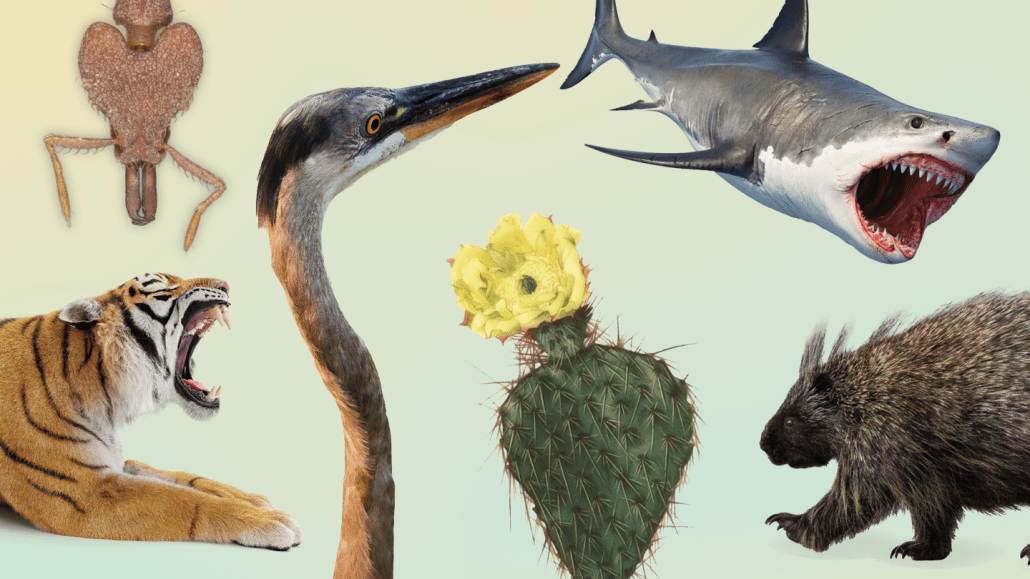
A study of 143 piercing tools, from tusks to love darts, finds they trade off piercing ability for durability. And no one shape wins out.
We summarize the week's scientific breakthroughs every Thursday.
The sun frequently flings plasma into space, but sightings of such eruptions on other stars are rare. Magnetic fields could explain why.
There’s never been a good method to check for violations of the Outer Space Treaty’s prohibition of nuclear weapons in space.
A scientist, a jar of pickles and a power strip walk into a room. The punchline involves physics, glowing condiments and a scientific party trick.
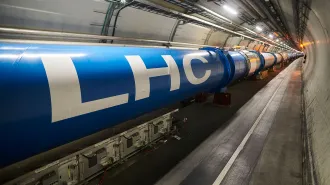
The High-Luminosity LHC, planned to switch on in 2030, could help physicists unravel mysteries about the Higgs boson, dark matter and more.
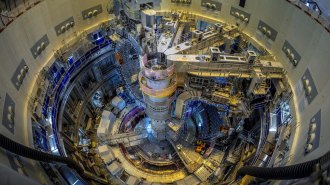
Researchers were unsure whether alpha particles would aid or hinder fusion. Simulations suggest they help, by dampening turbulence.
A mathematical model shows that attempting to sever a fundamental particle of light could conjure new ones out of thin air.
First dreamed up decades ago, the world's first nuclear clocks are set to improve quickly, becoming more precise and aiding the hunt for dark matter.
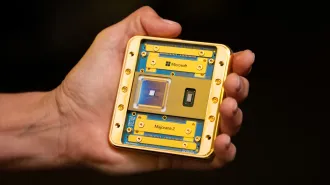
Swapping materials in its Majorana 2 chip boosted the effectiveness of quantum bits that rely on the math of topology to reduce errors, Microsoft says.
Metals like copper oxidize — reacting with oxygen in the air — but gold doesn’t, thanks to a quick switch in atom arrangement on its surface.