Physics
We summarize the week's scientific breakthroughs every Thursday.
- Astronomy
Readers’ interest piqued by Parker Solar Probe, general relativity and more
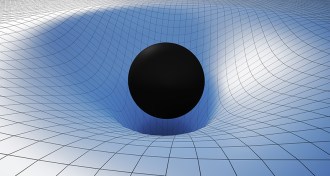
Readers had questions about NASA's Parker Solar Probe, Einstein's general relativity theory and underwater cables used as earthquake sensors.
- Quantum Physics
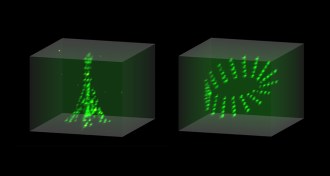
Rubidium atoms mimic the Eiffel Tower, a Möbius strip and other 3-D shapes
Scientists have arranged atoms of the element rubidium into complex three-dimensional structures.
- Materials Science
A new material harnesses light to deice surfaces
A new sun-powered material could someday melt the ice off airplane wings, wind turbines and rooftops.
- Physics
The strength of gravity has been measured to new precision
Researchers have measured Newton’s gravitational constant, known as Big G, with the greatest precision yet.
- Particle Physics
Electrons surf protons’ waves in a new kind of particle accelerator
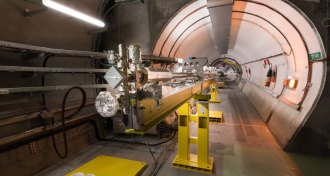
For the first time, scientists accelerated electrons using plasma waves from proton beams.
- Particle Physics
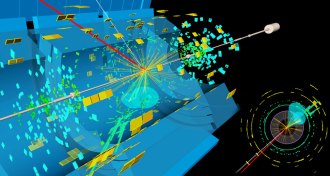
An elusive Higgs boson decay has finally been spotted
Two experiments at the Large Hadron Collider confirm that the Higgs boson decays into bottom quark pairs.
- Quantum Physics
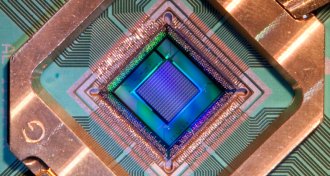
Quantum computer simulates two types of bizarre materials
In calculations involving about 2,000 quantum bits, a D-Wave machine reproduced the behavior of exotic substances.
- Physics
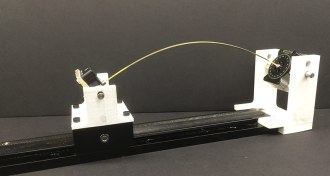
Here’s how to bend spaghetti to your will
Researchers have discovered how to snap spaghetti sticks without sending bits of pasta flying.
- Chemistry
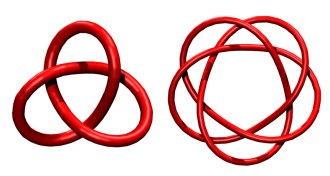
See the ‘periodic table’ of molecular knots
A new table of knots points the way to twisting molecules in increasingly complex pretzels.
- Astronomy
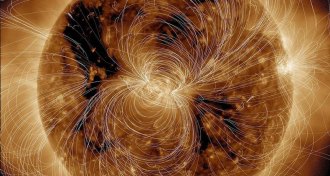
Strange gamma rays from the sun may help decipher its magnetic fields
The sun spits out more and weirder gamma rays than anyone expected, which could give a new view of the sun’s magnetic fields.
- Quantum Physics
A new quantum device defies the concepts of ‘before’ and ‘after’
Two events can happen in different orders at the same time, thanks to quantum physics.
- Particle Physics
Ghostly antineutrinos could help ferret out nuclear tests
Antineutrino detectors could one day help reveal stealthy nuclear blasts.