Space
We summarize the week's scientific breakthroughs every Thursday.
- Astronomy
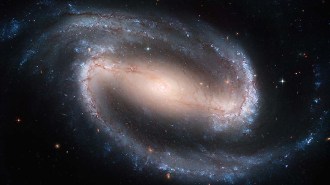
High-speed gas collisions prevent star birth in galaxies’ bars
The spiral galaxy NGC 1300 makes few if any stars in its bright bar. Simulations suggest gas clouds colliding at high speed stunt star formation.
- Space
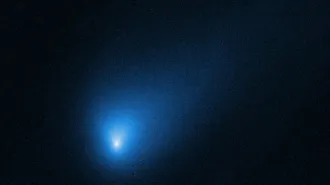
Interstellar comet Borisov has an unexpected amount of carbon monoxide
The second known visitor from outside the solar system has three times as much CO relative to H2O than any comet seen in the inner solar system.
- Planetary Science
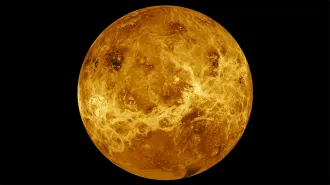
Unlike Earth, the gases in Venus’ atmosphere aren’t uniformly mixed
Measurements of Venus’ atmospheric nitrogen show that a planet’s upper atmosphere doesn’t necessarily match the lower atmosphere.
- Physics
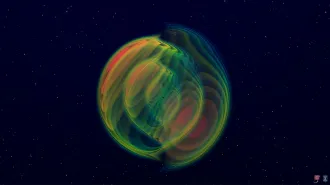
Gravitational waves have revealed the first unevenly sized black hole pair
For the first time, LIGO and Virgo scientists spotted gravitational waves produced when one big black hole merged with a smaller one.
- Space
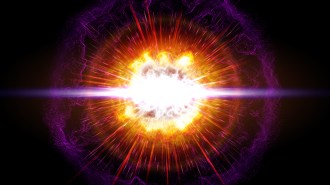
A weird stellar explosion may have caused the brightest supernova yet seen
Astronomers may have spotted the first known example of a rare “pulsational pair-instability” supernova.
- Astronomy
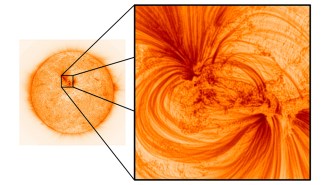
New images of the sun reveal superfine threads of glowing plasma
Snapshots from NASA’s High-Resolution Coronal Imager show thin filaments of plasma not seen before in the sun’s outer atmosphere.
- Physics
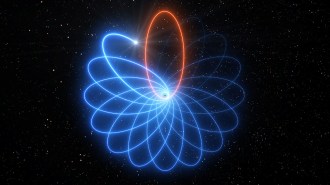
A star orbiting the Milky Way’s giant black hole confirms Einstein was right
An oddity previously seen in Mercury’s orbit has been spotted in a star circling the supermassive black hole at the Milky Way’s center.
- Space
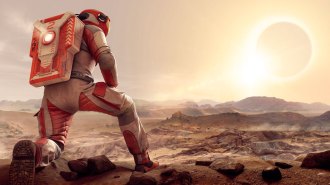
‘Spacefarers’ predicts how space colonization will happen
In Spacefarers, Christopher Wanjek provides an optimistic yet realistic view on how humans might colonize the rest of our solar system.
- Physics
Stephen Wolfram’s hypergraph project aims for a fundamental theory of physics
Simple rules generating complicated networks may be how to build the universe.
- Astronomy
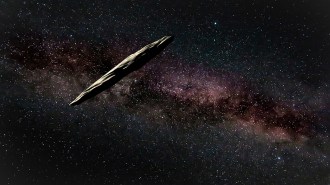
‘Oumuamua might be a shard of a broken planet
A new origin story for the solar system’s first known interstellar visitor suggests it may have been part of a world that got shredded by its star.
- Physics
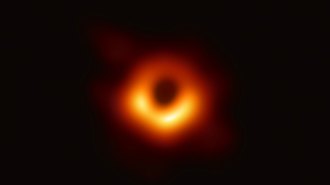
A year after the first black hole image, the EHT has been stymied by the coronavirus
With this year’s observing run canceled due to the coronavirus, the Event Horizon Telescope team is analyzing data from 2017 and 2018.
- Space
New search methods are ramping up the hunt for alien intelligence
Six decades of radio silence hasn’t stopped scientists searching for intelligent life beyond Earth. In fact, new technologies are boosting efforts.