Space
We summarize the week's scientific breakthroughs every Thursday.
- Astronomy
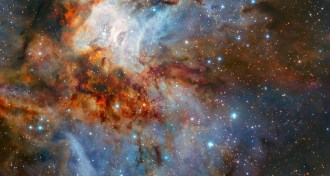
See this star nursery shine in a stunning new infrared image
A newly released image of star cluster RCW 38 shows the intricate details of wisps of gas and dust surrounding newborn stars.
- Astronomy
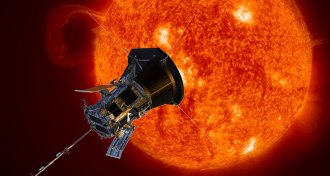
NASA’s Parker probe is about to get up close and personal with the sun
The Parker Solar Probe is about to make a historic voyage to touch the sun.
- Astronomy
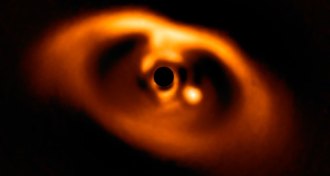
Astronomers snap the first baby pictures of a planet
New telescope images give the clearest view of an exoplanet embryo yet.
- Astronomy
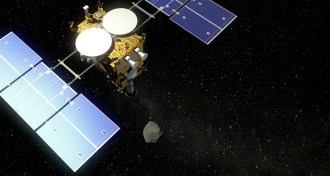
Japan’s Hayabusa2 spacecraft arrives at the asteroid Ryugu
The Hayabusa2 spacecraft says “hello” to near-Earth asteroid Ryugu.
- Planetary Science
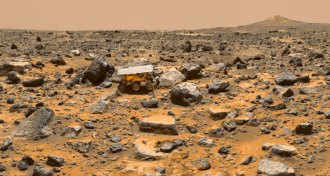
Mars got its crust quickly
The Martian crust had solidified within 20 million years of the solar system’s formation.
- Astronomy
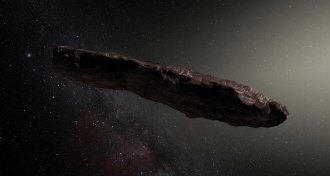
‘Oumuamua may be a comet, not an asteroid
The solar system’s first known interstellar visitor doesn’t appear to be the asteroid that scientists thought it was.
- Physics
Einstein’s general relativity reigns supreme, even on a galactic scale
Scientists have made the most precise test of Einstein’s theory of gravity at great distances.
- Physics
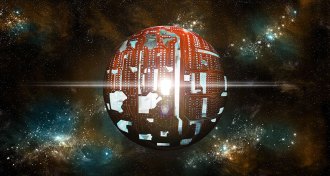
To combat an expanding universe, aliens could hoard stars
An advanced alien civilization might combat the impact of dark energy by harvesting stars.
- Astronomy
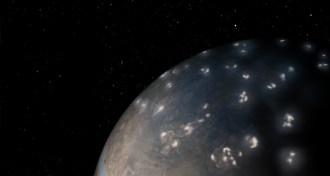
On Jupiter, lightning flashes from storms swirling at the poles
After almost 40 years, scientists have discovered that Jupiter has lightning that is similar to lightning on Earth — it just happens in a different place.
- Planetary Science
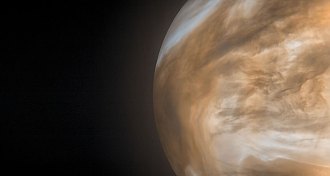
Venus’ thick atmosphere speeds up the planet’s spin
Venus’ thick atmosphere can push on mountains on the surface, changing its rotation period by a few minutes every day.
- Astronomy
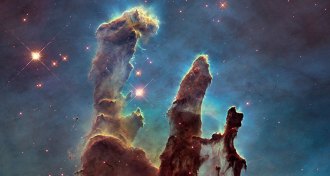
Magnetic fields may be propping up the Pillars of Creation
Scientists made a map of the magnetic field within the Pillars of Creation, a star-forming area depicted in an iconic Hubble Space Telescope image.
- Astronomy
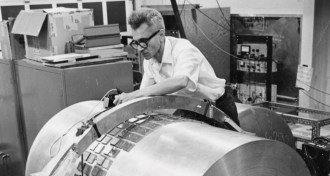
In 1968, scientists thought they were close to detecting gravity waves
Despite an unverified discovery in 1968, spacetime ripples remained elusive for nearly 50 years.