All Stories
- Planetary Science
How Earth’s radiation belt gets its ‘stripes’
The rotation of the Earth may give the planet's inner radiation belt its zebralike stripes.
- Climate
Climate change may spread Lyme disease
The territory of the ticks that transmit Lyme disease is growing as the climate warms.
- Paleontology
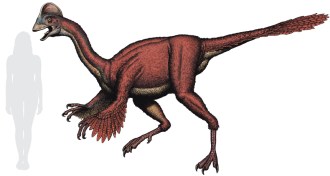
The dinosaur ‘chicken from hell’
Fossils suggest that a supersized chickenlike reptile called Anzu wyliei roamed what are now the Dakotas roughly 67 million years ago.
- Life
Vitamin A deficit in the womb hurts immune development
Mice deprived of vitamin A in utero grow up with undersized immune organs.
- Animals
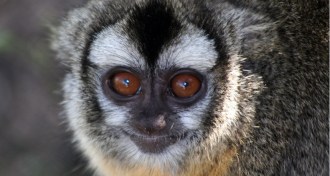
Owl monkeys’ fidelity linked to males’ quality of parenting
The evolution of animals’ sexual fidelity is probably linked to the intensity of male care, the researchers suggest.
- Animals
Like a boomerang, relocated python comes back again
Burmese pythons, which have invaded the Everglades, can find their way home when people move them dozens of kilometers.
- Genetics
Early Polynesians didn’t go to Americas, chicken DNA hints
Contamination of ancient chicken DNA may explain previous report linking Polynesians to South America.
- Math
Our Mathematical Universe
Math is everywhere: medicine, sports, banking, gambling, National Security Agency espionage.
- Science & Society
Stone throwers might toss fingerprints into police hands
An Israeli police lab is studying methods to develop fingerprints on rock to identify stone throwers.
- Genetics
Giant moa thrived before people reached New Zealand
Humans probably caused the extinction of giant wingless birds called moa in New Zealand, DNA evidence suggests.
- Astronomy
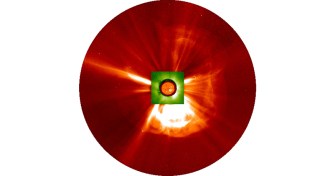
Sun’s ejections collide to create extreme space storm
In July 2012, the sun shot off streams of charged particles and magnetic fields that collided to create a record-setting space storm.
- Animals
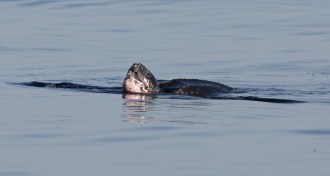
How to count a sea turtle
Trends, not absolute numbers, matter more when it comes to conservation efforts for sea turtles.