A new sort of Alzheimer’s drug shows glimmers of promise
The experimental drug lowered tau levels and showed small improvements in memory loss
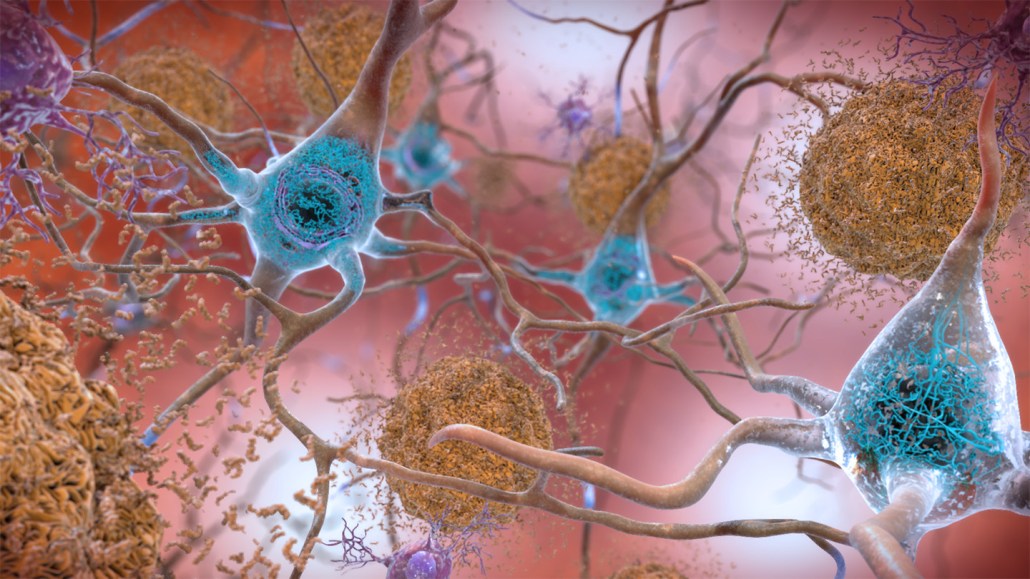
An experimental drug targets tau (seen in blue in this illustration), a protein that forms toxic tangles in Alzheimer’s disease. Other recently approved drugs target the buildup of amyloid plaques (brown).
National Institute on Aging/NIH
This is a human-written story voiced by AI. Got feedback? Take our survey . (See our AI policy here .)
LONDON — An experimental drug can sweep tangles of tau from the brain, raising hopes that the treatment could help Alzheimer’s disease patients, according to clinical trial data released July 14.
The compound, called diranersen and developed by pharma giant Biogen, reduced tau levels in patients’ cerebrospinal fluid by between 50 and 65 percent as compared with the start of the trial. The drug also seemed to slightly slow people people’s cognitive decline compared with those given a placebo.
But it’s unclear whether a change of this size will help patients. And the results raised a puzzling conundrum: Contrary to expectations, the patients who had the biggest reductions in their levels of tau didn’t benefit the most in cognitive testing.
“This story has been almost a decade in the telling,” said neurologist Catherine Mummery, who presented data on the drug to a packed conference room at the Alzheimer’s Association International Conference. Mummery, head of novel therapeutics at the University College London Dementia Research Center, began the first diranersen trial in October 2017.
The results are a “significant step forward,” says molecular neuroscientist Heather Snyder of the Chicago-based Alzheimer’s Association. Over seven million people ages 65 and older in the United States have Alzheimer’s, and treatments to slow its progression, much less cure it, have been hard to come by.
Diranersen is what’s called an antisense oligonucleotide — a synthetic chunk of DNA that silences genes. It binds to the MAPT gene, which produces tau, a protein that’s been implicated in Alzheimer’s disease. In the condition, tau goes haywire, forming into tangles which damage nerve cells.
The Phase II trial, which aimed to determine the drug’s effectiveness and safety, recruited 416 participants with mild cognitive impairment or early-stage Alzheimer’s disease. Researchers believe that intervening before the disease advances will give therapies the best chance of success.
Trial scientists split their cohort into three groups that received the drug: one received a 60-milligram dose of diranersen every 24 weeks, while the other groups received a higher 115 mg dose either every 12 or 24 weeks. The drug was injected directly into patients’ spinal cords. A fourth group received a placebo. The trial lasted 76 weeks in total.
The team assessed patients using a battery of cognitive tests that measured such things as their memory, problem-solving ability and ability to keep track of time and location.
Scientists expected the drug to affect patients’ scores in a dose-responsive way, meaning that those assigned to get the highest dose of diranersen would get the greatest benefit. But the data didn’t show this. Instead, all intervention groups declined at a slower rate than the placebo group.
But there was a twist. While all the participants’ cognitive scores got worse as their Alzheimer’s progressed, the people in the lowest, 60 mg–dose group seemed to show the slowest decline. Their scores dropped 26 percent less than those in the placebo group — who not surprisingly fared the worst — compared with 9 percent for the highest dose. And yet, they also showed less reduction in their tau levels as compared with these high-dose groups.
In theory, diranersen should proportionally reduce the impact of Alzheimer’s disease on the brain by reducing tau levels, but the trial data didn’t support this. This could be due to the small number of people enrolled in the trial, or the drug’s small effect sizes, says Rob Howard, a psychiatrist at University College London who wasn’t involved in the study. Howard says that the size of the change in cognitive scores was “pretty tiny,” and it remained to be seen what it would mean for patients in the real world. “It’s the age-old question, are these clinically meaningful differences?” he adds.
Biogen plans to move the drug into Phase III trials, testing it in a larger group. Howard says that strategy was the right one. “There’s some efficacy signal here,” he says. If that study goes as planned, and the compound gets U.S. Food and Drug Administration approval, it would be the first tau-targeting drug to alter memory in Alzheimer’s disease.
In 2023 and 2024, the FDA approved lecanemab and donanemab, the first new drugs for Alzheimer’s disease in nearly two decades. They target a different protein called amyloid beta, which forms into sticky plaques in the brain. But tau has attracted interest because while amyloid plaques appear first in Alzheimer’s disease, tau changes have a much stronger link to cognitive decline.
The trial data suggested that diranersen improved cognition by roughly the same amount as the amyloid drugs. But diranersen didn’t share these compounds’ damaging side effects, which can cause tiny brain bleeds. Some patients had side effects related to the lumbar punctures used to inject the drug, while others experienced confusion, but this appeared to be temporary, Mummery said.
It’s still unclear whether diranersen could be used alongside, or in sequence with, amyloid-targeting drugs, although Snyder says it’s feasible. Other clinical trials are already testing the combination of tau- and amyloid-targeting drugs in patients with rare, inherited forms of Alzheimer’s, she says. “We are seeing the entire movement of thinking about these different targets and how can we start putting tau together with amyloid.”