All Stories
- Astronomy
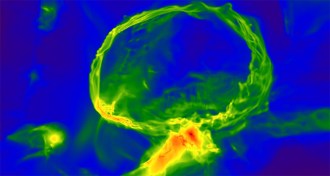
Newfound gas cloud may be graveyard of first stars
A 12-billion-year-old gas cloud, rich in hydrogen and helium but nothing else, may house the remains of the universe’s first stars.
- Physics
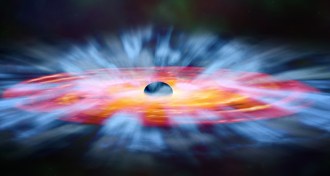
More details on Stephen Hawking’s solution to black hole problem
Stephen Hawking and colleagues have finally provided more information about how black holes might preserve information.
- Physics
At last, some details on Stephen Hawking’s solution to black hole problem
Stephen Hawking and colleagues have finally provided more information about how black holes might preserve information.
- Earth
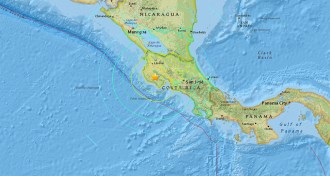
Ground shakes expose faraway earthquake hot spots
A major earthquake in Costa Rica revealed faraway areas where fluids have weakened rock and boosted the risk of a major earthquake, new research suggests.
- Health & Medicine
Young infants have perceptual superpowers
Babies have superpowers that let them see and hear things that adults can’t.
- Animals
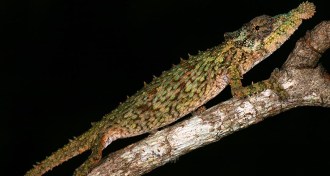
Littlest chameleons pack powerful tongues
A tiny chameleon from South Africa sets an acceleration and power record for amniotes.
- Animals
Small lizard packs powerful tongue
A tiny chameleon from South Africa sets an acceleration and power record for amniotes.
- Archaeology
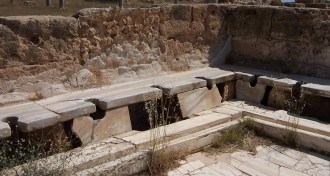
Roman toilets didn’t flush parasites
Roman sanitation measures did little to dent parasite numbers, a study finds.
- Archaeology
Roman toilets didn’t flush parasites
Roman sanitation measures did little to dent parasite numbers, study finds.
- Astronomy
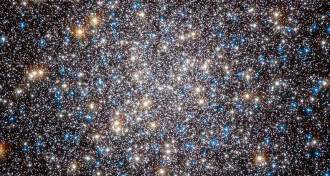
To search for an advanced civilization, take a U-turn to star clusters
Globular star clusters might be safe, stable homes for long-lived advanced civilizations.
- Health & Medicine
New dietary guidelines emphasize big picture
Americans’ new guidelines for healthy eating focus on subtle shifts to dietary habits.
- Genetics
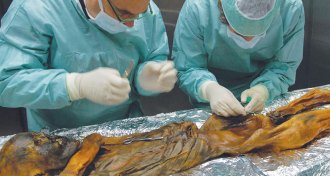
The Iceman tells a new tale: Infection with ulcer-causing bacteria
Ötzi the Iceman was infected with a virulent strain of H. pylori. A new study is the first to piece together an ancient genome of these bacteria.