A textbook assumption about early land vertebrates may be wrong
The shift from water to land didn’t require amphibian-like metamorphosis, fossils reveal
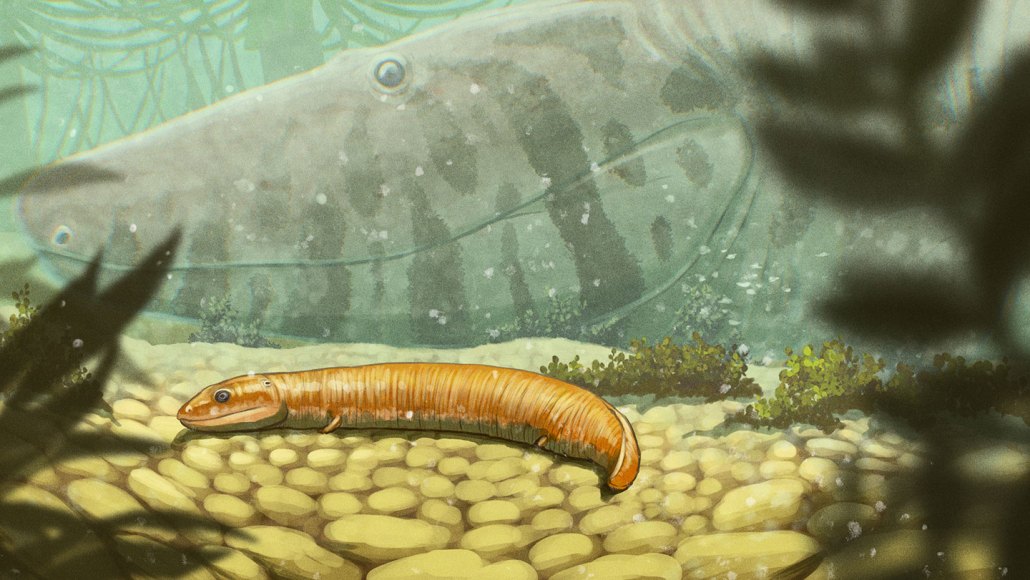
Early vertebrates that made the transition from water to land were born looking like smaller versions of their parents, as this illustration of crocodile-like embolomeres shows.
©Gabriel Ugueto
This is a human-written story voiced by AI. Got feedback? Take our survey . (See our AI policy here .)
New fossil evidence is overturning a long-held assumption about how vertebrates first transitioned from water to land. The hatchlings of three different animals related to the earliest land-goers show that the animals did not go through an amphibian-like metamorphosis, researchers report June 18 in Science. “They came out of the egg looking like the adult,” says paleontologist Jason Pardo of the Field Museum in Chicago.
The transition to land drove the evolution of tetrapods, the group of four-limbed animals that includes all reptiles, amphibians, birds and mammals. Scientists have historically thought that the first vertebrates to venture onto land underwent metamorphosis from a larval form during their development. In amphibians today, this rapid transition from hatchling to adult involves losing features such as external gills and tail fins and gaining others such as expanding lungs and new limbs as the animals move from an aquatic life to a partly terrestrial one.
“We kind of assume that this metamorphosis is ancestral to all terrestrial vertebrates,” says evolutionary biologist Laura Porro of University College London, who was not part of the study. “And this pretty conclusively shows that it’s not.”
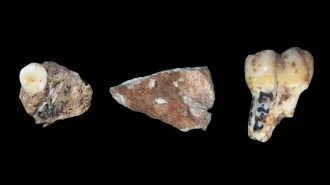
Pardo and Arjan Mann, a paleontologist also at the Field Museum, investigated fossils of newborn early tetrapods, roughly 308 million years old, from Mazon Creek in Illinois. The researchers used scanning electron microscope images to tease out details of the exceptionally preserved fossils, which include soft tissues such as skin and cartilage. The fossils of the babies, which died shortly after hatching, lack the features associated with an amphibian-like larval stage, such as external gills and specific undeveloped bones.
“We’ve got a pattern of none of these animals having anything that looks like a larval stage, let alone metamorphosis,” Pardo says.
The earliest known tetrapod relatives that could crawl on land lived about 375 million years ago, and fossilized tracks provide evidence of even earlier land expeditions. Although the animals in the new study lived millions of years later, they are late-surviving examples of older lineages. That suggests their forebears also grew without a rapid change via metamorphosis.
Fossil evidence
Fossils of hatchings from two early tetrapods and a close relative show no signs of external gills, and they have certain bones already developing. The evidence suggests the animals were not born as larvae that metamorphosed into their adult forms. That contradicts an assumption that the earliest vertebrates that transitioned from water to land had to go through an amphibian-like metamorphosis to make the shift. Click through the slideshow to see fossils of the three animals.
-
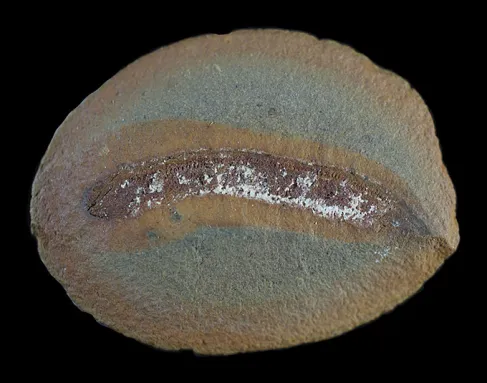
An early tetrapod called an embolomere. Arjan Mann -
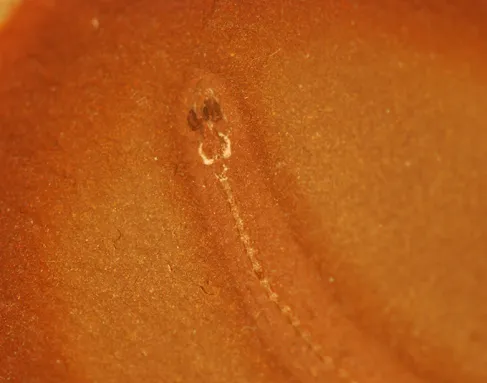
An early tetrapod called an aïstopod. Arjan Mann -
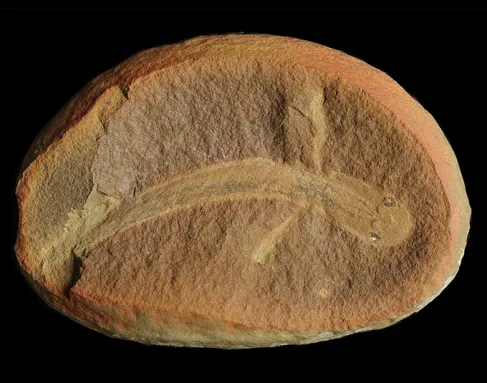
A close tetrapod relative called a megalichthyid. Arjan Mann
One animal, called an embolomere, grew into a large predator that hunted in lagoonlike environments during the Carboniferous Period, about 360 million to 300 million years ago. These animals spent most of their time in the water, but short legs allowed them to crawl onto land. “These are kind of like a cross between a crocodile and an eel,” Pardo says.
The researchers analyzed two embolomere fossils, each only a centimeter or two long. One still had an internal yolk sac, a pocket of nutrients that the newborn survived on before it started eating food.
“The fact they still have a yolk sac suggests that these are very, very young animals,” Porro says.
Skeletal evidence suggests that adult embolomeres probably had lungs for gulping air and possibly had bony structures to support internal gills as well. It is not clear whether the hatchlings breathed air or relied on internal gills to breathe in the water until they grew bigger and required more oxygen.
One of the other animals was a megalichthyid, a fishlike creature that had some of the skeletal features of later tetrapods. And the third was an aïstopod, which looked like a snake but was actually a tetrapod that lost its limbs. Both probably had lungs, while megalichthyids possessed internal gills as well. Scientists have speculated that aïstopods may have been able to breathe through their skin, like amphibians.
Together, these three animals represent early tetrapod development. “I think what makes the case so strong is it’s got those three different groups,” Porro says.
There are still many unanswered questions about how vertebrates set out on land, an extraordinary transition that altered terrestrial ecosystems across the planet. Scientists don’t know how many times animals may have independently made this leap, for example. But with new evidence that they didn’t need metamorphosis to do it, a clearer picture has emerged of the first steps in the sand.
“I think that’s going to be written into future textbooks,” Porro says.