The truth about brain rot, according to science
Emerging research suggests overusing digital devices can be harmful. But can this truly rot our brains?

Illustration by Noah Verrier
This is a human-written story voiced by AI. Got feedback? Take our survey . (See our AI policy here .)
Emma Lembke joined Instagram at age 12. Soon, she found herself “scrolling mindlessly for hours, addicted to gaining a certain number of likes, a certain number of comments.” She often wanted to stop — but couldn’t.
She’s not alone. Most of us these days know the feeling of mindlessly scrolling through low-quality content. We call this sensation “brain rot.” The term can also refer to the content being consumed. Tung Tung Tung Sahur, a personified wooden drum (illustrated above), is one in a slew of silly AI-generated characters deemed “Italian brain rot” because many of them have Italian-sounding names. Trendy among middle schoolers, these absurdist characters show up in memes, videos, Roblox games and more.
Brain rot is kind of a joke, but it also really isn’t. A growing number of young people and their parents claim that spending too much time on social media, the spawning ground for brain rot, can mess with mental health. Thousands of cases accusing social media companies of harming young users with addictive features are now making their way through U.S. courts.
In May, the U.S. government released a Surgeon General’s warning about the harms of screen use for young people, calling out social media as well as gaming, chatbots and more. “Policy makers and tech companies need to acknowledge the potential for harm and create frameworks to protect children to allow for healthy and joyful use,” states the warning, which includes a disclaimer that the document was edited using the AI tool ChatGPT.
But the term “brain rot” evokes something more pernicious. Could browsing through stupid content actually make us stupid? This fear isn’t new. Back in 2009, the former CEO of Google, Eric Schmidt, voiced concerns about how digital media was impacting young people’s intelligence: “I worry that the level of interrupt, the sort of overwhelming rapidity of information … is in fact affecting cognition,” he said in an interview with talk show host Charlie Rose.
Scientific research is now emerging to support claims that overuse of digital devices in general — and social media in particular — can be harmful, especially to mental health. However, the evidence that any sort of technology use harms intelligence is still weak, says media psychologist Susanne Baumgartner at the University of Amsterdam. “It’s so popular to have a statement that it ruins your brain if you use social media,” she says. “But there are very few studies that really scientifically support this notion.”
Still, you should probably think twice about how much time you and others are spending glued to your devices, Baumgartner says.
Brain rot is a lot like candy, says Kris Perry, the executive director of Children and Screens, a New York–based nonprofit that works to make the public aware of how digital media can affect kids. Like candy, a little brain rot now and again won’t hurt you. But the more you partake, Perry says, the bigger a problem it can become.
Distractions in your pocket
Everything we do helps build or strengthen some brain pathways and trim back others. “What you do with your brain affects your brain,” says neuroscientist Torkel Klingberg at the Karolinska Institutet in Stockholm. This is called neuroplasticity.
“If we have constant distractions in the entire population year after year, we will have long-term effects.”
Torkel Klingberg
neuroscientist
A plastic brain allows us to learn and grow from experiences. It also allows those experiences to mold and change us. This is especially true for adolescents, whose brains undergo rapid change. Neurologically speaking, “adolescence” lasts into the early 30s, and our brains continue to adapt and change throughout our lives.
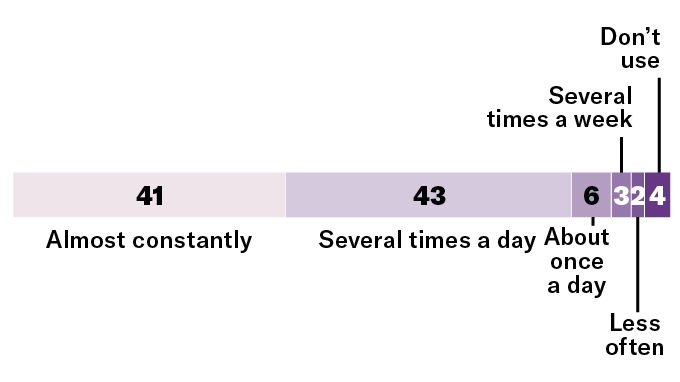
Many of our brain-molding experiences now take place on screens. A Pew Research Center survey conducted in 2025 found that 63 percent of U.S. adults ages 18 to 29 say they are online “almost constantly.”
Of course, kids and adults alike can do creative or practical things on our devices. We can connect with faraway family and friends, make art or play educational games. These things can help develop a healthy brain.
But it’s often far too easy to get distracted and sucked into brain rot.
Addicted to screens
Having a phone or tablet nearby offers up endless temptations. And you don’t even have to be on your device to get distracted. One study found that just having your phone in the same room as you — available but not in use — can make it more difficult to think and process information.
Jason Nagata, a doctor who specializes in teen health and digital media at the University of California, San Francisco, led a study tracking which apps young people opened and used while in school. Spoiler alert: Educational tools were near the bottom of the list. Instead, Nagata says, “the top apps were social media, YouTube videos and video gaming.”
These types of findings don’t surprise Lembke. Now in her early 20s, Lembke used social media for five to six hours per day as a preteen. Back then, she says, “I felt much worse about myself … I felt depressed. I felt more anxious.”
However, Lembke felt trapped in the online world. “My social life was there, so I couldn’t leave,” she says. Now, she understands that her compulsive scrolling and checking wasn’t really her fault. Social media apps and other similar technologies “are built to pull you in,” Lembke says. “They are built to maximize attention at all costs.”
This design can lead to symptoms similar to those seen with addiction to drugs or alcohol, Nagata says. In a 2021 study of almost 500 16- to 19-year-old students in India, more than one in three showed signs of addiction to their phones, including constantly checking for updates on social media or feeling pain in their wrists while using their phones. Addictive or at least habit-forming smartphone use also interferes with sleep, studying and friendships.
Extremely Online: Internet Use Among U.S. Adults
In a national survey conducted in 2025, 41 percent reported being online almost constantly. The number is even higher for young adults: 63 percent for those ages 18 to 29.
In March, a California jury found that Meta, the company behind Instagram, and Google, the company behind YouTube, had harmed a young user’s mental health. That user, now 20, had been on social media compulsively since she was a child. She said this had triggered anxiety and depression, and the jury agreed, awarding $6 million in damages. When Lembke heard the news, she felt like she’d just won the Super Bowl. “I was tearing up,” she says. “It felt like finally there was a legal path for accountability that was being charted.”
Adults are at risk of problem-causing social media or phone use too. But the younger you are, the harder it tends to be to control your screen use, Klingberg says. That’s because choosing to put down or ignore a tempting device requires using the prefrontal cortex, a brain area that, among other things, is involved with “self-management and impulse control,” Perry says. But the prefrontal cortex is one of the last brain regions to fully mature.
The teen brain also responds strongly to rewards. Reward pathways in the brain activate when we do things such as eat chocolate or win money. Research has shown that getting likes on social media triggers these same pathways. This sensitivity normally decreases with age. But when young people checked social media constantly, one study found, their brains remained highly sensitive to rewards.
Despite all these obstacles, Lembke managed to take control and make a change. In ninth grade, she deleted the Instagram app from her phone. “I felt really freed,” she says. In her senior year of high school, she founded the Log Off Movement, which empowers young people to think critically and make mindful decisions about how they engage with online content.
However, Lembke thinks her early compulsive social media use left “deep scars.” She has struggled with an eating disorder that she thinks is largely due to images and interactions she saw and experienced on Instagram as a young girl. She says the app’s content changed “the relationship I had with myself and my body.”
Cause and effect
Concerns about young people’s use of social media and other digital technologies have led researchers to dig deeper.
One important research project is known as the ABCD, short for Adolescent Brain Cognitive Development, study. It has been collecting data from more than 11,500 U.S. teens since 2016. At the beginning, participants were ages 9 or 10. Each year since then, researchers have assessed these young people’s health and screen use. And every other year, the participants have gone through medical tests, including brain scans.
In 2025, Nagata and colleagues reviewed what scientists learned from the ABCD data. They linked higher amounts of screen time to a higher risk of health issues such as depression, attention-deficit/hyperactivity disorder and eating disorders.
It’s one thing to link health problems and screen time, but it’s far tougher to show one causes the other. Following the same young people over the course of several years helps. Researchers can study whether more screen time actually leads to health problems at some later date.
Nagata’s team used a subset of the ABCD data to see what happened to kids and teens with disordered patterns of phone and social media use. One year later, these young people were more likely than their peers to experience depression, attention issues, sleep problems and several other health issues, the team reported in February in the American Journal of Preventive Medicine.
“If you feel bad about the content that you’ve been seeing, then that is maybe a signal [to stop].”
Jason Nagata
doctor specializing in teen health and digital media
Klingberg, the neuroscientist at the Karolinska Institutet, was part of a team that analyzed four years’ worth of ABCD data. Rising social media use led to a greater likelihood of inattention symptoms over that time period, the team found. But the opposite was not true. Inattention symptoms did not lead to more social media use, the researchers reported in January in Pediatrics Open Science.
Klingberg’s group also looked at brain scans collected during the ABCD study. High social media use — around two hours or more per day — slightly stunted development of the cerebellum, the scans showed. Though the effect was very small, Klingberg says, “the trend was towards increasing changes.” If that trend continues over the next few years, he says, the effect would matter. The cerebellum has many roles. It’s important for body control, language and emotions and has been linked to attention, Klingberg says. So the cerebellum changes that his team found could help explain attention issues experienced by teens who increase their social media use.
Importantly, social media use was the only screen activity showing a negative impact on brain development in this study. Video games can actually help make kids smarter, Klingberg’s previous research has shown. But games might still pose some risks, he cautions, like “if you get so hooked that you can’t control the amount of gaming.”
Now, using AI to do work for you could be a new form of brain rot. Last year, researchers put this theory to the test in people ages 18 to 39. The team measured brain activity as groups of study participants wrote essays during several sessions over a four-month period. One group couldn’t use any online tools for help. Another group had access to Google search. The last group used ChatGPT.
Those using ChatGPT lagged behind the others in their level of brain activity and their ability to remember the essays they’d written, the researchers reported last June in a study posted at arXiv.org. That study has not gone through peer review. But one that has from October 2025 supports the arXiv paper’s findings. Researchers compared how much people learn when using either Google search or an AI chatbot to research a topic. They found that those who used Google could explain their topic more deeply and thoroughly.
Tzipi Horowitz-Kraus is a neuroscientist at Technion–Israel Institute of Technology in Haifa who was not involved in either study but has done independent research in this area. When kids get an easy answer from AI, she says, they’re “not developing the basic skills that [they] need in order to perform as an adult in this world.”
Adapt and fight back
If everyone growing up now is gobbling brain rot, any problems it causes with thinking, attention or mental health could become an epidemic, Klingberg says. “If we have constant distractions in the entire population year after year, we will have long-term effects,” he says.
That sounds scary. But don’t expect a brain-rotted zombie apocalypse any time soon.
“Children adapt to new media quickly,” Baumgartner says. Teens who use digital devices a lot while also doing other things will say they can’t focus, her research finds. However, when they are not trying to multitask, they can still focus as well as their peers who report less multitasking. This suggests to her that screens impact kids’ motivation to pay attention, not their ability. So, she concludes, brain rot “does not completely ruin your brain.”
“What you do with your brain affects your brain.”
Klingberg
Still, Baumgartner says, brain rot can be a big problem if it replaces healthier things kids and adults could be doing with their time. When you’re gazing into the glowing rectangle of your phone, you’re not working, studying, playing sports, sleeping or spending quality time face to face with friends and family. So it’s often not the brain rot itself that’s harmful, but the loss of other activities you could have been doing.
Nagata agrees. “If you’re using media in a way that’s making you feel better about yourself so that you’re learning, you’re connecting with people, that’s great,” he says. “If you feel bad about the content that you’ve been seeing, then that is maybe a signal [to stop].”
In the end, though, it’s not fair to put the responsibility for managing screen time entirely on us — and especially not on kids, since their brains haven’t fully developed. Perry and Lembke argue that tech companies shouldn’t be allowed to market products that harm kids’ health. The lawsuits currently moving through U.S. courts will help decide this issue.
Lembke hopes that in the future, people will look back on today’s social media the way we now look back on smoking in public places. Just a couple decades ago, “smoking was the status quo,” she says. “Think about how much we have changed.” She also hopes that the devices and apps we use to connect with each other will no longer spread brain rot. Rather, Lembke says, these tools should “give more power to the individual to shape their experiences.”