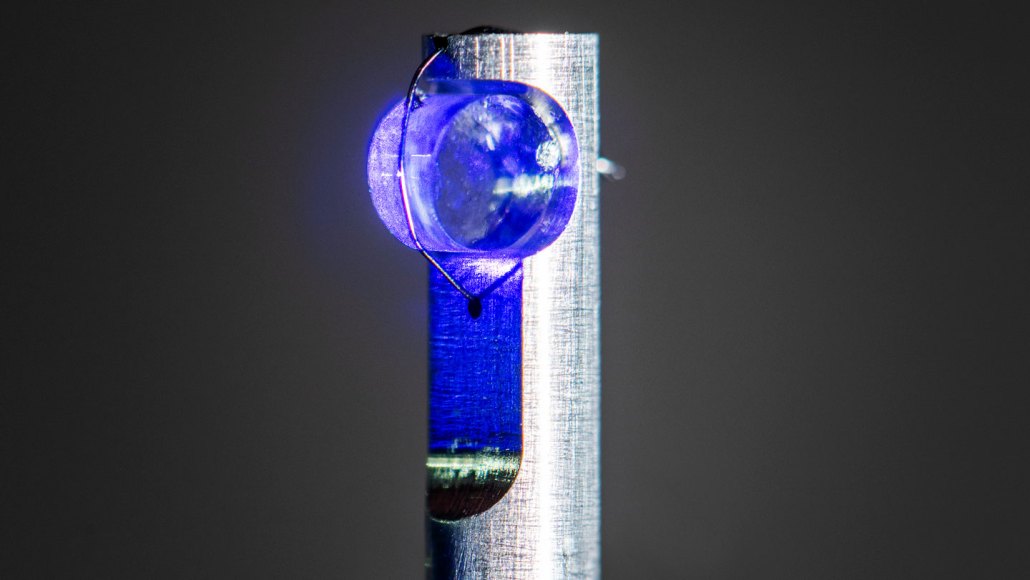
A crystal of calcium fluoride that is infused with thorium atoms (shown) is at the heart of a new nuclear clock.
Luca Toscani De Col/TU Wien
For the first time, scientists used an atomic nucleus as a clock.
The world’s most precise timepieces are made using atoms, specifically their electrons. But clocks based on atomic nuclei — protons and neutrons — might eventually outperform them, while also testing basic laws of physics in new ways. Now, the decades-old dream of a nuclear clock has finally been realized, two independent teams of researchers report.
The technology is still at an early stage, but the physics behind it is so different from that of atomic clocks that it’s already broken new ground, researchers report in a paper submitted June 3 to arXiv.org. “In some types of measurements, we’re already outperforming all of the atomic clocks,” says physicist Thorsten Schumm of TU Wien in Vienna.
Schumm and colleagues used the clock to look for evidence of dark matter, the invisible, massive substance that is thought to pervade the universe. No signs of the shady stuff materialized, but the clock’s estimated sensitivity to certain types of dark matter rivaled or beat that of atomic clocks.
“This is an outstanding result,” says theoretical physicist Victor Flambaum of the University of New South Wales in Sydney, who was not involved with the research. And the feat should spur more progress: “This is only the first step. [The] race for building super-accurate nuclear clocks just started.”
Nuclear clocks’ potential to weigh in on dark matter and other exotic physics scenarios helps explains why, in this branch of physics, “nuclear clocks have become one of the most actively pursued frontiers,” says Shiqian Ding of Tsinghua University in Beijing. In a study submitted June 7 to arXiv.org, Ding and colleagues describe their nuclear clock, which is based on similar technology to that of Schumm and colleagues. (Neither paper has been peer reviewed.)
At their hearts, both clocks consist of crystals of calcium fluoride imbued with thorium, which are probed with a laser. The two clocks showed similar performance. Ding and colleagues used a much more powerful laser, but Schumm and colleagues had more plentiful thorium in their crystal.
And thorium is key: In the entire periodic table, there’s just a single type of atomic nucleus that can be used to make a clock: thorium-229. That’s because the nucleus has to mesh well with the other major player, the laser.
In atomic and nuclear clocks, the wiggling electromagnetic waves of a laser’s light act like the swinging pendulum in a grandfather clock. If that laser light weren’t anchored to something steady, its frequency would drift over time, as if the grandfather clock’s tick-tock slowed down or sped up. But in an atomic or nuclear clock, the laser’s frequency is locked to a jump between energy levels for a particular atom or nucleus. For an atomic clock, the electrons make the jump, and for a nuclear clock, it’s the nucleus. Thorium-229 is special because it’s the only atomic nucleus with an energy jump that’s the right size to be probed by a laser.
To lock a laser to an energy level jump, the laser must be frequently readjusted, using the outcome of measurements to determine how to nudge its frequency. In the new works, the two teams succeeded in implementing this feedback loop, a step that was absent in earlier demonstrations that laid the groundwork for a nuclear clock.
“This was the final missing step before calling it an actual clock,” says physicist Lars von der Wense, who was not involved with the research. The clocks didn’t yet outperform the best atomic clocks in terms of their timekeeping ability. But the technology is expected to advance rapidly, with improvements to lasers and crystals on the horizon, says von der Wense, of Johannes Gutenberg University Mainz in Germany.
Nuclear clocks’ arrival has been hotly anticipated. Compared with atomic clocks, nuclear clocks are less sensitive to stray electromagnetic fields, and can be made out of solid materials, whereas atomic clocks demand that the atoms are suspended in a cumbersome vacuum chamber. That suggests possibilities for making more portable, robust ultraprecise clocks.
What’s more, atomic nuclei are subject to different forces than electrons, opening up new avenues of study. Protons and neutrons are held together by the strong nuclear force, whereas electrons are subject mainly to electromagnetic forces. Numbers called fundamental constants determine the relative strength of those forces, and comparisons of an atomic clock to a nuclear one could be used to search for variations in those numbers over time. Those variations could be due to ultralight dark matter — the subject of Schumm and colleagues’ search.
It’s been a long wait since scientists first dreamt up the idea of a thorium nuclear clock in 2003. But “I have always been optimistic about the success of this project,” says physicist Ekkehard Peik of the National Metrology Institute in Braunschweig, Germany. Peik is one of the scientists who proposed the idea and a coauthor with Schumm on the new paper.
After initially slow progress, researchers have made rapid advances in recent years. Now, Peik says, “I am certain that this momentum will continue and that a great deal of interesting research … is only just beginning.”