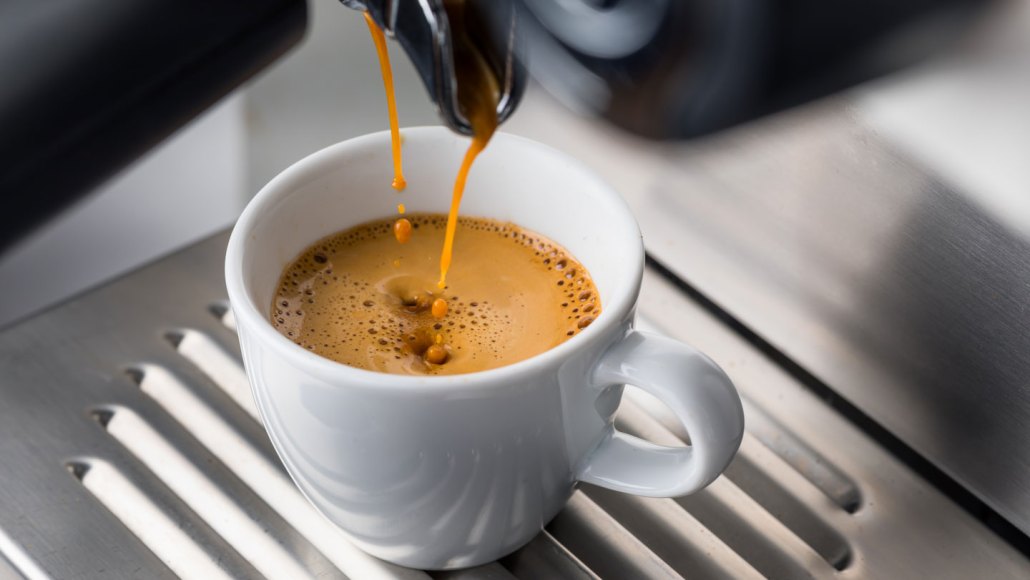
A new equation calculates the permeability of ground coffee to water, to help pull the perfect shot of espresso.
bhofack2/iStock/Getty Images Plus
A memorable shot of espresso is less about roast and more about percolation — and now there is an equation to back that up.
The physics explaining how gases bubble through volcanoes or how water and oils flow through Earth’s crust can also help quantify the perfect percolation of hot water through ground coffee, researchers report in the April 1 Royal Society Open Science.
“I mostly work on volcanic eruptions,” says Fabian Wadsworth, an earth scientist at Ludwig-Maximilians-Universität München in Germany. He first became interested in the physics of making espresso as a pedagogical tool to teach students fundamental concepts of percolation. “Coffee felt like a natural way that students might get engaged with those problems,” he says.
Espresso begins with ground coffee beans, which get tamped — or compressed — into a receptacle to form a compact body called a puck. Hot, pressurized water then extracts flavors, bitterness and caffeine for your morning or afternoon needs.
To craft a quality espresso, you need two things, Wadsworth says. The first is to ensure the ground beans are even by removing clumps and tamping the puck uniformly, “so you don’t have one area of the puck where flow is happening more than another.” An even puck ensures the water diffuses throughout all the particles, capturing as much hidden flavor as possible.
The second factor, Wadsworth says, is “controlling the time it takes for the water to move through the coffee.” The more densely packed the puck, the longer water stays in contact with the particles. Too much contact will result in a bitter brew, while too little won’t extract enough flavor or caffeine.
In the equation, the researchers start with the premise that the grounds are evenly distributed and tamped with equal pressure across the puck. “Once you’ve achieved evenness, you can use our model to calculate the speed of the flow,” Wadsworth says.
To verify the equation, Wadsworth and his colleagues scrutinized two coffee roasts — Tumba from Rwanda and Guayacán from Colombia — ground at 11 settings each, totaling 22 samples. With software that turns multiple X-ray cross sections into 3-D renderings, they charted how fluid moved through the samples.
The results suggest the espresso equation works just as clearly to describe percolation through grounds as other equations describe gas moving through magma or water through sandstone. The results help show how factors such as grain size can significantly impact taste through permeability. “If you were to double the grain size, you increase the permeability by a factor of four,” Wadsworth says.
Harnessing insights from volcanology for coffee research is “genuinely exciting and shows how methods developed in one field can open new perspectives in another,” says coffee science expert Samo Smrke of the Zurich University of Applied Sciences, who was not involved with the work.
The model will make the most sense to expert baristas with machines equipped to measure pressure and flow rates, Wadsworth says. “They might have a different language for talking about it, but I think they would be able to understand what we did and appreciate it.”