The natural history of every U.S. state is on display at a new D.C. exhibit
This is America’s story, naturally
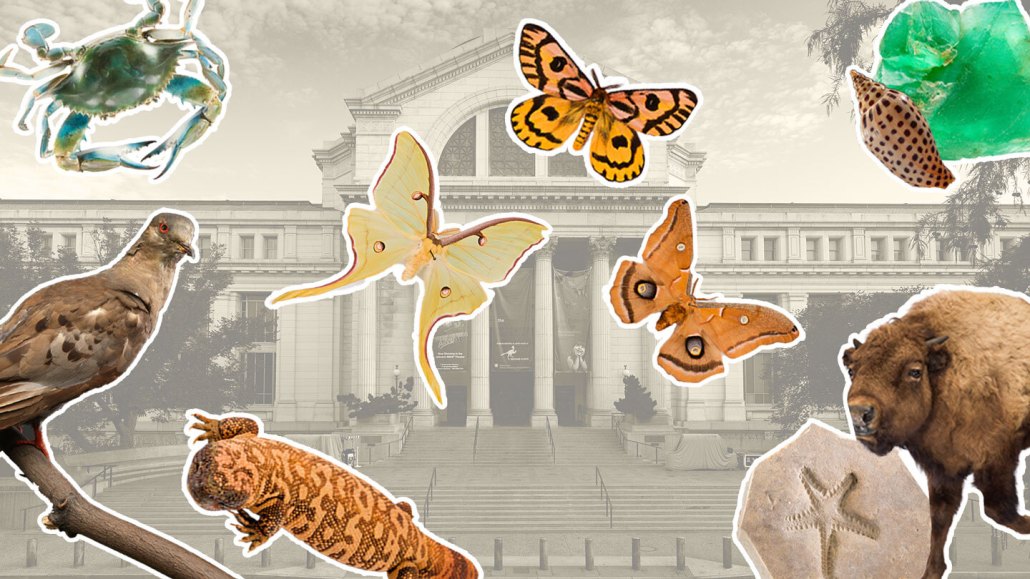
From the last passenger pigeon to a 240-million-year-old graveyard of giant amphibians — a new exhibit at the Smithsonian National Museum of Natural History in Washington, D.C., lets visitors explore the natural diversity and cultural heritage of America. I got an early look at “From These Lands,” which is part of a Smithsonian Institution initiative marking the nation’s 250th birthday. Here’s the video.
Transcript
Aaron Tremper — Assistant Editor at Science News Explores
Imagine looking at the United States not through its borders — but through its land, its creatures, and the stories they hold. That’s the lens the Smithsonian Museum of Natural History is offering with its newest exhibit: From These Lands. We attended the press preview for a first look.
The exhibit explores America’s national story through more than 600 specimens and cultural objects from across the country. And, by the U.S., I mean all of it — all 50 states, the District of Columbia, and even the five U.S. territories.
Kirk Johnson — Sant Director, National Museum of Natural History
“Our real goal is for everyone who comes to this museum to see themselves and their place in this exhibit. Every object has a host of stories, and this exhibit intends to bring all those stories together around individual objects.”
Aaron Tremper
But rather than organizing by state, the exhibit is built around themes — stories that cut across borders and connect us to the land we share. America contains multitudes, and this exhibit leans into that.
Aaron Tremper
What makes the United States diverse isn’t just the people that live here. It’s also seen the wide array of living things, both big and small, that call America home. One colorful example of this diversity is a display featuring insects from different states and Washington, D.C. The preserved specimens offer a snapshot of the estimated 91,000 species found in the United States so far.
Aaron Tremper
Along with celebrating diversity, From These Lands also looks at what happens when that diversity becomes threatened. For one of those stories, the exhibit brings viewers below the waves.
Torben Rick — Curator of North American Archaeology
“Kelp forests are these just incredible, high biodiverse forests in the ocean that flank the entire Pacific coast of the U.S. Urchins, for instance, eat kelp, sea otters eat urchins. In a healthy system they all kind of keep each other in balance. But what happened during the global fur and oil trade, sea otters and other seals and sea lions were pushed to the brink of extinction and we saw in many areas they were they were totally eliminated. They’ve been making a recovery. There’s been a real concerted effort by conservation biologists and restorations around the U.S. to bring sea otters back.”
Aaron Tremper
Martha, the last passenger pigeon — one of the museum’s most iconic objects — and she makes an appearance too. But the curators made a deliberate choice here: they’ve placed this extinct species alongside one that was pulled back from the edge: the Guam rail.
Torben Rick
“What happened in Guam is towards the end of World War II, brown snakes were accidentally introduced. So, you’ve got an invasive species that comes in — several bird species who had never encountered a predator like that went extinct. The Guam rail was pushed to the brink, to the edge, but what happened in the 1980s is Smithsonian scientists from the Conservation Biology Institute, the zoo, started a breeding program and intervened and started that restoration, and what we see now is there’s over 200 Guam rails that have been released into the wild in Guam.”
Aaron Tremper
One display that stops you in your tracks: an array of fossils from New Mexico — a graveyard of gigantic, salamander-like amphibians, some stretching up to nine feet long, from roughly 240 million years ago.
Stewart Edie — Research Geologist, Curator of Fossil Mollusca
“It’s a lot of amphibian all at once, and it makes you wonder how in the world did this happen? The initial interpretation was that this must have been some pond where they had aggregated and it dried out and they all vanished. But when you look more closely, what you see is that it’s not just articulated skeletons. They’re not just there. They’re jumbled. They’re all mixed up. So there was some movement involved. So as the science continued, they looked more closely at the bones and they realized that there’s actually not a lot of what we would call “weathering,” so exposure to sunlight and the elements. They’re pretty fresh. There was likely an event like a flood that moved bodies, and they accumulated and the bones got all jumbled and they were rapidly buried.”
Aaron Tremper
As someone who’s followed the museum’s bird collection for years, this section hit differently. The Smithsonian’s bird collection has been growing for over a century — it’s a record of animals frozen in time, telling us not just how populations have shifted and where species have traveled, but increasingly, through new technologies, what’s written in their very DNA.
But what makes these collections truly remarkable isn’t just the science. It’s who’s behind them.
Stewart Edie
“Teddy Roosevelt was an avid birder, and in his late teens he happened to collect these two specimens and donated them to the museum. It’s not just the museum scientists — these specimens are coming from all parts of our country and helping to grow the national collections and helping us create this cumulative knowledge of biodiversity through time.”
Aaron Tremper
Though it’s easy to get lost checking out the awesome specimens, From These Lands isn’t just about observing. It also encourages viewers to venture off the beaten track and see places beyond their backyard.
Kirk Johnson
“I wanted to trigger people to visit the rest of the nation. Go see a place you’re not familiar with. Go think of a place you’ve only heard the name before and go to that place and experience what it is. ‘Cause every part of this nation is wonderful and really interesting, and there are so many ways to look at a given place, and what we try to do here is catalyze your curiosity about how you might approach a place.”
Aaron Tremper
The exhibit is part of Smithsonian’s Our Shared Future: 250, a museum-wide initiative marking the nation’s 250th birthday.