Talking dogs and chatty cats could one day ‘speak’ in our language
Recent AI and other tech advances may soon enable chats with animals
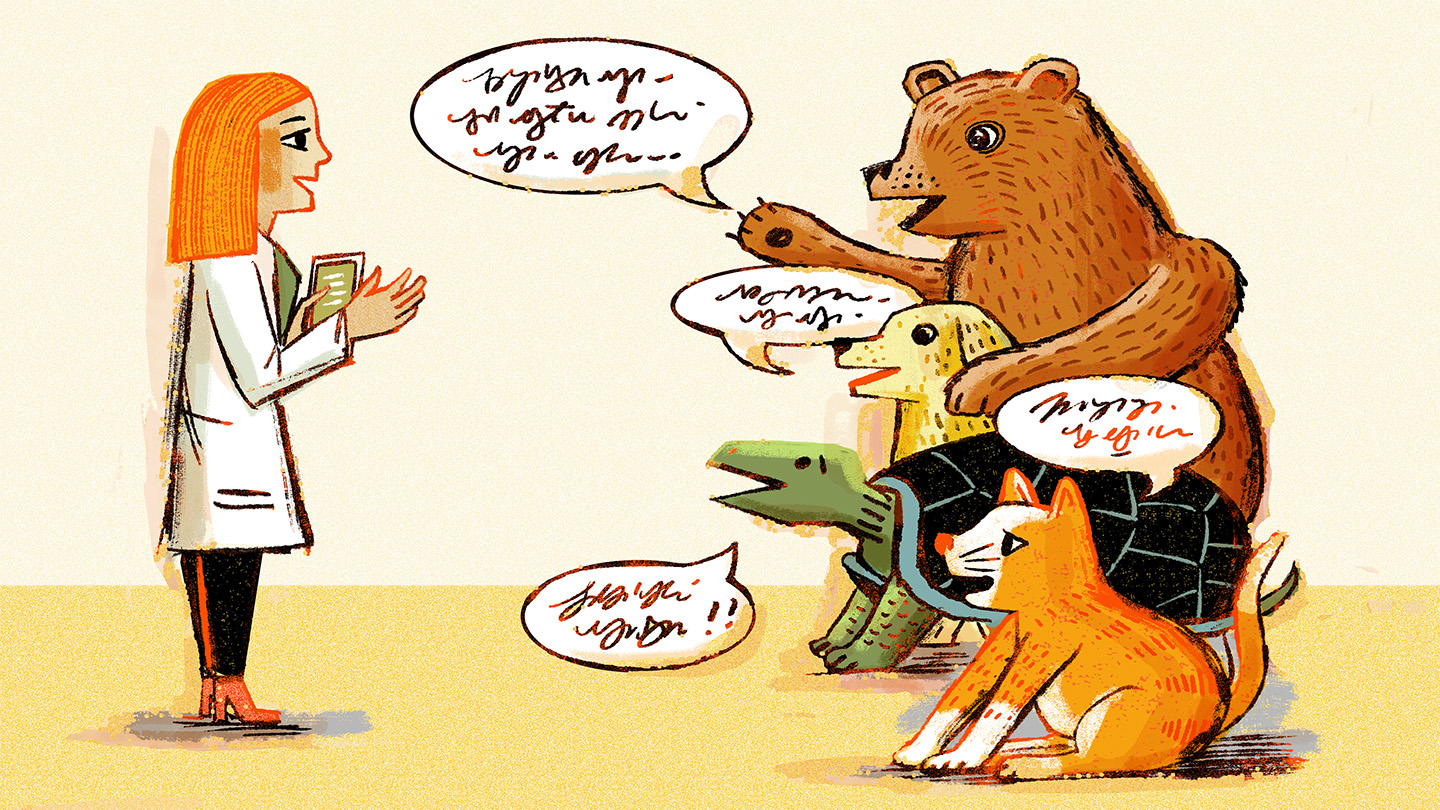
Imagine talking to — and understanding — other animals. Advances in decoding animal sounds might someday make that a possibility.
ROBERT NEUBECKER
This is a human-written story voiced by AI. Got feedback? Take our survey . (See our AI policy here .)
In the animated movie Up, a boisterous dog wears an electronic collar that translates his doggy thoughts into English words. “My master made me this collar,” he tells his new acquaintances. “He is a good and smart master and he made me this collar so that I may talk — SQUIRREL!”
In fiction, it’s a familiar piece of technology, a tool that can decode animals’ squeaks, meows, clicks and such into understandable human language. The sci-fi trope works in both directions. In the cartoon Rick and Morty, for instance, a translator lets Morty, a human boy, eavesdrop on squirrels that are running a worldwide cabal of crime. Their fast, cute little voices talk about coup d’états, overthrowing the world order and chemtrails.
Back here in the nonfiction world, anyone with a pet has probably wondered at one point or another what’s going on in that inscrutable little head. Scientists can’t say. But there are some reasons to think that devices that decode animal sounds into language that humans can understand won’t be works of science fiction forever.
Advances in computing power, artificial intelligence and ways to measure sounds promise to speed this translating process, turning animal chatter into bits of information that could be decoded by humans.
Of course, some animals can already talk to us — in our preferred languages, too. Neuroscientist Erich Jarvis tells a story of a parrot that left its California home. It returned years later speaking Spanish, says Jarvis, of the Rockefeller University in New York City.
Those sorts of language skills are rare. The mental skills and physiological flexibility needed to think up a message and make intricate vocal sounds to convey it are traits present in fewer than 1 percent of vertebrate species, says New York University neuroscientist Michael Long. And with rare exception, none really speak our language. But that gap is not insurmountable.
“Animals are speaking — to use speaking in a very loose way — more vibrantly than we had ever given them credit for,” Long says.
Dolphins and whales, like parrots, may make good conversation partners with people. In 2023, scientists were able to use a decoded whale “hello” to enjoy a short chat with an Alaskan humpback. It wasn’t exactly scintillating; the exchange consisted of a volley of whale whups, translated as “hello” in English. Still, it was an interspecies chat. Another group of researchers has since discovered that whale language shares statistical properties with those spoken by humans. With these sorts of advances, perhaps we’ll soon be swapping krill recipes.
Some of Jarvis’ research includes mice genetically engineered to produce more complex sounds. He and colleagues are scrutinizing key genes that are active in good vocal learners. Mice with a human version of a protein called NOVA1, for instance, made more complex vocalizations. To be clear, this isn’t a talking mouse situation yet. But research is moving fast.
Long notes that communicating with animals doesn’t require a fancy sci-fi gadget. “Animals are broadly expressive,” he says. The sad yowls of a cat sitting by her empty food dish are no great mystery. Some messages don’t even require a vocal tract. Mongolian gerbils, for instance, thump the ground percussively. Dances, posture and color can all carry messages.
So while we wait for a gizmo that translates our pets’ thoughts into words, consider the wildly variable ways animals communicate. Long’s cats, for instance, have plenty to say, making their needs and wants “very, very transparent.” Should a cat-human translator ever exist, though, Long’s message to one of his cats would be short, sweet and practical: “I would tell him not to sit too close to the stove when I’m cooking. I think that’s it.”