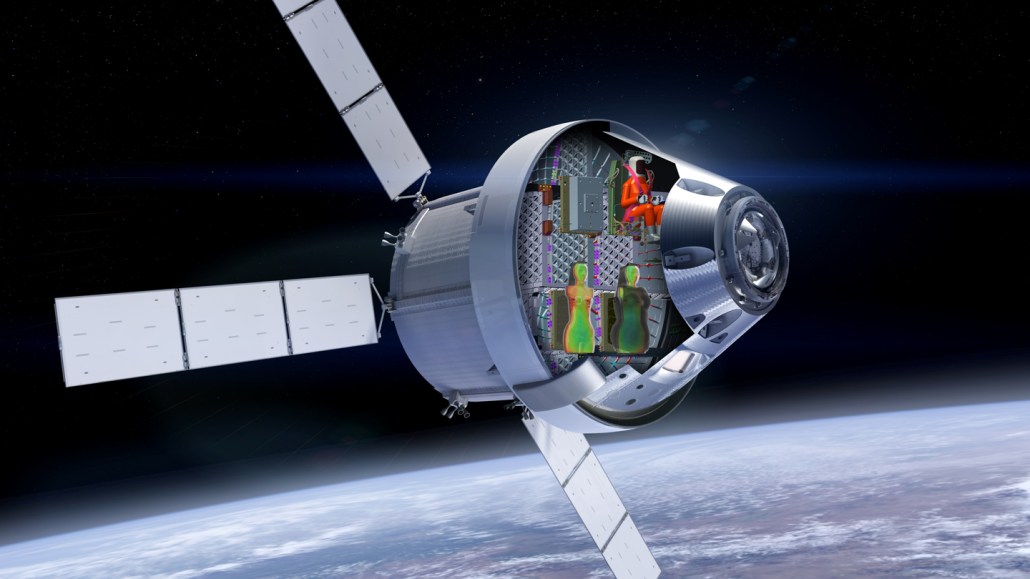
During the Artemis I mission in 2022, researchers tested the AstroRad vest as radiation protection on model human torsos inside the Orion spacecraft. The colors in this 3-D rendering illustrate that the one on the left, which was not wearing the vest, got a larger dose of radiation.
NASA, Lockheed Martin, DLR, StemRad
A plastic vest could help protect astronauts from solar radiation storms.
Researchers tested the vests aboard Artemis I, an uncrewed flight around the moon in 2022. Although Artemis I didn’t experience any solar storms during its 25-day mission, the vest could significantly reduce the amount of radiation an astronaut would receive during such an event, researchers report August 12 in Science Advances.
In a type of storm called a solar particle event, the sun blasts high-energy protons into space. Earth’s magnetic field shields the planet’s surface from that radiation, but exposure during space travel increases the risk of several types of cancer.
Scientists sent two models of female torsos into space aboard Artemis I and measured how much radiation they received while passing through the inner Van Allen belt, a zone of high-energy charged particles trapped by Earth’s magnetic field.
One, nicknamed Zohar, wore an AstroRad vest, a garment made from high-density polyethylene weighing 26 kilograms (57 pounds). The vest is designed to protect sensitive organs, including bone marrow, lungs, the gastrointestinal tract, breasts and ovaries. The other, dubbed Helga, wore no protection. Both had radiation sensors embedded at several points.
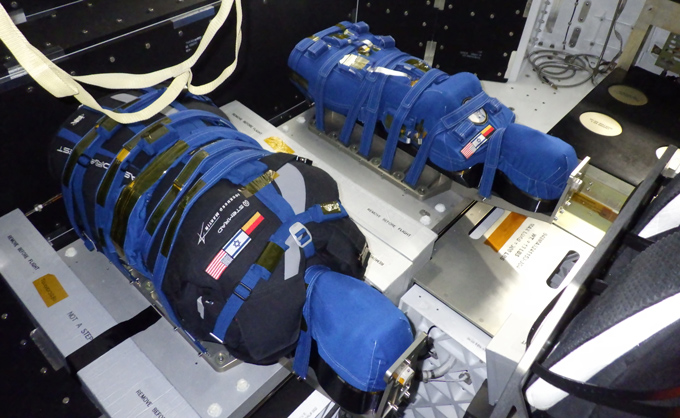
“The amount of dose reduction that we saw was surprising,” says Jordan Houri, lead scientist for space exploration at StemRad, a Tampa, Fla.–based company that developed the vest with Lockheed Martin. Using data from the Van Allen belt, Houri and colleagues calculated how the vest would have performed during solar particle events that occurred in August 1972 and October 1989.
AstroRad would have reduced an astronaut’s radiation exposure by about 60 percent during the 1972 event, from 222 millisieverts to 87.5 millisieverts, the team found. It would have reduced the dose by about 40 percent during the higher-energy 1989 event. People on Earth’s surface typically absorb around 3 millisieverts of radiation from natural sources each year.
Wearing the vest during a strong solar particle event could spare an astronaut the equivalent of at least several weeks of exposure to background radiation in space. That could allow them to complete longer-duration missions without exceeding NASA’s career radiation dose limits of 600 millisieverts.
AstroRad vests can be tailor-made for each astronaut, but the team is now working on a modular design to allow astronauts to modify a single baseline vest for different body shapes and sizes. That would reduce the amount of mass launched and allow one astronaut to perform work during a solar storm while the others remain inside an onboard storm shelter, Houri says.