Benign but not harmless: Uterine fibroids
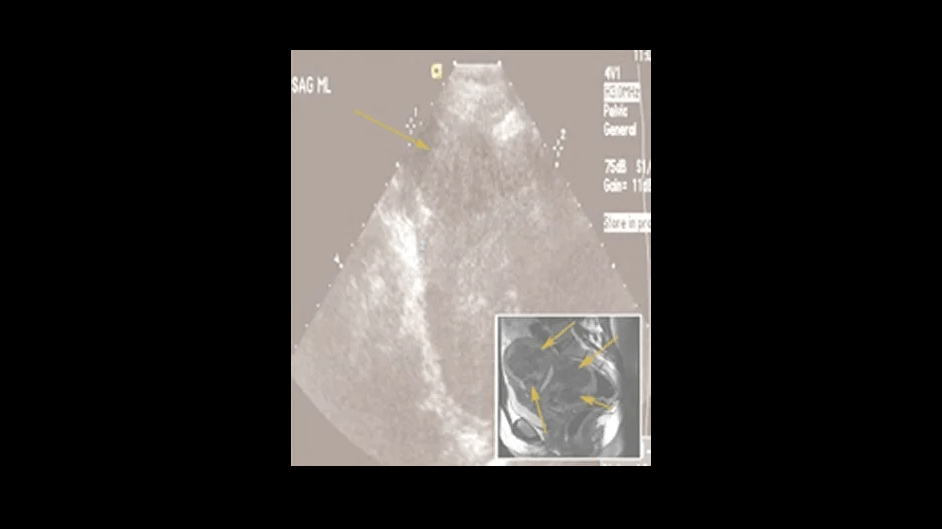
Ultrasound showing uterine fibroids (dark areas marked with arrows), with a magnetic resonance image providing additional information (inset).
Stewart/Brigham and Women's Hospital
For biomedical engineer Erika Moore, her research is personal. Having lived with uterine fibroids — noncancerous tumors that grow in the uterus — she knows that while these poorly understood growths are classified as benign, they’re far from harmless. SN’s Tina Hesman Saey reports on how Moore is investigating the mechanism that makes them grow.
🧫 Modeling mechanisms in hydrogel
Uterine fibroids can cause anemia, pain, heavy or irregular menstrual bleeding and reproductive challenges. In the U.S., an estimated 70 percent of white women and 80 percent of Black women will develop them by age 50. And treatment options are paltry, with professionals able to recommend either monitoring or surgery.
We don’t fully understand why or how fibroids grow. Nor are there great in vitro or animal models to aid in research, in particular because they don’t replicate the uterus’s complex 3-D tissue mechanics.
Moore and her team use gelatinous materials called hydrogels to simulate the uterine environment, where they examine how fibroid cells behave, a strategy they published in September in the journal ACS Biomaterials Science & Engineering. Growing these cells in the hydrogel can reveal how they migrate, interact with other cells and change depending on their environment. The team can also explore how certain drugs affect the fibroid cells. Their hope is that they will one day understand how to stop them from forming entirely.
🧪 Historically neglected medicine
Medicine has undervalued and ignored women’s health concerns for centuries. As more researchers and investors realize this area’s critical importance, startups are looking to fill the massive gaps in women’s reproductive medicine. And while all women suffer this discrimination, women of color do so in disproportionate amounts.
In addition to uterine fibroids, conditions like endometriosis, polycystic ovary syndrome and menstrual disorders are still not entirely understood. In 2024, the so-called femtech industry was worth nearly $60 billion.
👩🏿🔬 It’s about time
From diagnostic tools to potential treatments, biotech companies are eager to bolster medical knowledge surrounding women’s reproductive health.
- Womed: Stemming from research at a biopolymer lab at France’s University of Montpelier, this company was founded in 2006 to find solutions for intrauterine growths. For uterine fibroids, they’re developing technology to reduce abnormal bleeding associated with the condition. In December 2023, they raised over $6.9 million.
- Afynia Laboratories: Founded in 2021, this Hamilton, Canada-based company developed a screening blood test for endometriosis. Endometriosis can be difficult to diagnose without surgery. Instead, the test compares blood levels of bits of genetic material key to endometriosis with those from surgically confirmed endometriosis cases. This seed-stage company most recently raised $5 million this past February, bringing their total to $6.6 million over four funding rounds.
- Evestra: This biopharma company targets women’s healthcare, including uterine fibroids and endometriosis. Founded in 2007 and based in San Antonio, Texas, this company is developing treatments in the form of a pill and vaginal ring. In 2009, it raised $1.8 million, and in 2020 received a $15.9 million grant from the Bill & Melinda Gates Foundation to develop contraceptives for people in underserved regions.
Better late than never.
Disclaimer: The Science News Investors Lab newsletter is for informational purposes only and does not constitute investment advice. Society for Science and Science News Media Group assumes no liability for any financial decisions or losses resulting from the use of the content in this newsletter. Society for Science and Science News Media Group do not receive payments from, and do not have any ownership or investment interest in, the companies mentioned in this newsletter. Please consult a qualified financial advisor before making any investment decisions.