Can ancient games teach us new tricks?
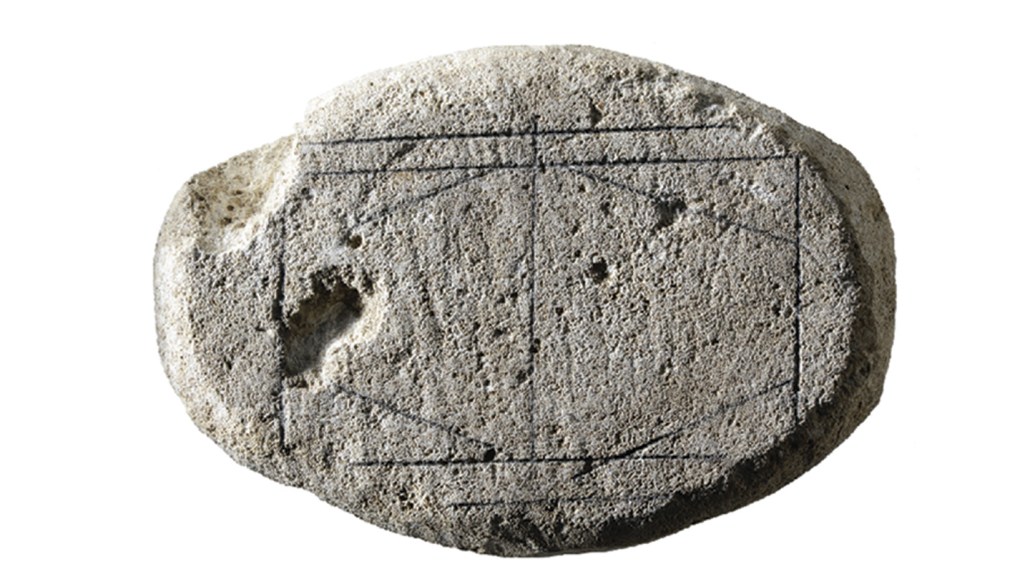
A game “board” is inscribed on a flat piece of limestone found amid the ruins of Coriovallum, a Roman-era town in what’s now the Netherlands.
Courtesy of Restaura
By Susanna Camp
Excavations of a Roman-era settlement unearthed a limestone board game that may have provided hours of entertainment for plebeians and centurions alike. But wouldn’t you know, the instruction booklet was not included. Undeterred, the researchers used the latest AI tools to reconstruct the rules. Catch the opening move here from Tom Metcalfe for SN.
⚙️ Reverse-engineering play
What do you get when you cross archaeology with gaming research? A new science called Archæoludology, the forensic study of “ludemes” — the basic building blocks of games, such as “move to a space” or “capture a piece”. Using a digital tool called Ludii, the research team simulated more than 100 rule variations to determine which combinations resulted in a playable experience, while replicating the pattern of wear on the stone. This research demonstrates how AI can bridge gaps in the archaeological record, allowing historians to revive lost cultural artifacts by testing their viability in a virtual environment.
🃏 Why ancient play matters
Why should we care about a game played with stone markers on a limestone slab? In addition to learning new historical perspectives on the development of human culture and mathematical knowledge, discovering lost games provides fresh data sets for AI to solve, which helps refine algorithms for navigation, logistics and strategic planning. Adjacent areas of innovation include dynamic models of historical sites known as digital twins, plus product development in the $250 billion video game industry.
👾 Gamifying the future
While the Romans provided the boards, these companies are providing the brains to analyze them:
- Ludii (Digital Ludeme Project): This is the flagship research project (often partnered with academic and private labs) mentioned in the article. They have created a universal “game engine” that can model almost any board game in existence to study human mathematical and strategic evolution. Ludii is primarily funded by the European Research Council (ERC) with a grant of approximately $2 million, serving as a foundational data provider for private AI labs.
- DeepMind (Google): A titan of the tech industry, DeepMind’s origin is rooted in games (AlphaGo, AlphaZero). The company uses game-based environments as the primary training ground for their most advanced neural networks. Google parent company Alphabet’s investment in DeepMind is in the billions, validating the concept of understanding “play” as a critical component of mastering thorny problems in mathematics, materials science and more.
- Kallikor uses game logic and simulations to model complex real-world systems like next-generation warehouses. Kallikor is part of the London-based venture studio Improbable, which creates, validates and scales new startups and has raised over $900 million from investors like SoftBank and Andreessen Horowitz.
Want to try your hand at some ancient games? Check out the Ludii games portal.
Disclaimer: The Science News Investors Lab newsletter is for informational purposes only and does not constitute investment advice. Society for Science and Science News Media Group assumes no liability for any financial decisions or losses resulting from the use of the content in this newsletter. Society for Science and Science News Media Group do not receive payments from, and do not have any ownership or investment interest in, the companies mentioned in this newsletter. Please consult a qualified financial advisor before making any investment decisions.