Robo-optics, Organ Clocks, Blood Tech + Reforesting
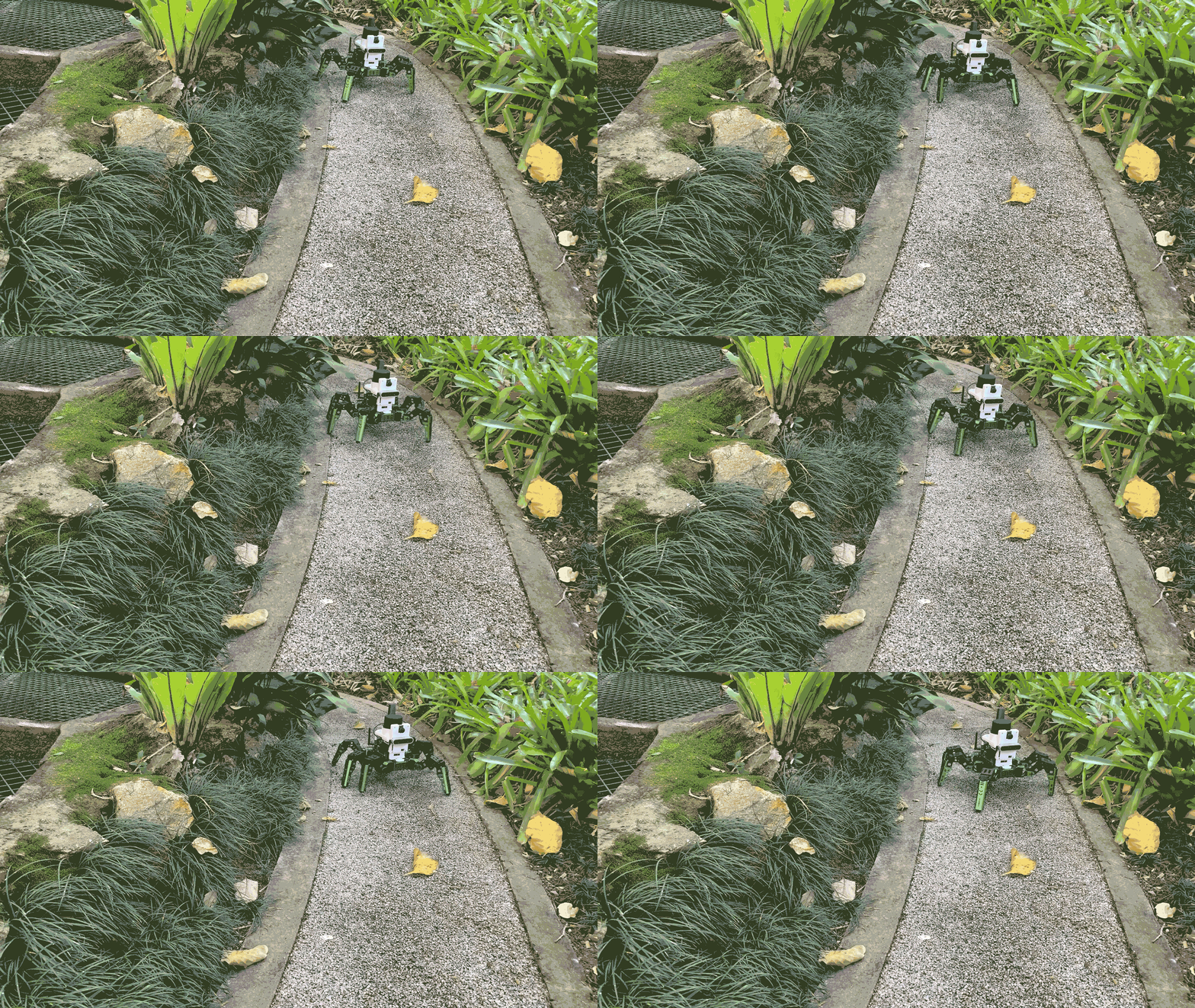
As this robot scuttles down a path, it uses a sensor, chip and tiny AI model inspired by biological eyes and brains to determine its location. The system uses a tenth of the energy of a conventional camera-based system and could work on any robot.
Adam Hines
By Susanna Camp and Elana Spivack
👁 Low Energy, High Efficiency Remote Sensors
A new seeing robot has entered the chat, and the energy needed to power its vision is only a fraction of what conventional location systems demand. Kathryn Hulick reports for Science News on an eyelike sensor incorporated with a chip and tiny AI model that can change the remote visual sensing arena.
🤖 Low-Power Superpower
Robots that gather visual information from their surroundings need an eye of some sort. While in some cases a camera and an AI that determines location may serve as that apparatus, that’s not always the most efficient visualizing instrument because a camera is always capturing information even if the environment remains static, needlessly using a huge amount of energy. To save energy, researchers have developed a system called LENS, comprising a sensor, chip and tiny AI model.
LENS uses an existing, commercially available product known as Speck, which is the sensor-chip duo, created by the company SynSense. Akin to a human eye, Speck operates more efficiently than a camera. It pays attention to how the environment changes through a process known as neuromorphic computing, which more closely resembles how our eyes and brain take cues. The pixels in its sensor only respond to changes in brightness, feeding this information into a computer processor that acts like neurons relaying signals in the brain. This relatively simple setup uses only 10 percent of the battery power standard positioning systems need, but can accurately recognize places through analysis of its environment’s contours.
🔋An Eye for Business
Systems like this can come in handy for robots of all sorts. Whether they venture into outer space or deep undersea, these machines can render images and locations accurately and efficiently. LENS could also be useful for drones used to capture locale-specific footage, and for microrobots that medical professionals are developing to probe the digestive tract.
💡AI-fficient
These companies are already leveraging tech to make neuromorphic, energy-efficient innovations.
- SynSense: This Zurich, Switzerland-based company provides LENS with Speck, the sensor-chip combo acting like a human eye. Founded in 2017, this tech company specializes in ultra-low power processors that take inspiration from the natural world. It’s raised over $51 million across 10 funding rounds, most recently this past January. Among its investors are Pufeng Venture Capital and Baidu Ventures.
- Innatera: Based in the Netherlands, this Series A tech company produces ultra-low power processors and sensors. Its product provides real-time analysis using neuromorphic systems that can recognize audio patterns, detect when visitors come and go, and track activity. It raised a total of $27.3 million over 4 funding rounds, including $5 million in June 2024.
- Grayscale AI: Based in San Francisco, this AI company founded in 2020 produces technology based on neuromorphic systems. Using 1,000 times less energy than a traditional processor but 100 times faster, their technology also combines sensors with AI to create a brain-like solution for self-driving vehicles and the transport logistics industry. It’s raised over $384,000 over four funding rounds.
- Blumind: Founded in 2020, this Ottawa, Ontario, Canada-based machine learning company develops analog neural signal processors, which the company says require less power than digital alternatives. Running on 12 watts, which is comparable to a LED lightbulb, this analog processor can integrate into smart homes, wearables and security systems. Blumind raised nearly $15 million this past April with 5 investors.
Keep an eye out for more energy-efficient, neuromorphic AI models!
🕰️ Age clocks get better with age
Do you know your “biological age”? Numerous wellness clinics and companies offer biological age testing for those looking to predict their future health, but at least one team of researchers aims to recalibrate the standard. Celina Zhao reports for SN on human protein organ clocks.
⏳Beyond Chronology: The Body’s True Timelines
Typical biological age tests evaluate biomarkers in blood or saliva to measure indicators like blood sugar levels, cholesterol, hormone levels, and even so-called epigenetic changes like DNA methylation patterns. The goal is to determine the rate at which your body is aging internally, based on the health of your cells and tissues. New work by Stanford neurology researchers Hamilton Oh and Tony Wyss-Coray takes a different tack. The team studied human blood plasma proteins from a long-term health tracking database to estimate the biological age of 11 organs, including the heart, lungs, kidneys and brain. An “older” heart age, for instance, could signal an increased risk of heart disease, while an “older” brain showed a higher likelihood of developing Alzheimer’s.
👩💻Decoding Longevity
Organ age research is paving the way for biotech companies to develop diagnostics, personalized interventions and even therapies aimed at slowing or reversing organ aging, with the goal of extending healthy human lifespan.
Researchers Oh and Wyss-Coray have founded a new biotech company, Teal Omics, to develop an AI-enabled platform to predict organ age. Based in Cambridge, Massachusetts, the company is privately funded with several key investors including IKJ Capital and FORM Life Ventures. They have not publicly disclosed any financial data to date.
📋The best of the rest: Key Players in Biological Age Diagnostics
For a more traditional approach, the following companies offer services based on biological age clocks.
- BioAge Labs (BIOA-NASDAQ), based in Emeryville, California, discovers and develops novel therapies for conditions driven by metabolic aging through its internal programs and partnerships with Novartis and Eli Lilly. The company raised $321 million in private financing, including from Andreessen Horowitz and Khosla Ventures, before their IPO in 2024.
- TruDiagnostic, based in Lexington, Kentucky, offersadvanced epigenetic testing to analyze over 150 biomarkers for personalized nutrition and health insights. The company has not disclosed financial investment data but notably announced earlier this year it will give a $400,000 grant to fund research projects in DNA methylation, longevity science and diagnostics at universities or other biotechs.
- Tally Health, based in New York City, provides an at-home biological age test and personalized recommendations for lifestyle interventions to improve cellular health and potentially slow aging. The company raised$10 million in seed funding in 2023.
With “organ clocks” now ticking, the future of health investment is all about precision.
🌲Climate-Resilient Reforestation
Trees, much like people, are on the move — desperate to find a safe haven in a rapidly changing climate. They “move” by dispersing their seeds, which then establish new populations farther north or at higher elevations. But global warming is proving to be a much faster sprinter than these botanical marathoners, and time is running out. Sophie Hartley explores the critical implications for biodiversity and carbon sequestration for SN.
🏃🏽♂️The Great Green Migration: A Race Against Time
Many tree species simply cannot migrate quickly enough to keep pace with rising temperatures and altered precipitation patterns. This mismatch is exacerbating an already dire situation: global deforestation continues at an alarming rate, with the Food and Agriculture Organization of the United Nations estimating the damage at 10 million hectares of forest lost annually. To put that number in perspective, that’s roughly the size of Portugal disappearing every year. Iconic examples include the ongoing destruction of the Amazon rainforest and the increasing intensity of wildfires, such as those seen in California and Australia, which decimate vast tracts of established forest.
🌱Cultivating Tomorrow’s Canopy: Funding the Future Forest
Given that natural tree migration is too slow, human intervention is becoming increasingly vital. The practice of strategically growing resilient species is often referred to as “assisted migration” or “climate-adapted reforestation.” Reforestation efforts are funded by a diverse array of sources, including national governments, international non-governmental organizations (NGOs), philanthropic foundations, and a growing segment of corporate environmental, social, and governance (ESG) initiatives. Carbon offset markets also play a role, providing financial incentives for large-scale tree planting projects. In other words, there’s room to grow for investment in commercialization.
🌳Branching Out: Startups Leading the Reforestation Charge
Here are a few startups whose mission is to plant trees more efficiently and intelligently, at scale.
- Earthshot Labs, based in Mill Valley, California, combines AI, satellite imagery, and ecological modeling to identify optimal sites for reforestation and restoration, predict success, and monitor project impact. The company received funding in May 2025 from Google for Startups, bringing their total capital raised to date to $21 million. Advisors include noted environmental activist and entrepreneur Paul Hawken of climate solutions–focused Project Drawdown, iconic Silicon Valley investor Steve Jurvetson of Future Ventures, and a slew of quantitative ecologists.
- Flash Forest, based in Toronto, Canada, uses drone technology and machine learning to rapidly plant trees (nearly 3 million to date, at a daily rate of thousands of proprietary seed pods designed to help fragile young trees thrive). They aim to accelerate reforestation efforts in areas affected by deforestation and wildfires. Founded in 2022, the company has raisedover $8 million in seed funding to date.
- Land Life Company, based in Amsterdam, the Netherlands, specializes in large-scale ecosystem restoration, employing technology like their “Cocoon” planting system that plants specially coated, super-resilient seeds using an unmanned land vehicle to automate the planting and growing of plants in degraded and arid lands.
Climate-resilient reforestation is cultivating a greener, more stable future.
🧠Keeping Tabs on Brain Health Through Blood
When it comes to neurodegenerative diseases like Alzheimer’s, Parkinson’s, and ALS, early diagnosis and intervention can make all the difference in patients’ and caregivers’ quality of life. SN’s Tina Hesman Saey recently covered new research on unique biosignatures and proteins in blood that could change the diagnostics game.
🧬Biochemical Fingerprints
Proteins power our bodies all the way down to the cellular level. But when proteins go awry, like when they fold abnormally, the outcome could be neurodegenerative diseases. Several recent papers, drawing on samples from over 18,000 people, reveal how detecting proteins associated with these diseases may improve diagnosis.
One study published in the journal Nature Medicine discovered that these misfolded proteins generate unique and shared biochemical fingerprints across these diseases, which could make it easier to diagnose them and detect subtypes.
Another study also published in Nature Medicine demonstrates that people carrying a form of the APOE gene called APOE4, which is the biggest genetic risk factor for developing Alzheimer’s, have the same blood signature whether or not they have the disease. This discovery suggests that the APOE4 protein may contribute to the early stages of many other diseases.
🩸Investing in Blood Testing
Commercial blood tests for neurodegenerative disease diagnosis are still in their infancy. Just this past May,the U.S. Food and Drug Administration cleared the first blood test used to diagnose Alzheimer’s disease for marketing. But when it comes to other diseases beyond Alzheimer’s, like Parkinson’s and ALS, blood tests are still very much in developing stages. Investing to develop technology that can detect neurodegenerative diseases early saves on the cost of later-stage treatment.
💉Betting on Brain Health
Here are a few companies using skin and blood to detect the abnormally folded proteins associated with neurodegenerative diseases.
- NeuroDex: Based in Massachusetts, this precision brain medicine company was founded in 2019. In a for-research-only kit, it investigates blood-based biomarkers that can diagnose different forms of dementia. Their LuminEV research kit analyzes extracellular vesicles, which are structures on the nano-scale in blood that carry molecules including proteins. So far they’ve conducted two funding rounds.
- Synaps Dx:Based in Rockville, Maryland, this biotech company founded in 2016 developed a skin biopsy called DISCERN that tests for Alzheimer’s through three unique biomarkers. They’ve raised a total of $10 million in funding, with investors like Semler Scientific and Bull & Bear.
The more biochemical fingerprints we have at our fingertips, the sooner we can detect and diagnose neurodegenerative diseases.
Disclaimer: The Science News Investors Lab newsletter is for informational purposes only and does not constitute investment advice. Society for Science and Science News Media Group assumes no liability for any financial decisions or losses resulting from the use of the content in this newsletter. Society for Science and Science News Media Group do not receive payments from, and do not have any ownership or investment interest in, the companies mentioned in this newsletter. Please consult a qualified financial advisor before making any investment decisions.