Astronomy
- Astronomy
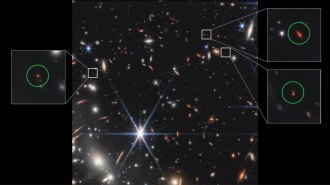
The James Webb telescope spotted the earliest known ‘quenched’ galaxy
A galaxy dubbed GS-9209 ceased forming stars more than 12.5 billion years ago after a 200-million-year-long sprint.
- Astronomy
The Kuiper Belt’s dwarf planet Quaoar hosts an impossible ring
Quaoar’s ring lies outside the Roche limit, an imaginary line beyond which rings aren’t thought to be stable.
- Astronomy
Lots of Tatooine-like planets around binary stars may be habitable
A new simulation suggests that planets orbiting a pair of stars may be plentiful, and many of those worlds could be suitable for life.
- Astronomy
New data show how quickly light pollution is obscuring the night sky
Tens of thousands of observations from citizen scientists spanning a decade show that the night sky is getting about 10 percent brighter every year.
- Astronomy
The James Webb telescope found ‘Green Pea’ galaxies in the early universe
The James Webb telescope spotted tiny “green” galaxies that might have helped trigger a dramatic cosmic makeover more than 13 billion years ago.
- Planetary Science
Methylated gases could be an unambiguous indicator of alien life
On Earth, methylated gases are produced by organisms cleaning up their environment — and by little else. The same might be true on some exoplanets.
- Astronomy
The James Webb Space Telescope wasn’t the only big space news in 2022
DART crashed into an asteroid, Artemis went to the moon and we got a pic of our galaxy’s monstrous black hole. Space was a busy place this year.
- Astronomy
The James Webb telescope is getting glimpses of small, far-off planets
Hints of one exoplanet atmosphere’s chemical makeup and the discovery of a planet orbiting another star are two of the telescope’s early successes.
- Astronomy
The first planet found by the Kepler space telescope is doomed
The exoplanet dubbed Kepler 1658b is spiraling toward its host star and will meet a fiery death in less than 3 million years.
- Astronomy
How the James Webb telescope’s glances back in time are reshaping cosmology
The observatory has found dozens of galaxies from less than 550 million years after the Big Bang, suggesting galaxies formed faster than once thought.
- Astronomy
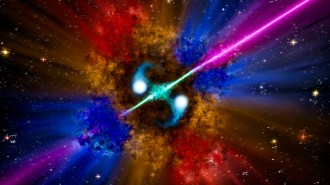
A bizarre gamma-ray burst breaks the rules for these cosmic eruptions
The 50-second gamma-ray burst is the first that unambiguously breaks the rule that long bursts usually come from supernovas.
- Astronomy
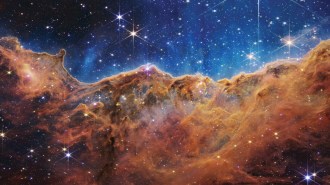
In 2022, the James Webb Space Telescope brought us new views of the cosmos
Science News looks back at some of the most stunning images from the James Webb telescope’s first year in space.