Astronomy
- Astronomy
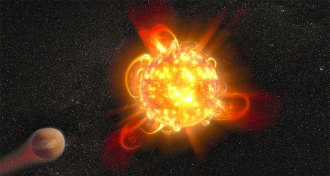
Massive superflares have been seen erupting from stars like the sun
Older stars, like the sun, can still send out massive bursts of energy that can be seen from light-years away.
- Astronomy
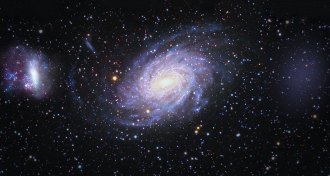
Astronomers may have spotted the ghost galaxy that hit the Milky Way long ago
Astronomers think they’ve identified a galaxy that hit the Milky Way and ruffled its edges millions of years ago.
- Astronomy
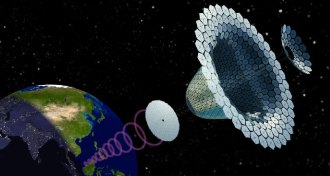
50 years ago, scientists wanted to build solar panels on the moon
In 1969, scientists proposed building solar panels on the moon to convert the sun’s energy into electricity that can be used on Earth.
- Astronomy
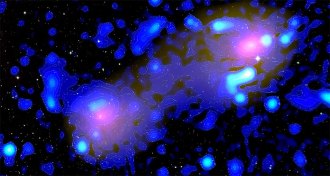
In a first, magnetic fields have been spotted between two galaxy clusters
The discovery of magnetic fields in the gaseous filament between two galaxy clusters suggests that some large cosmic structures are magnetized.
- Astronomy
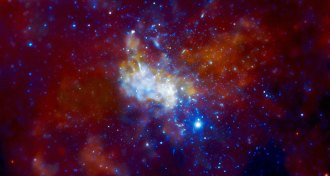
The accretion disk around our galaxy’s black hole has been spotted at last
The Milky Way's central black hole has a disk of gas and dust orbiting it, astronomers can finally say with confidence.
- Astronomy
Watch the oldest surviving film of a total solar eclipse
A short film of the 1900 total solar eclipse was restored by conservation experts and is now available to view online.
- Astronomy
Questions about solar storms, slingshot spiders and more reader feedback
Readers had questions about solar storms, a robotic gripper, slingshot spiders and more.
- Physics
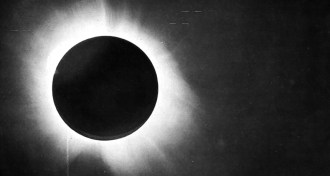
100 years ago, an eclipse proved Einstein right. Today, black holes do too — for now
In 1919, an eclipse affirmed Einstein’s famous general theory of relativity. Now scientists hope to use black holes to poke holes in that idea.
- Physics
Big black holes can settle in the outskirts of small galaxies
Astronomers have found dozens of surprisingly massive black holes far from the centers of their host dwarf galaxies.
- Ecosystems
Readers were curious about green icebergs, aliens and more
Readers had questions and comments about icebergs and climate change, CBD and NASA’s search for E.T.
- Astronomy
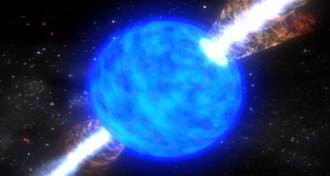
Dying stars called collapsars may forge much of the universe’s gold
Spinning stars that collapse into black holes could help explain the origins of heavy elements such as gold and silver.
- Physics
What a nearby kilonova would look like
Physicists imagined what we’d see in the sky if two neutron stars collided just 1,000 light-years from Earth.