Neuroscience
- Neuroscience
Parents’ presence promotes a child’s pluck
Parents’ presence or absence during a learning exercise determines whether their child is fearful later, or willing to explore.
- Neuroscience
When tickling the brain to stimulate memory, location matters
Conflicting results regarding the benefits of brain stimulation may be explained by the precise location of electrodes.
- Neuroscience
Brain waves may focus attention and keep information flowing
Not just by-products of busy nerve cells, brain waves may be key to how the brain operates.
- Neuroscience
How biology breaks the ‘cerebral mystique’
The Biological Mind rejects the idea of the brain as the lone organ that makes us who we are. Our body and environment also factor in, Alan Jasanoff says.
- Neuroscience
Depression among new mothers is finally getting some attention
Scientists search new mothers’ minds for clues to postpartum depression.
- Neuroscience
Readers muse about memory, magnetic monopoles and more
Readers had questions about the physical trace of memory, magnetic monopoles, blowflies and more.
- Neuroscience
The debate over how long our brains keep making new nerve cells heats up
Adult humans don’t have newborn nerve cells in a memory-related part of the brain, a controversial paper suggests.
- Neuroscience
Some flu strains can make mice forgetful
Mice infected with influenza had memory problems a month later, a result that hints at a link between infections and brain performance.
- Neuroscience
Babies can recover language skills after a left-side stroke
Very young babies who have strokes in the language centers of their brain can recover normal language function — in the other side of their brain.
- Neuroscience
To hear the beat, your brain may think about moving to it
To keep time to a song, the brain relies on a region used to plan movement — even when you’re not tapping along.
- Health & Medicine
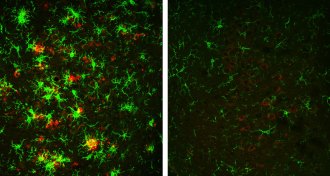
Cutting off a brain enzyme reversed Alzheimer’s plaques in mice
Inhibiting an enzyme involved in the production of Alzheimer’s protein globs also made old globs, or plaques, disappear in mouse brains.
- Neuroscience
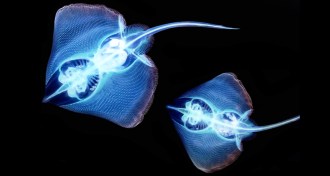
The wiring for walking developed long before fish left the sea
These strange walking fish might teach us about the evolutionary origins of our own ability to walk.