Planetary Science
- Planetary Science
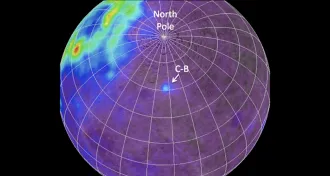
Moon’s farside hints at violent volcanic explosions
The spread of the element thorium in the moon's Compton-Belkovich region suggests that silica volcanoes there once had violent explosions.
- Planetary Science
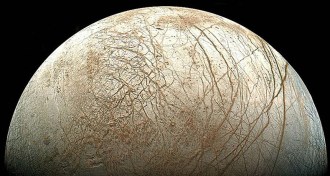
Plate tectonics spotted on Europa
First evidence for plate tectonics elsewhere in solar system discovered on Jupiter’s icy moon Europa.
- Astronomy
Rosetta’s comet shows few signs of surface ice
The first data sent back from one instrument aboard the Rosetta spacecraft suggests that comet 67P/Churyumov-Gerasimenko has little surface ice.
- Planetary Science
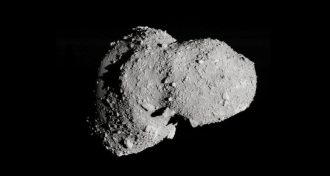
To explain asteroid composition, scientists invoke nuts
Brazil nut effect may explain why only large boulders dot surfaces of asteroids.
- Astronomy
Dust nabbed by spacecraft may be from outside the solar system
NASA’s Stardust mission captured seven particles that probably come from interstellar space, providing researchers with the first direct samples from beyond the solar system.
- Planetary Science
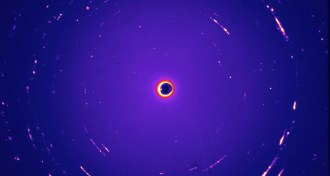
Spacecraft films Pluto’s largest moon in orbit
New Horizons spacecraft, en route to Pluto, captures nearly one orbit of dwarf planet’s largest moon.
- Planetary Science
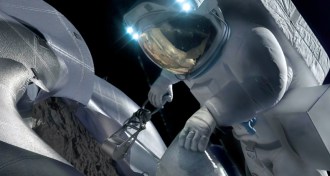
NASA bets on asteroid mission as best path to Mars
NASA wants to bag an asteroid using robotic arms or an enormous sack and place the rock in the moon’s orbit for study. This may keep astronauts working but not, as NASA claims, get them Mars-ready.
- Planetary Science
Rosetta spacecraft confabs with a comet
After a 10-year chase, ESA’s Rosetta spacecraft has met up with comet 67P/Churyumov–Gerasimenko.
- Planetary Science
Three volcanic eruptions rock Jupiter’s moon Io
Over two weeks last year, the tiny moon Io blazed with three vigorous volcanic eruptions.
- Planetary Science
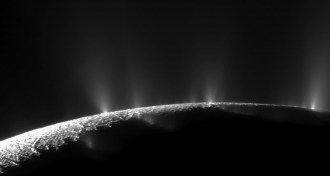
Saturn moon’s geysers draw water from subsurface sea
More than six years of Cassini data indicate that the water jets on the surface of Saturn’s moon Enceladus connect to deep-ocean reservoirs via expanding cracks in surface ice.
- Planetary Science
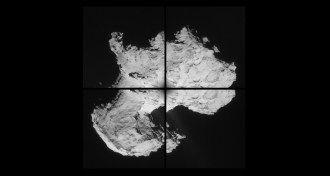
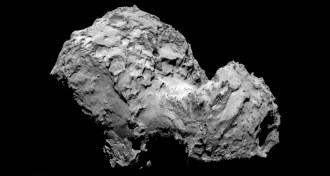
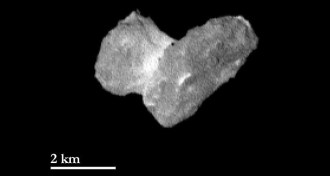
Rosetta spacecraft gets better view of comet’s fuzz
News images are giving astronomers a sense of the size of comet 67P/Churyumov-Gerasimenko's coma and the shape of its core.
- Earth
Early life probably fell victim to massive space rocks
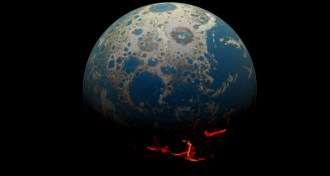
Planet-sterilizing impacts probably snuffed out early life on Earth until around 4.3 billion years ago.