Space
We summarize the week's scientific breakthroughs every Thursday.
- Planetary Science
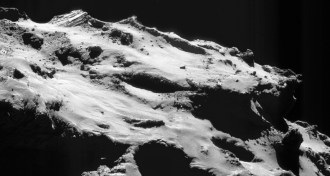
So long, Rosetta: End is near for comet orbiter
During its time in orbit around comet 67P, the Rosetta spacecraft discovered diverse terrains, organic molecules and a source of water quite different from Earth’s oceans.
- Astronomy
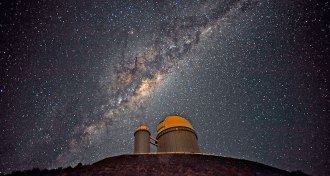
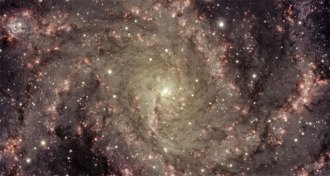
Solar system sits within major spiral arm of Milky Way
The solar system appears to live in one of the major spiral arms of the Milky Way, not in an offshoot as previously thought.
- Astronomy
Solar system sits within a major spiral arm of the Milky Way
The solar system appears to live in one of the major spiral arms of the Milky Way, not in an offshoot as previously thought.
- Planetary Science
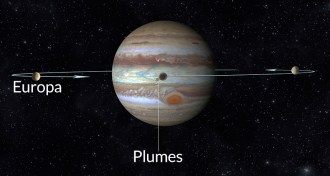
Europa spouting off again
Plumes of presumably water erupt from the surface of Jupiter’s frozen moon Europa, in images taken by the Hubble Space Telescope.
- Planetary Science
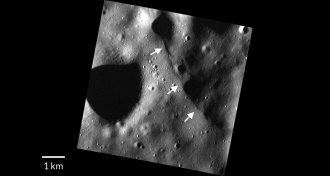
Mercury’s surface still changing
A population of small cliffs on Mercury suggests that the planet might have been tectonically active in the last 50 million years.
- Planetary Science
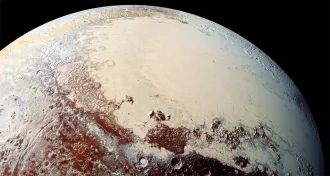
A salty sea could lurk beneath the heart of Pluto
An ocean more than 100 kilometers thick might hide beneath Pluto’s surface.
- Astronomy
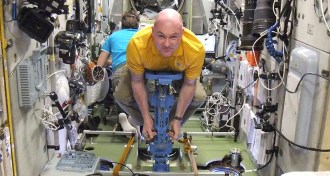
Old-school contraptions still work for weighing astronauts
To weigh themselves, astronauts still use technology invented about 50 years ago.
- Astronomy
Anna Frebel digs a young universe
Astronomer Anna Frebel has discovered record-breaking stars, including the most pristine in the galaxy.
- Cosmology
A cosmic quandary, risks of hatching early and more reader feedback
The cosmos, tadpole escape artists, vehicle collisions and more in reader feedback.
- Astronomy
The sun isn’t the only light source behind that summer tan
About 99.999% of the light that creates a suntan comes from the sun; the rest comes from the Big Bang and galaxies throughout the universe.
- Astronomy
Vanished star may be first known failed supernova
A star that vanished in another galaxy might be the first confirmed case of a failed supernova — and the birth of a black hole.
- Planetary Science
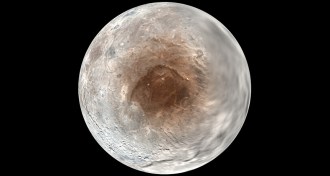
Source of Charon’s red north pole is probably Pluto
The dark red pole on Charon, the largest moon of Pluto, is probably gas that escaped from Pluto and was then transformed by sunlight.