Space
We summarize the week's scientific breakthroughs every Thursday.
- Earth
‘A Most Improbable Journey’ offers scientific take on human history
Walter Alvarez’s “A Most Improbable Journey” gives readers a tour of “Big History,” linking human history to unpredictable cosmic, geologic and biological events.
- Planetary Science
Mars lander debris spotted
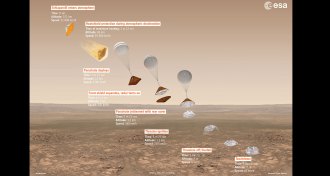
The Mars Reconnaissance Orbiter imaged the impact site of the Schiaparelli Mars lander, missing in action since its October 19 descent.
- Astronomy
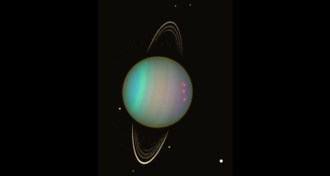
Uranus moon count: 27 and rising
Two more moons might be lurking around Uranus, causing material in the planet’s rings to clump up, Voyager 2 data suggest.
- Planetary Science
Two unseen moons may circle Uranus
Two more moons might be lurking around Uranus, causing material in the planet’s rings to clump up, Voyager 2 data suggest.
- Planetary Science
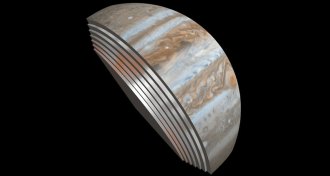
First peek under clouds reveals Jupiter’s surprising depths
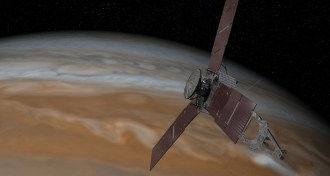
Jupiter’s colorful bands originate several hundred kilometers beneath the cloud tops, the Juno spacecraft reveals.
- Planetary Science
Mars lander silent as mission scientists work out what went wrong
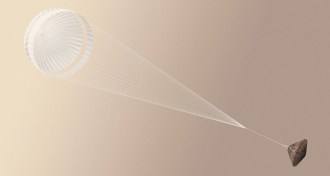
Schiaparelli lander is still silent on the surface of Mars while mission scientists try to understand what happened during the probe’s descent.
- Planetary Science
Experts don’t agree on age of Saturn’s rings
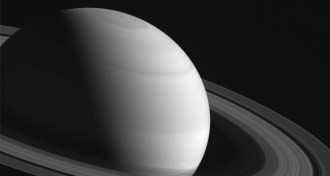
Saturn’s rings could be almost as old as the solar system, and the Cassini craft is poised to help find out.
- Planetary Science
Juno spacecraft goes into ‘safe mode,’ continues to orbit Jupiter
The Juno spacecraft has gone into safe mode while in orbit around Jupiter. Mission scientists are also closely monitoring a fuel valve issue on the probe.
- Planetary Science
Mission scientists await signal from Mars lander
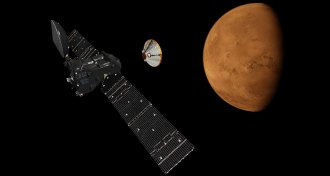
The ExoMars mission’s Schiaparelli lander went silent before its scheduled landing on the Red Planet.
- Planetary Science
Possibly cloudy forecast for parts of Pluto
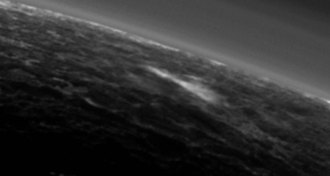
Reflective patches on Pluto could be hints of rare cloud formation on the dwarf planet.
- Planetary Science
ExoMars mission set to arrive at Red Planet on October 19
The European ExoMars mission is about to arrive at the Red Planet, dropping a lander on the surface and putting a spacecraft into orbit.
- Planetary Science
Lava may be flowing from Venus volcano
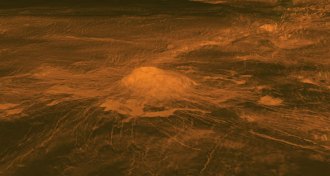
Lava flows might explain a hot spot seen in data from Venus Express spacecraft.