All Stories
- Animals
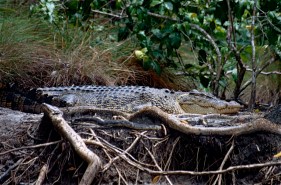
Some crocodiles go out on, or up, a limb to hunt, keep warm
Observations of crocodiles from Australia, Africa and North America show that four species could waddle up and along branches above water. They do this to regulate their temperature and look for prey, scientists suggest.
- Neuroscience
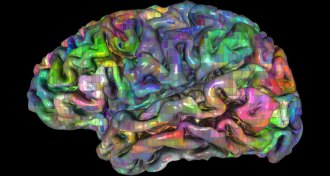
Ways of seeing the brain inspire notions of how it works
As scientists have developed more sophisticated methods and ideas, their understanding of how the brain works has shifted too.
- Animals
Orangutans hit the ground walking
A surprising affinity for moving across the forest floor may aid threatened apes.
- Life
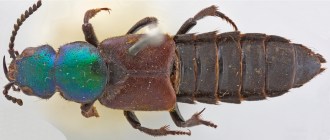
Happy birthday, Mr. Darwin
A male rove beetle that Charles Darwin collected in Argentina in 1832 has finally turned up and been named in his honor.
- Health & Medicine
Introducing the first bank of feces
A new nonprofit called OpenBiome is hoping to do for fecal transplants what blood banks have done for transfusions. It’s a kind of Brown Cross.
- Life
Nonhuman city natives in decline but can be conserved
Cities have been a downer on biodiversity but native populations still remain in urban areas, offering a starting point for possible conservation efforts.
- Health & Medicine
Drug injection could limit heart attack damage
Study in pigs suggests hydrogel treatment might minimize the risk of heart failure in survivors.
- Physics
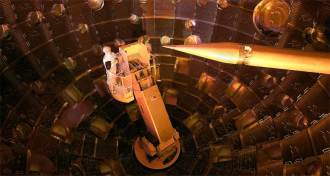
Getting warmer in attempt to reach ignition
Fusion energy output hits modest milestone at National Ignition Facility.
- Humans
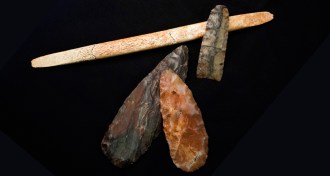
Clovis baby’s genome unveils Native American ancestry
DNA from skeleton shows all tribes come from a single population.
- Life
Charms of small males may collapse a Darwin’s finch species
Mating rules may be changing for one of the storied Galápagos birds.
- Astronomy
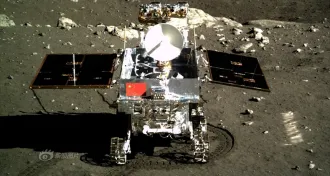
China’s lunar rover fails to connect with controllers (updated)
Yutu, or Jade Rabbit, could not be restored to full function, Chinese media report.
- Materials Science
Making it work, on paper and just maybe in practice
Last spring, Science News reported on the lack of progress by the main U.S. nuclear fusion effort. As the researchers still contend, laser-initiated fusion should work. It works on paper. But in practice, even a set of extremely powerful lasers failed to trigger the fusion of hydrogen nuclei and the concomitant chain reaction and release of net energy expected.