All Stories
- Physics
Sounds from gunshots may help solve crimes
Sound wave analysis may help forensic scientists figure out what types of guns were fired at a crime scene.
- Science & Society
Empathy for animals is all about us
We extend our feelings to what we think animals are feeling. Often, we’re wrong. But anthropomorphizing isn’t about them. It’s about us.
- Health & Medicine
This week in Zika: vaccine progress, infection insights
Vaccine candidates for Zika virus take a step forward, birth defects span spectrum of problems and doubts about Zika’s link to microcephaly may be extinguished by new reports from Colombia.
- Physics
Falling through the Earth would be a drag
Scientists study how friction affects a hypothetical jump through the center of the Earth.
- Health & Medicine
Vaccines could counter addictive opioids
Scientists turn to vaccines to curb the growing opioid epidemic.
- Paleontology
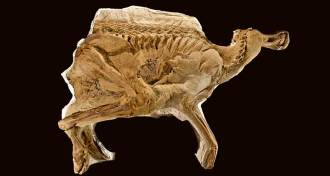
Parasites wormed way into dino’s gut
Tiny slimed tunnels in the guts of a 77-million-year-old duck-billed dinosaur fossil offer the first hard evidence that dinosaurs may have been infected by parasitic worms, paleontologists say.
- Planetary Science
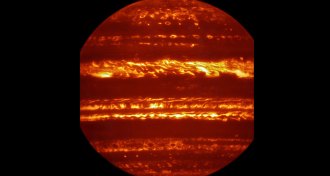
Jupiter shows off its infrared colors
Jupiter glows with infrared light in new images taken in preparation for the July 4 arrival of the Juno spacecraft.
- Science & Society
Special Report: Aging’s Future
What is aging? How does it change the brain? How did different life histories evolve? This special report addresses those questions and more.
- Earth
Winning helium hunt lifts hopes element not running out
A volcanic region of Tanzania contains more than a trillion liters of helium gas, enough to fill 1.2 million medical MRI scanners — or hundreds of billions of balloons, researchers report.
- Materials Science
Shark jelly is strong proton conductor
A jelly found in sharks and skates, which helps them sense electric fields, is a strong proton conductor.
- Animals
Two newly identified dinosaurs donned weird horns
Two newly discovered relatives of Triceratops had unusual head adornments — even for horned dinosaurs.
- Health & Medicine
Tight spaces cause spreading cancer cells to divide improperly
Researchers are using rolled-up transparent nanomembranes to mimic tiny blood vessels and study how cancer cells divide in these tight spaces.