An ancient Chinese skull might change how we see our human roots
Reconstruction of a damaged 1-million-year-old skull suggests a surprising link to H. sapiens
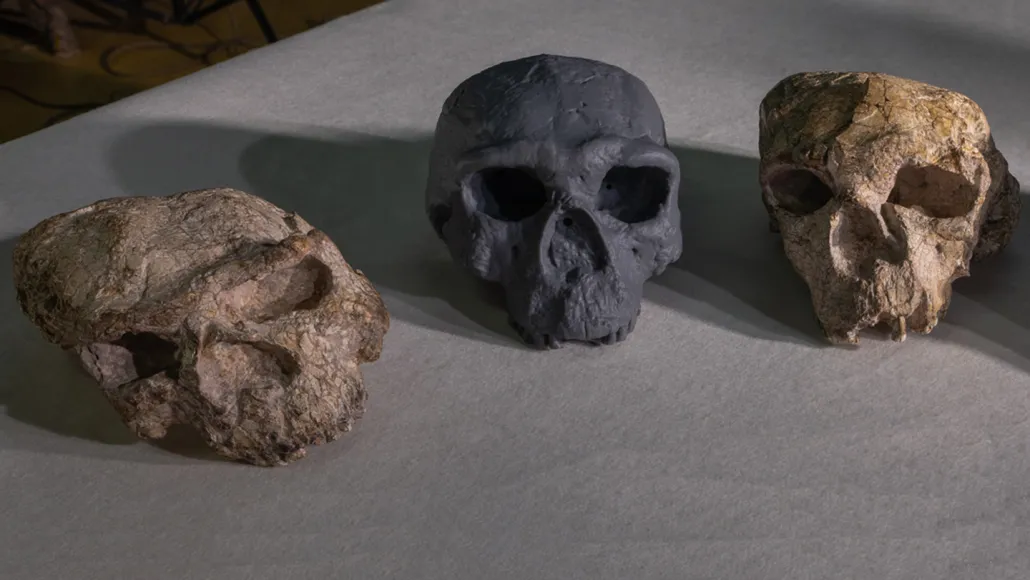
A digitally repaired, roughly 1-million-year-old Chinese skull has contributed to a new framework for human evolution. A replica of the reconstructed skull, center, sits between its original fossil version, right, and a second, more extensively crushed Homo skull from the same Chinese site.
Guanghui Zhao
A roughly 1-million-year-old Chinese hominid skull has long vexed efforts to nail down its evolutionary identity.
Fossil comparisons using a new digital reconstruction of this specimen, dubbed the Yunxian 2 skull, indicate that it belonged to an early member of an Asian hominid line that culminated in a now-extinct species called Homo longi, researchers report in the Sept. 25 Science. The reconstructed skull corrects features that were partially crushed while buried, say paleoanthropologist Xiaobo Feng of Shanxi University in Taiyuan, China, and colleagues.
Feng’s team regards its new findings as a framework for rethinking how a confusing array of Middle Pleistocene hominid fossils, dating from about 789,000 to 130,000 years ago, fit into human evolution. In a novel twist, the scientists’ results suggest that an ancient line of hominids leading directly to Homo sapiens possessed a slightly closer evolutionary relationship to H. longi and its ancestors, including Yunxian 2, than to Neandertals. Their findings also portray Denisovans, for the first time, as members of H. longi and thus closer relatives of H. sapiens than of Neandertals.
But longstanding debates about how human evolution played out will undoubtedly continue. While it’s exciting to have a corrected version of Yunxian 2, Middle Pleistocene evolution represents an enduring mystery, says paleoanthropologist Sheela Athreya of Texas A&M University in College Station.
Yunxian 2 and other Homo fossils display varying sets of skeletal traits that cannot easily be sorted into distinct lineages, says Athreya, who did not participate in the new study. For now, she says, Denisovans and their relationship to Yunxian 2 and proposed H. longi fossils remain poorly understood.
Feng and colleagues disagree. In their view, H. longi includes China’s 146,000-year-old Harbin skull, nicknamed Dragon Man, several other Chinese fossils near the Harbin skull’s age and Denisovans, an Asian population known more from ancient DNA than fossil finds.
Excavations in 1989 at the Yunxian site on a riverbank in central China produced a badly crushed Yunxian 1 skull, which has proven difficult to reconstruct. Further digging uncovered Yunxian 2 in 1990 and Yunxian 3 in 2022. The last find awaits a published description.
Previously dated reversals of Earth’s magnetic field recorded in sediment layers and bones of extinct animals found near the Yunxian skulls enabled an estimate of their age.
Given the Yunxian 2 skull’s age of around 1 million years and its unusual mix of skeletal traits, the scientists refrained from assigning the Chinese fossil to H. longi or any other Homo species. One notable skeletal curiosity of Yunxian 2 consists of a long, low braincase that nonetheless held a relatively large brain. But some traits, such as narrowly spaced eye sockets and a wide, flat nasal opening, link Yunxian 2 to H. longi, the researchers say.
To work out Yunxian 2’s lineage, Feng’s group sorted it and 104 other hominid skull and jaw specimens from Africa, Asia and Europe into anatomically similar groups. A computer analysis identified H. longi, H. sapiens and Neandertal lineages by generating evolutionary trees that most simply and directly explained distributions of different skeletal traits. In this way, the timing of common ancestors for these lineages was calculated.

H. longi’s evolutionary predecessors, including the Yunxian 2 individual, shared a common ancestor around 1.32 million years ago with a lineage later capped off by H. sapiens, the scientists calculate. That estimate builds on recent DNA analyses indicating that two ancestral populations of people today split as early as around 1.5 million years ago.
European fossils classified by some researchers as Homo antecessor, dated at between 900,000 and 800,000 years old, also qualify as members of the H. longi lineage, Feng and colleagues say.
Feng’s group calculates that the first members of a separate line of Neandertal ancestors emerged about 1.38 million years ago. If so, members of the H. sapiens lineage had closer evolutionary ties to H. longi ancestors than to the Neandertal lineage.
If the Yunxian 2 skull provides a glimpse of Homo anatomy shortly after the origins of both the H. longi and H. sapiens lineages, “it may represent one of the most important windows into evolutionary processes that shaped our genus,” says paleoanthropologist and study coauthor Chris Stringer of the Natural History Museum in London.