Uncategorized
- Life
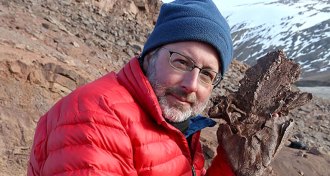
Find your inner fish with PBS series on human evolution
A new documentary explores how the human body came together over 3.5 billion years of animal evolution.
- Health & Medicine
Triclosan aids nasal invasions by staph
The antimicrobial compound triclosan, commonly found in soaps and toothpaste, may help Staphylococcus aureus stick around.
- Anthropology
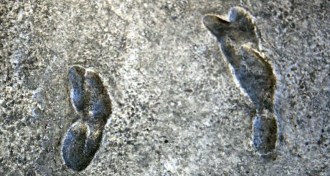
Laetoli footprints show signs of unusual gait
Contrary to prior study, 3.6-million-year-old hominids in Tanzania did not walk like humans.
- Anthropology
Earliest case of a battered child found in Greece
A baby living in Athens around 2,200 years ago was probably beaten to death.
- Earth
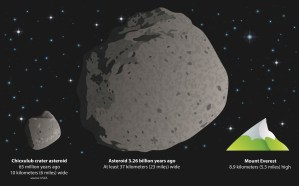
Huge space rock rattled Earth 3 billion years ago
An asteroid almost as wide as Rhode Island may have plowed into Earth 3.26 billion years ago, leaving a trace in South Africa’s Barberton greenstone belt.
- Anthropology
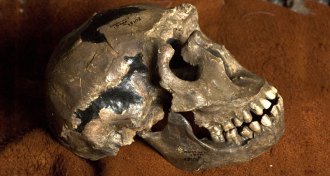
Ancient boy died surprisingly young
Imaging analysis reduces age of Australopithecus sediba youngster from 9 to 7.5 years old.
- Climate
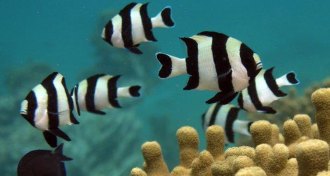
Reef fish act drunk in carbon dioxide–rich ocean waters
In first test in the wild, fish near reefs that bubble with CO2 lose fear of predators’ scent.
- Anthropology
Turkana Boy sparks row over Homo erectus height
Estimating the adult height and weight of an ancient youth from his skeleton has proven tricky.
- Climate
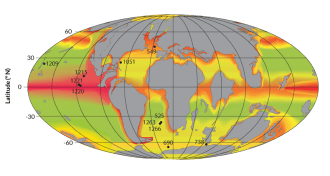
Ocean bacteria may have shut off ancient global warming
Ocean-dwelling bacteria may have helped end global warming 56 million years ago by gobbling up carbon from the CO2-laden atmosphere.
- Climate
IPCC calls for swift switch to alternative power
Rapid adoption of green power production will be necessary to avert a climate crisis, latest IPCC report says.
- Astronomy
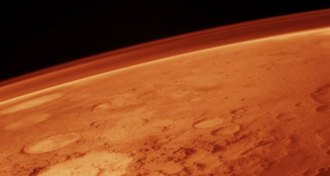
Early Mars couldn’t hold liquid water long
Small rocks hit Mars 3.6 billion years ago, suggesting an early atmosphere too thin for liquid water to hang around very long.
- Particle Physics
Exotic particle packs a foursome of quarks
Tetraquarks could help physicists understand the universe’s first generations of matter.