Uncategorized
-
Astronomy“Black holes” in space
Science News Letter was the first publication to use the term in print in 1964.
-
AstronomyEnormous cosmic lens magnifies supernova
Galaxy warps light of distant exploding star, greatly increasing its brightness.
By Andrew Grant -
EarthThe long and winding Colorado
The history of the West’s iconic river is written in the dramatic landscapes it has shaped. How to interpret that chronicle has become a contentious issue among geologists.
-
MathTomorrow’s catch
A biologist who formerly applied his mathematical talents in finance has developed new ways of predicting the ups and downs of fish populations.
-
LifeMarine microbes shed packets of DNA, nutrients
The world’s most abundant marine microorganism, the photosynthetic bacteria Prochlorococcus, spits out nutrient-rich vesicles into ocean waters, perhaps for genetic exchange or as a survival mechanism.
-
NeuroscienceA schizophrenia drug turns on protein factories in cells
Haloperidol reshapes neurons, which might explain how the medicine works.
-
ComputingMaterials’ light tricks may soon extend to doing math
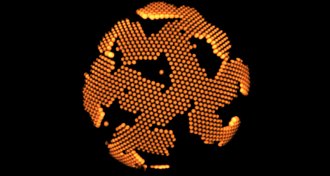
A simulation paves the way toward metamaterials that can perform ultrafast complex mathematical operations using light waves.
-
Health & MedicinePacemaker treats sleep apnea
Experimental device works for many patients who can’t use breathing machines.
By Nathan Seppa -
AnimalsDog-paddle science debunks notion of underwater trot
From Newfoundlands to Yorkshire terriers, canines swim with similar, distinctive gait.
By Susan Milius -
AstronomyEarth-mass planet resembles a mini-Neptune
KOI-314c, an exoplanet 200 light-years away, is about 60 percent larger than Earth but made mostly of gas.
By Andrew Grant -
PsychologyMigraines respond to great expectations
Patients get more pain relief from drug and placebo labeled as headache busters than from those labeled as dummy pills.
By Bruce Bower -
ChemistryBattery blueprint promises green energy storage
A device that relies on organic molecules could cheaply bank power from renewable sources.
By Beth Mole