Cosmic rays could, in theory, sustain life on other worlds
The radiation can break underground water into an ingredient for life-giving energy

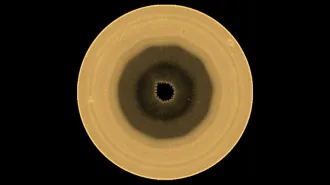
Enceladus, a moon of Saturn, could theoretically harbor underground life sustained by cosmic rays, according to a new study.
JPL/NASA, Space Science Institute
Galactic cosmic rays — high-energy particles from outside the solar system — could theoretically power life on certain frigid worlds. The radiation can trigger chemical reactions underground, whose products might sustain microbes there, researchers report July 28 in the International Journal of Astrobiology. The idea suggests that life could exist on bodies beyond those traditionally thought to be habitable.
“This whole idea of unconventional habitability, especially afforded by … radiation, I think is really underexplored,” says astrobiologist Zach Adam of the University of Wisconsin–Madison, who was not involved in the study.
Astronomers suspect that organisms could reside on specific planets in their stars’ habitable zones, where they’re close enough to the stars for liquid water to sit on their surfaces. But when pondering livable environments, astrobiologist Dimitra Atri grew interested in earthly extremophiles.
The bacterium Candidatus Desulforudis audaxviator, for instance, was discovered almost three kilometers underground and can survive on the products of a radioactive decay–induced chemical reaction called radiolysis. The reaction splits water molecules into different components, one of which helps the bacteria make food.
“This was game-changing,” says Atri, of New York University Abu Dhabi in the United Arab Emirates. The species highlights radiation’s potential to help, rather than hurt, a living thing.
Radiation is best known for its harmful effects, such as cell damage or cancer. But many organisms have defenses against radiation, such as tanning — or producing melanin — when exposed to low-energy radiation from the sun. In addition, any hypothetical microbes living underground would be protected from the highest levels of inbound high-energy radiation from cosmic rays. These particles come from supernovas and other energetic phenomena.
Atri and colleagues wanted to see how much microbial life could be supported by cosmic ray–induced radiolysis on other worlds. The researchers examined the possibility on Mars, Jupiter’s moon Europa and Saturn’s moon Enceladus. Each location is suspected to harbor underground water and has a thin atmosphere easily penetrated by cosmic rays, unlike Earth’s hefty shield.
The team simulated what happens when cosmic rays split water molecules at various depths on those worlds and how many cells the chemical reaction could maintain. Specifically, the researchers analyzed the rate of electrons produced. Within cells, electrons play a vital role in making adenosine triphosphate, or ATP, the main energy currency “for all life that we know of,” Atri says. Some bacteria can slurp up electrons from the environment.
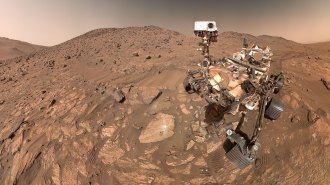
Calculations revealed that, of the three worlds, Enceladus could power the most life. At a depth of two meters, cosmic ray–induced radiolysis would result in enough ATP to sustain 42,900 cells per cubic centimeter, based on Escherichia coli’s metabolism. Mars could support 11,600 cells per cubic centimeter at 0.6 meters below its surface, and Europa could support 4,200 cells per cubic centimeter at one meter deep.
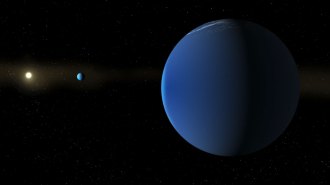
“This expands our search, the potential where life can exist,” Atri says. Very cold planets — even rogue ones without a star — could be within what he and his colleagues call the radiolytic habitable zone. As a next step, Atri plans to simulate the conditions of Enceladus, Europa and Mars in his lab and test how earthly extremophiles behave.
The calculations are quite convincing, says astrobiologist Franco Ferrari of the University of Szczecin in Poland, who was not involved in the study. But radiation alone may not be enough to sustain life. For instance, all known organisms need sugars, usually glucose, a molecule primarily produced in the presence of sunlight, he notes. Researchers should consider whether worlds in the radiolytic habitable zone host environmental features that can provide all the resources necessary for life.
Additionally, the cosmic rays would make a small amount of usable energy, “just enough to keep things going,” Adam says. “We’re not talking about having this massive, flourishing ecosystem.” But a constant barrage of high-energy particles could theoretically sustain established microbes indefinitely.
The work, he says, provides “justification for looking at unconventional places to find life in the universe.”