A comet may have flipped its spin and entered into a death spiral

Gas streaming off comet 41P probably slowed it to a stop and began rotating it the other way

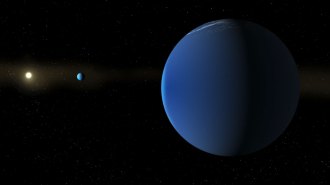
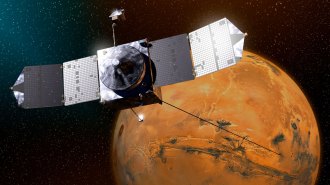
Observations from NASA’s Hubble Space Telescope suggest that comet 41P/Tuttle-Giacobini-Kresák (illustrated) reversed the direction of its spin in 2017.

NASA, ESA, CSA, Ralf Crawford/STScI

For the first time, a comet may have been caught flipping its spin.

Sometime between April and December 2017, comet 41P/Tuttle-Giacobini-Kresák apparently started twirling in the opposite direction, astronomer David Jewitt reports in the April Astronomical Journal. The simplest explanation, the study says, is that gases escaping from the small comet forced its rotation to slow, stop and reverse.

The kilometer-or-so-wide comet may keep spinning faster in the new direction until it tears itself apart, says Jewitt, of the University of California, Los Angeles. The fatal pirouette demonstrates why small comets — those less than a kilometer wide — are relatively scarce, he says. “They spin up so quickly, they’re gone in a relatively short time.”

41P is thought to have assumed its current orbit around the sun some 1,500 years ago, after a close encounter with Jupiter. Its trajectory brings it into the inner solar system every 5.4 years.

In May 2017, observations by NASA’s Neil Gehrels Swift Observatory showed that 41P’s spin was rapidly decelerating. At the time, 41P completed a rotation every 46 to 60 hours — taking more than double the amount of time that it had in March, when scientists at the Lowell Observatory in Flagstaff, Ariz., observed it. The change was the quickest shift in a comet’s spin ever observed, researchers reported the following year in Nature.

For the new study, Jewitt analyzed images taken by NASA’s Hubble Space Telescope in December 2017. He found that 41P was spinning about once every 14 hours, or in about a third of the time observed in May of that year — its spin had switched from slowing to accelerating.  

Heat from the sun probably sublimated some of 41P’s icy parts, generating gases that would have acted like thrusters on a spacecraft, Jewitt says. The torque generated by those gases would have first slowed 41P’s spin to a halt, and then led it to start turning in nearly the opposite direction. This interpretation would explain the observed changes, Jewitt says.

Jewitt’s calculations suggest that as 41P’s spin accelerates, centrifugal forces will eventually overcome the comet’s gravity, causing it to break apart. It’s difficult to predict exactly when that will occur, since the comet’s outgassing can fluctuate, but it won’t be long, Jewitt says — maybe just a few decades.

There are objects in the sky that can seem eternal, Jewitt says, but this is a reminder that some won’t be there for much longer.

Nikk Ogasa is a staff writer who focuses on the physical sciences for Science News. He has a master's degree in geology from McGill University, and a master's degree in science communication from the University of California, Santa Cruz.