Designer Flu
How scientists made a killer virus airborne — and who should know
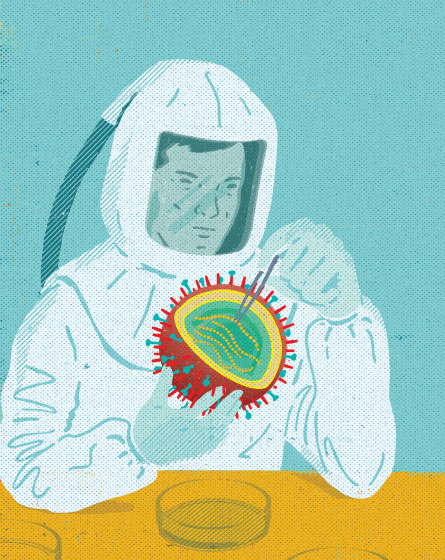
Last summer, scientists performed an experiment that could have been ripped from the script of a Hollywood thriller. Sealed off in high-tech laboratories in the Netherlands and Wisconsin, researchers transformed one of the world’s most deadly viruses, transmissible by direct contact, into versions capable of spreading through the air.
Unlike in the movies, news of the lab-made viruses was not delivered as a threat, and the scientists doing the work weren’t henchmen of an evil dictator or members of a shadowy terrorist organization. Instead, the researchers were on the good-guy team — respected academics investigating how a type of flu virus that typically targets birds might become contagious in people.
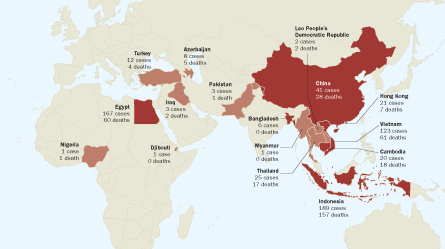
Though the avian flu virus known as H5N1 infects and kills mostly birds — including chickens, turkeys and waterfowl — it has sickened more than 600 people worldwide since an outbreak in Hong Kong in 1997, killing about half of them. The virus doesn’t pass easily from person to person even with close contact, let alone through the air. Most victims contracted it after handling infected birds or from contaminated environments.
But the Netherlands and Wisconsin research teams created their airborne versions of the virus in attempts to determine whether the virus could become easily transmissible among people. Knowing more about the virus’s potential to make such a change might help public health workers spot a budding pandemic, and even point to ways to head off such a global catastrophe.
Yet even though the researchers undertook the work for noble reasons, they soon found themselves as embroiled in intrigue and worldwide controversy as any fictional villains. Since the Dutch researchers announced the work at a scientific meeting in Malta in September, their saga has featured closed-door meetings, security reviews, publishing restrictions, a voluntary halt on the research, a media frenzy that included a flurry of opinion pieces by other scientists and even threats of imprisonment. The Wisconsin team’s story has played out similarly, only with slightly less drama. At issue is the danger posed by the lab-made versions of air-transmissible H5N1 and who should know how they were created.
Each team submitted a paper to a major scientific journal — one to Nature and one to Science — containing step-by-step instructions for turning H5N1 into an airborne virus, including information about the changes in the genetic instruction book important for the transformation. Initially, a U.S. government advisory board charged with determining whether the research was fit to print decided that open publication posed too great a risk of misuse, recommending the publication of severely redacted versions. Critics siding with the board warned that terrorists or rogue nations could use the information to re-create the viruses and unleash them on the world.
Proponents of publishing argued that public health workers need to know which mutations spell trouble in case those mutations are spotted in the wild. At the end of March, the board reversed its decision, ruling — after some clarifications — that the benefits of information sharing outweighed the risks.
One paper has now been published in a full-length version in Nature (SN Online: 5/2/12); as of mid-May, the second was still in the peer review and editing process. (Editor’s note: The second paper was published in the June 22 Science. Click here for news story.) But the controversy the papers ignited has made flu virus research, and the issues of national security and data sharing that come along with it, topics of debate over lab benches and dinner tables.
Before it was clear that the papers would ever see print, they were called “the two most famous unpublished manuscripts in modern life science history” by Michael Osterholm, director of the Minnesota Center of Excellence for Influenza Research and Surveillance in Minneapolis.
Flu-id rulings
Osterholm serves on the 23-member National Science Advisory Board for Biosecurity, NSABB for short, charged with assessing whether the H5N1 papers should be published. Established in 2004, the board evaluates biological research that could be used for nefarious purposes. Such “dual-use” research is generally performed to uncover the basic biology of disease-causing organisms for medical or public health purposes, but could be twisted by people with evil intentions into biological weapons.
In its history, the board has reviewed six other scientific papers, in all cases recommending publication with no changes or only minor modifications, says Paul Keim, an anthrax researcher at Northern Arizona University in Flagstaff who chairs the advisory board.
But in the case of the two H5N1 flu papers, “The full board recommended that neither manuscript be published with complete results,” Keim said April 3 in London at a meeting organized by the Royal Society and other groups. “The board found that these results had an unusually high magnitude of risk.”
Knowing all the details of the research could allow someone to skip years of work and quickly make a transmissible version of the virus, the advisers concluded after first reviewing the papers in November.
What made some board members so uncomfortable — and what the media quickly picked up on — was the nature of the virus. To call H5N1 deadly is putting it mildly. The virus kills an estimated 59 percent of the people it infects.
Though some studies say the actual kill rate is far lower, “Even if it is 20 times lower, it would still have a mortality rate that far exceeds that of the 1918 flu,” says Osterholm. That pandemic racked up a body count of tens of millions of people worldwide.
“People like myself have almost been ridiculed for our position on the risks of the influenza virus,” Osterholm says. If smallpox or SARS were ever to escape from a lab and start infecting people, it would be bad but could easily be brought under control, he says. “Influenza is very different. Influenza is like having one screen door on your submarine. It will sink you.”
So telling the general public, including potential terrorists, how to make an airborne version of highly lethal H5N1 was, at least at first, deemed a risk that outweighed the public health benefit of publication.
But other scientists were outraged by the decision, which they saw as holding back essential information. The papers show that although H5N1 has been around for 15 years and has not yet developed the ability to spread easily from person to person, it could be just a few mutations away from becoming a human-transmissible virus. Full disclosure about the steps required for that transformation could be key to finding viruses already heading down that path in the wild.
The Netherlands group, headed by Ron Fouchier of Erasmus Medical Center in Rotterdam, found that five mutations are enough to make the virus infectious through airborne particles in ferrets, which are often used as stand-ins for humans in infectious disease experiments. At the Royal Society meeting, Fouchier was unable to discuss details about the type of mutations that his group found because of Dutch restrictions on the export of dual-use research. (Fouchier’s team has since been granted an export license.)
But the United States had already lifted a similar ban, giving Yoshihiro Kawaoka of the University of Wisconsin–Madison the go-ahead to present his team’s results in full. Kawaoka’s team also reported its findings online May 2 in Nature.
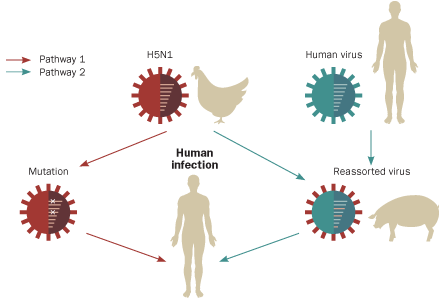
Strictly speaking, the Wisconsin group’s transmissible virus is not H5N1 bird flu virus. Instead it is a composite of H5N1 and the H1N1 “swine flu” virus that caused a pandemic in 2009. To create the combination virus, the researchers replaced a sugar-spiked protein called hemagglutinin (the H in H5N1) found in the 2009 virus with one from the bird flu virus. Hemagglutinin studs the flu virus’s outer envelope and helps the virus grab and invade cells. Although the researchers genetically engineered the bird/swine combination virus in the lab, the experiment mimicked the sort of parts-swapping that influenza viruses often go through in nature.
Merely swapping hemagglutinins wasn’t enough to make the composite virus into an airborne infectious flu in ferrets, though. The original combination virus didn’t pass between ferrets in neighboring cages. Researchers helped the virus along by transferring it directly from one ferret to another. In ensuing rounds of researcher-assisted ferret infections, mutations cropped up in the hemagglutinin protein.
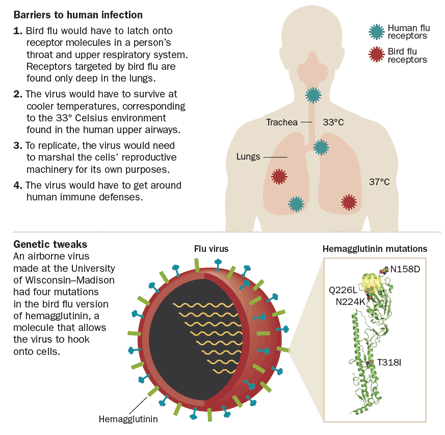
At least four changes to the molecule were needed to make the virus readily transmit via airborne droplets, the researchers found. Three of the mutations, all located in a part of the protein needed to attach to cells, switched the virus from one that could latch onto cells in the digestive tract of birds and the lungs of mammals to one that also could hang on in mammalian upper respiratory tracts. Grabbing on in that region is necessary for virus particles to spread via coughing and sneezing.
A fourth change in hemagglutinin may affect how well the virus can fuse with cells in ferret — and presumably human — hosts. That mutation makes the hemagglutinin more stable and allows the virus to replicate better in mammalian cells, Kawaoka said.
A group of influenza researchers and public health officials convened by the World Health Organization, after hearing the results presented in February, concluded that this information would be valuable for public health workers. A full accounting of the data would aid surveillance teams in identifying naturally occurring mutations that indicate H5N1 is becoming less of a bird virus and more of a human virus, proponents of publishing said. Besides, the WHO panel concluded, there is no currently feasible way to withhold the data from most of the world while still quickly disseminating the information to those who really need to know it.
One of the mutations Kawaoka found in the hemagglutinin molecule may already be helping the virus adapt to humans. In Egypt, 219 H5N1 viruses taken from birds had the mutation, called N158D, while 87 H5N1 viruses isolated from birds did not. All 46 H5N1 viruses isolated from humans carried the mutation, suggesting that the genetic change is important for the virus to infect humans.
And during the Royal Society meeting, Fouchier said that when his data are put alongside Kawaoka’s, a pattern emerges that begins to reveal which biological traits an influenza virus needs to become a pandemic strain. It’s the ability to spot the trends in virus evolution that makes publishing this kind of information so important, the researchers argued. Even if surveillance measures aren’t enough to catch the virus before it becomes a pandemic, Fouchier said, knowing how it is likely to happen will allow researchers to design vaccines and antiviral medications to combat a future pandemic.
Deadly or not
One reason that the cons of publishing may have initially appeared to outweigh the pros is that the findings were hyped. Part of that hype came from the researchers themselves. Fouchier was quoted on Science’s website as saying that the virus created in his lab is “probably one of the most dangerous viruses you can make.” Scientists as well as members of the media and public interpreted that statement and other remarks Fouchier made to mean that the team’s lab-made virus retained its killing capacity as it gained the ability to pass from ferret to ferret. The research done by Kawaoka’s team was painted with the same scary brush, even though no ferrets died in those experiments.
But it turns out that the lab-made viruses are neither as deadly nor as transmissible as many people had initially believed.
“What the world thought isn’t exactly what happened,” says Anthony Fauci, director of the U.S. National Institute of Allergy and Infectious Diseases in Bethesda, Md.
Since the advisory board’s original decision was handed down, Kawaoka and Fouchier have been trying to set the record straight, giving detailed presentations to the World Health Organization and at the advisory board meeting at the end of March. The teams rewrote their papers giving more details about the viruses’ transmissibility and lethality (thanks to journal editors at Nature and Science who relaxed word-count restrictions). The additional information, rewritten papers, face-to-face meetings with the researchers and a new comprehensive U.S. government policy on how to handle dual-use research tipped the board’s risk-benefit balance and the board reversed its initial decision. On March 30 the board voted to allow the details of the papers to be published in full.
Keim said that the data in the first versions of the papers have not been changed, but that the presentations and interpretations have. The original version of Fouchier’s paper, for instance, highlighted the virus’s lethality when it was put directly into ferrets’ tracheae.
The mutant, transmissible form of the virus killed one of eight animals and only when delivered in high doses into the trachea, Fouchier explained following the board’s initial decision.
“It’s absolutely clear that H5N1 is a highly pathogenic virus for chickens,” Fouchier said. “You inoculate a chicken, the chicken will drop dead.” And high doses of the virus put directly into the lungs will kill a ferret in three days. But inoculating the viruses into ferrets’ tracheae is another story. Most develop the common symptoms of ferret flu — ruffled fur, loss of appetite and lethargy. “They might get a little bit of flu,” he said, “but they certainly do not drop dead.”
Ferrets that contracted the virus from other ferrets’ sneezes also didn’t die. “It’s certainly not highly lethal if ferrets start coughing and sneezing at one another,” Fouchier said.
A second misconception centered on how well the virus spread. Media reports said that “the virus would spread like wildfire if it came out of our facility,” Fouchier said. “But we do not think this is the case.”
His team’s transmissible, quintuple mutant version of H5N1 appears to spread less efficiently than the 2009 pandemic swine flu strain. “This is a lousy transmitter at this stage still,” he said. He cited several pieces of evidence indicating that the virus doesn’t spread well, including that fact that animals infected with the mutant H5N1 made few infectious particles. The quantity of such particles is important because the dose of a virus people are exposed to can influence how sick they get.
What’s more, ferrets previously exposed to seasonal flu were completely protected from severe disease when given the team’s airborne H5N1. A group of researchers in Belgium reported in 2009 in Vaccine that being infected with an H1N1 virus gives pigs partial protection against H5N1. Extending those findings to humans, Fouchier said people who have caught seasonal flu would have some protection against H5N1. “Very few individuals would actually develop severe disease, but would actually be protected by cross-protective immunity.”
Osterholm disputes the claim that immunity to other flu viruses will protect people from H5N1. “There is no data in the human experience to support that,” he says. Contracting one year’s seasonal flu strain doesn’t protect people from next year’s version of the virus, so there’s no reason to think that getting other flu strains or flu vaccines will protect people from H5N1, he said.
The argument that the Fouchier team’s virus isn’t so deadly doesn’t convince Osterholm that proceeding with publication is a good idea, either. Osterholm, who was one of the minority of members that voted at the advisory board’s March meeting to withhold data from the Dutch group’s paper, says he is more worried about the virus’s ability to spread. Even low transmissibility is bad: If a terrorist were to let such a virus loose, it may start recombining with seasonal flu strains to produce yet more nasty, pandemic strains.
Information revelation
Some scientists, Adolfo García-Sastre included, think concerns over terrorists making a lab-made replica are overblown. García-Sastre, a microbiologist at Mount Sinai School of Medicine in New York City who specializes in influenza biology, was part of a team that resurrected the 1918 flu virus in the lab and reported the feat in Science in 2005. “One could argue that the same thing could have happened when we re-created 1918, but nobody has done it,” he says.
That paper is the only one of the six the advisory board has reviewed that Osterholm now regrets not holding back from publication. The thought at the time was that people would already have immunity to H1N1 viruses, such as the 1918 virus, because many seasonal flu strains are similar. It was only when the 2009 H1N1 pandemic hit that he and others realized they had been wrong, he says. He doesn’t want to repeat the mistake with H5N1, and making the Dutch team’s paper fully available could be just such a mistake.
But others say even if it is a mistake, it’s been made before — information about creating a more dangerous H5N1 virus is already out there. Researchers from the U.S. Centers for Disease Control and Prevention in Atlanta and the Scripps Research Institute in La Jolla, Calif., reported in the Jan. 5 Virology that they had made a more transmissible form of the virus. The researchers mutated the hemagglutinin from H5N1 and found that three mutations, including one known as Q226L that was also found in the Wisconsin study, were enough to make the virus able to pass via direct contact from ferret to ferret. But those researchers did not make a fully airborne version of the virus.
Many more changes would be required to achieve a version of H5N1 that could transmit easily between people, the CDC and Scripps team speculated. But the researchers may have been closer than they thought. This paper was not reviewed by the biosecurity advisory board.
“That was startling because we did not know it was in the works until it appeared,” Keim said.
Both Kawaoka’s and Fouchier’s groups have also previously published papers describing mutations found in H5N1 in the wild that allowed the virus to bind to cells in the upper respiratory tract, including mutations in some viruses isolated from infected people.
Almost anybody who has training in virology and molecular biology and the specialized skills to grow influenza viruses in the laboratory could, with instructions, replicate the viruses that these two teams created, García-Sastre admits. “But the same people who have this training can make this happen without knowing this information.”
The techniques the two groups used are common, and other researchers could use similar methods to develop their own version of an airborne H5N1. So withholding data about the mutations doesn’t make people any safer, García-Sastre argues. “I don’t want to say that everything should be published,” he says. “If someone stumbles upon something that no one could have predicted, or used techniques no one would have thought would result in a very dangerous virus, I think that should not be published.”
Most everyone agrees that eventually there will be a dual-use research paper that may be far too dangerous to publish. But for now, the power of public health information sharing has trumped biosecurity concerns.
After both famous manuscripts have had their day in print, the debate over dual-use research in general may be set aside. That’s exactly what many people don’t want to happen. Researchers, journal publishers and government officials have all urged that a mechanism for dealing with potentially dangerous information needs to be put in place before the next scary paper comes along.
That may happen sooner rather than later: Some reports suggest Fouchier’s ferret research uncovered yet another mutation in H5N1, one that may make the virus even more transmissible.
Screenwriters are already penning a sequel.
Biosecurity blowback
 © Alliance Images/Alamy
When two papers reporting lab-made infectious bird flu entered the limelight last year, they stirred up policy issues that went far beyond the question of to be or not to be published.
If the details of the studies were redacted, for example, then who should get to see the information? Currently there is no plan in place for identifying who deserves access to data of this type for public health purposes or for delivering the content in confidence. It is not even clear who has the authority to oversee such a data-distribution system. In the case of both flu papers, government agencies in the United States and the Netherlands decided — to the surprise of the researchers — that export restrictions applied to the scientific data.
Concerns also surfaced about what a precedent of redaction would mean for the future of public health science. Currently, countries share their viruses with the research world under the assumption that they will have access to any findings. Without access, those countries might not be so generous. And then there is the importance of publication to a scientific career: A precedent of redaction might dissuade scientists from tackling topics that mingle with biosecurity. An independent evaluation of one of the flu papers, commissioned by Nature, concluded that “pushing the best scientists towards blander areas in which they can more easily publish must increase our vulnerability” to diseases for which no countermeasures exist.
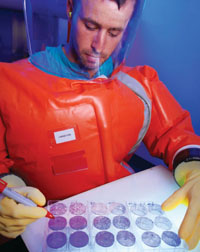
Other questions stemmed from the nature of the research itself. Canada has passed a regulation requiring that transmissible H5N1 human research be conducted at a Biosafety Level 4 lab, the highest designation, which requires scientists to work in space suits inside fully sealed facilities in which nothing gets in or out without sterilization (Level 4 lab shown). Such precautions are hard to come by in many countries where H5N1 is a problem.
Some people have even questioned whether this type of research should be done at all, or have suggested that policy concerns be addressed before studies move forward. In response, on March 29, the U.S. government issued a new, comprehensive policy for overseeing research on avian influenza and 14 other pathogens. This “cradle to grave” policy, as biologist Paul Keim calls it, would require scientists, institutions and funding agencies to take early steps to minimize risks to people, animals or plants. If risks can’t be mitigated, the government could classify the research or pull funding.