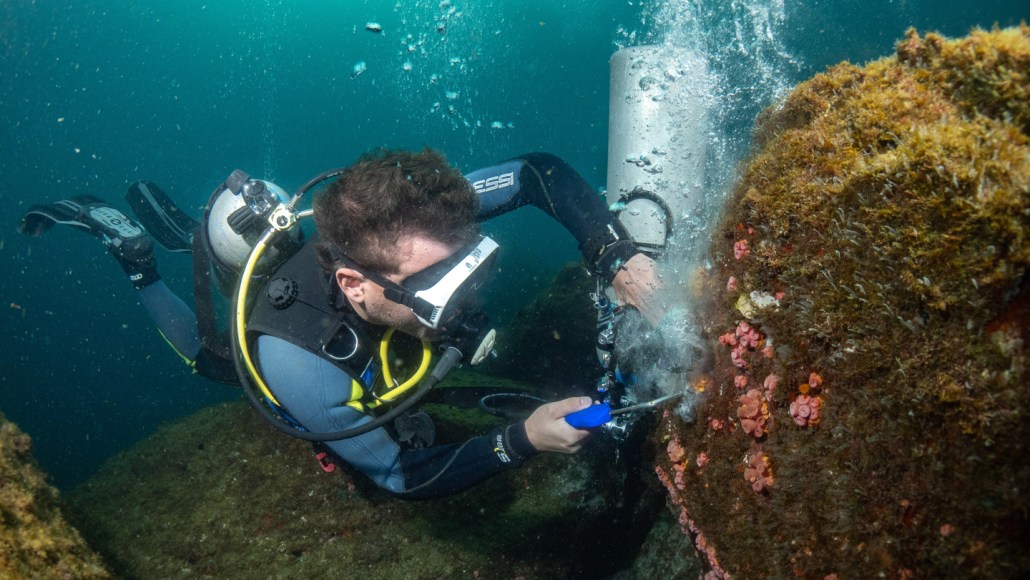
A researcher air blasts invasive sun corals in Brazil’s Alcatrazes Archipelago Wildlife Refuge.
Leo Francini
Invasive corals are getting blown out of the water — with undersea air guns.
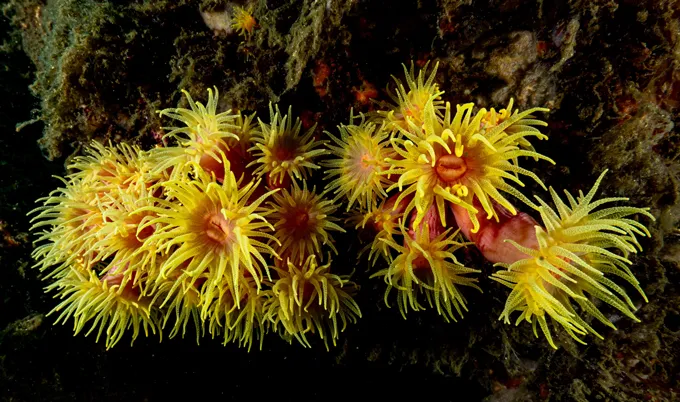
While corals around the world are dying in vast numbers due to ocean acidification, climate change, overfishing and disease, invasive counterparts such as sun corals are taking over biodiversity hotspots. Blasts of compressed air can probably rid ecosystems of these rapidly spreading intruders and prevent them from reestablishing, researchers report April 4 in Ecological Solutions and Evidence.
Sun corals (Tubastraea) are “very aggressive,” says Guilherme Pereira-Filho, a biologist at the Federal University of São Paulo. They first reached Brazil in the 1980s, though it’s not clear where they originated. Whenever one arrives at an appealing new home, “it can propagate so fast,” Pereira-Filho says. A tiny fragment can reproduce into a new colony, pushing out native corals and changing the ecosystem such that other squatters move in.
The most common removal method is pneumatic hammering, Pereira-Filho says. Unfortunately, this often releases exactly the tiny fragments that colonize anew. And the time- and labor-intensive technique can’t always get to the underwater nooks and crannies where these corals grow.
Inspired by the practice of using compressed air in labs to separate corals’ soft tissue from their stony skeletons, Pereira-Filho and colleagues fashioned an underwater facsimile by connecting an air gun to a diving regulator — the mechanism that controls a scuba diver’s breathing air. In Brazil’s Alcatrazes Archipelago Wildlife Refuge, they donned scuba gear — plus an extra tank for the air gun — and blasted 48 colonies alongside 14 colonies left untouched for comparison. They observed each colony right after blasting, 30 days later and 180 days later. The sun corals they blasted had been mostly obliterated.
Since previous research showed that some tissues can regenerate without any skeleton, the team wanted to know if air blasting solves that problem. During the removal process, they collected samples for the purpose of taking them back to aquariums in the lab. None of the samples regenerated.
“The experimental procedures are very well thought out,” says marine ecologist Joel Creed of Rio de Janeiro State University. Creed was initially concerned that the result would be “a soup of tissue that could spread out and settle,” instead of inert fragments that fell to the ocean floor.
Pereira-Filho was excited that the team’s relatively inexpensive idea worked. “It’s quite a simple method that can bring a lot of benefits for the management of this invasive species,” he says.
Next, the researchers are thinking big. They did this small-scale work at a popular dive spot in the refuge, and they want to try blasting at a much larger scale, like an entire island. They’d also like to develop heavy-duty equipment that can remove corals from human-made structures such as ship hulls — a significant source of invasive corals.
And another technique for fighting invasive corals is welcome, Creed says. “Let’s remember that the status quo would be to leave the coral happily producing hundreds of larvae per year,” he says. “This method is a step forward.”