Pickles glow when you plug them in. Science explains why

The scientific party trick results from mini blasts ignited by sparks, experiments suggest

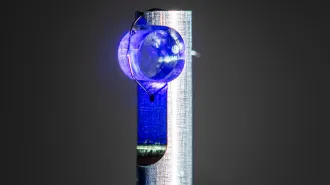
A pickle skewered by electrodes emits an orange glow at one end when plugged in. Researchers have new insights into the science behind this spectacle.

Joshua Méndez Harper and Benjamin Crall

COCOA BEACH, Fla. — Here’s what happens when you plug in a pickle.

At an otherwise formal meeting of the Electrostatics Society of America, electrical engineer Joshua Méndez Harper pulled out a jar of pickles, a power strip and some electrodes. “I’m hoping we will not have the fire alarm go off,” he said.

He skewered each end of a pickle with an electrode and flipped the switch. The pickle sizzled in protest, then glowed bright orange at one end. As an aroma of singed pickle wafted over the audience, he shut off the power. It’s a decades-old scientific parlor trick, and now Méndez Harper’s group at Portland State University in Oregon may figured out what the dill is.

Pickles are typically soaked in a salty brine. Since saltwater consists of ions — electrically charged atoms — pickles are able to conduct electricity. But the glow’s cause is debated. One idea is that pickle juice boils at the electrode, creating a pocket of vapor that blocks current flow, causing sparks to fly across the gap. Another idea involves electrolysis, a process through which an electric current breaks water into a mixture of hydrogen and oxygen. That mixture is explosive, so heat from the electrode might trigger small, luminous blasts.

Méndez Harper and colleagues outfitted a pickle with monitoring equipment in their laboratory, including a high-speed camera and hydrogen sensor. Then they zapped it with either alternating or direct current. (Méndez Harper is a professional — don’t try this at home.) Alternating current is the type from a wall socket, in which the charge flow switches directions periodically, whereas direct current is a steady flow.

Hydrogen was produced in both cases, indicating that some electrolysis does take place. But puzzlingly, the glow appeared only with alternating current. That suggested the mechanism actually involves both effects at once, Méndez Harper said in a talk June 16.

The oscillating nature of alternating current might help keep the vapor pocket open, allowing sparks to form that ignite the hydrogen and oxygen, Méndez Harper explained. Direct current, he proposed, could make the vapor pocket unstable, so that it collapses, producing hydrogen but no sparks, and therefore no ignition and no glow.

The team also wanted to answer why only one side of the pickle glows. That was less complicated: It’s the juicier side. A pickle placed vertically always glows on its bottom end, where brine collects, the team found.

After the demo, the pickle went in the trash. Taste tests weren’t on the menu.

Senior physics writer Emily Conover has a Ph.D. in physics from the University of Chicago. She is a two-time winner of the D.C. Science Writers’ Association Newsbrief award and a winner of the Acoustical Society of America’s Science Communication Award.